An overseas property mortgage is a loan used to finance real estate outside your home country, available from lenders in your country of residence or directly from banks abroad. These mortgages differ from domestic loans in nearly every dimension: deposit sizes are larger, interest rates are higher, legal requirements vary by country, and currency risk adds a layer of complexity that most domestic buyers never encounter. This article covers deposit requirements, lender types, currency considerations, legal obligations, and practical steps to help you approach cross-border property financing with confidence.
What is an overseas property mortgage?
An overseas property mortgage, also called an international mortgage or foreign property loan, is a financing arrangement that lets you purchase real estate in a country where you are not a permanent resident. Lenders can be based in your home country, in the country where the property is located, or through specialist international mortgage brokers who work across borders. The core mechanics resemble a standard mortgage: you borrow a percentage of the property value, repay over an agreed term, and the property serves as collateral. The differences lie in the risk profile, documentation demands, and regulatory environment that surrounds the transaction.
Most buyers discover quickly that the rules governing expat home loans are set by the destination country, not their home country. A British buyer purchasing in Egypt, a German buyer in Spain, or an American buying in Portugal will each face a different legal framework, different lender appetite, and different tax reporting obligations. Understanding these differences before you make an offer is the single most effective way to avoid costly surprises.

What are the typical deposit requirements for overseas mortgages?
Non-resident buyers typically need deposits ranging from 25% to 50% of the property value, significantly higher than the 5% to 20% common in domestic markets. This means that on a $300,000 property abroad, you should budget between $75,000 and $150,000 in cash before financing even begins. Lenders set these thresholds because they carry greater risk when lending across borders: enforcing a mortgage in a foreign jurisdiction is expensive, and property valuations abroad are harder to verify.
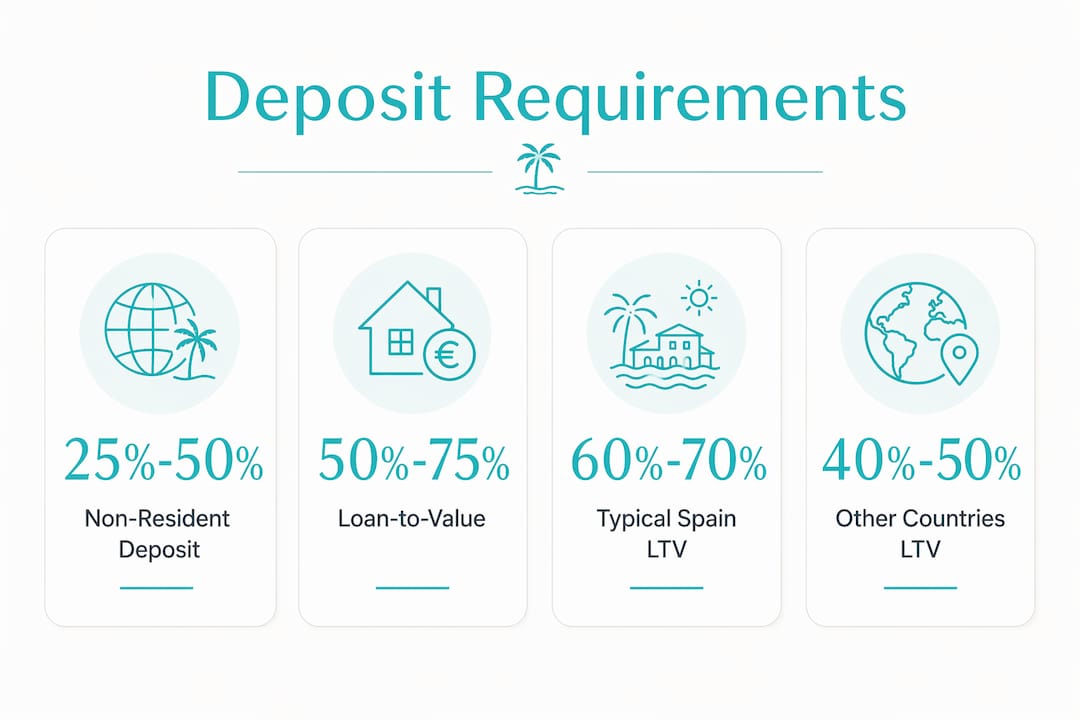
Loan-to-value ratios for foreign property financing typically sit between 50% and 75%, depending on the country, lender, and buyer profile. Some markets, particularly in North Africa and parts of Southeast Asia, offer even lower LTV ratios to non-residents. Bank valuations can be lower than the agreed purchase price, which means the lender calculates your loan against their figure, not yours. This can increase the cash deposit you need to bring to the table beyond what you initially planned.
| Country/Region | Typical LTV for Non-Residents | Approximate Deposit Required |
|---|---|---|
| Spain | 60%–70% | 30%–40% |
| France | 70%–75% | 25%–30% |
| Egypt | 50%–60% | 40%–50% |
| Portugal | 65%–70% | 30%–35% |
| Thailand | 0% (cash only common) | 100% |
Pro Tip: Always get an independent property valuation before submitting your mortgage application. If the lender's valuation comes in below the purchase price, you will need to cover the gap in cash, and finding out late in the process can derail the entire transaction.
How do interest rates and lender types vary for overseas mortgages?
Non-resident mortgage interest rates typically range from 8% to 13% as of 2026, depending on the country and lender profile. These rates are considerably higher than what most buyers pay at home, reflecting the additional risk lenders take on when extending credit across borders. A rate of 10% on a $200,000 loan adds roughly $20,000 per year in interest alone, so the financing cost must factor into your overall return calculation from the start.
Three main types of lenders operate in the international mortgage space, and each comes with different trade-offs:
- International banks and specialist lenders. Institutions like HSBC Expat and Santander International offer cross-border mortgage products designed specifically for non-resident buyers. They tend to have standardized processes, clear documentation requirements, and established relationships with local legal systems.
- Local banks in the destination country. Borrowing locally can mean better rates and a smoother legal process, since the lender already understands the local property market. The downside is that documentation requirements may be in a foreign language, and approval timelines can be unpredictable.
- Private banks and wealth managers. Private banking offers bespoke mortgage solutions for high-net-worth buyers, with greater flexibility on loan structure, currency, and repayment terms. These lenders consider global liquidity and cross-border assets rather than just local income, making them a strong option for buyers with complex financial profiles.
"Financing should be treated as a core part of the investment structure, not just a transactional step at the end of buying." — World Property Investor, 2026
Choosing the right lender type depends on your financial profile, the destination country, and how much flexibility you need. Buyers with straightforward income and a single property purchase often do well with specialist international lenders. Those with multiple assets or complex income streams benefit from exploring private bank lending flexibility before committing to a standard product.
What currency risks should buyers consider with overseas mortgages?
Currency risk is one of the most underestimated factors in foreign property financing. Exchange rate changes can raise costs even when the local currency price of the property stays completely stable. If you earn in US dollars but your mortgage is denominated in Egyptian pounds or euros, a shift in exchange rates between signing and completion can add thousands to your total cost.
Here are the four key currency risk scenarios every overseas buyer should plan for:
- Deposit transfer risk. The time between agreeing on a price and transferring your deposit can span weeks or months. Exchange rate movements during this period directly affect how much your deposit costs in your home currency.
- Monthly repayment risk. If your mortgage is in a foreign currency but your income is in your home currency, your monthly repayment amount fluctuates with the exchange rate. A 10% shift in rates means a 10% change in your effective monthly cost.
- Rental income alignment. If you plan to rent the property, aligning the currency of your rental income with the currency of your mortgage repayments removes one layer of currency exposure. Collecting rent in euros while repaying a euro mortgage is cleaner than collecting in dollars and converting monthly.
- Sale proceeds risk. When you eventually sell, the proceeds will be in the local currency. Converting back to your home currency at an unfavorable rate can significantly reduce your net return.
Pro Tip: Forward contracts lock in exchange rates for a future date, protecting your budget between offer and completion. Services like Wise Business, OFX, and Currencies Direct offer forward contracts specifically designed for property transactions.
What legal and administrative steps are required for overseas mortgages?
The legal process for buying property abroad is more complex than most buyers expect, and the consequences of skipping steps are severe. Hiring an independent local property lawyer is non-negotiable: legal encumbrances, unpaid taxes, and unresolved liens can follow the property to the new owner if title checks are not completed properly. This is not a step to delegate to the seller's lawyer or the real estate agent.
Key legal and administrative requirements include:
- Title verification. Your lawyer must confirm the seller holds clear title and that no debts, mortgages, or disputes are attached to the property.
- Local ownership rules. Some countries restrict foreign ownership to certain areas, property types, or ownership structures. Egypt, for example, allows foreign nationals to own property but limits the number of properties and requires registration with the Real Estate Publicity Department.
- Tax reporting obligations. US buyers must file FinCEN Form 114 (FBAR) if foreign financial accounts exceed $10,000, a threshold easily crossed during an overseas purchase. UK buyers have separate reporting requirements under HMRC's foreign income rules.
- Notary and registration fees. Many countries require a notary to formalize the sale, adding fees that are not typical in UK or US domestic transactions. Total acquisition costs including taxes and fees add approximately 8% to 15% to the purchase price in overseas markets.
You can find additional guidance on protecting your legal position when buying internationally, particularly in markets where title disputes are more common.
How can buyers prepare practically for an overseas mortgage application?
Mortgage approval requires proof of income, deposit sources, credit status, and clear documentation on how the property will be used. Gathering this documentation before you start viewing properties saves significant time and positions you as a serious buyer when you make an offer.
Practical preparation steps include:
- Set your budget in both currencies. Calculate the purchase price, deposit, legal fees, taxes, and currency conversion costs in both your home currency and the local currency. Build in a 10% buffer for rate movements and unexpected fees.
- Prepare your documentation file. Lenders typically request six months of bank statements, two years of tax returns or audited accounts, proof of deposit source, a credit report, and a copy of your passport. Having these ready before you apply cuts weeks off the approval timeline.
- Time your currency transfers carefully. Align your transfer schedule with the contract stages: reservation deposit, preliminary contract, and final completion. Each stage triggers a payment, and each payment carries currency risk if not hedged.
- Appoint a local property manager if renting. A local manager handles tenant relationships, maintenance, and local tax filings on your behalf, which is particularly important when you are managing the property from another country.
- Plan your exit strategy from the start. Know how you will sell, what the tax implications are in the destination country, and how you will repatriate proceeds. This is not pessimism; it is sound financial planning.
Pro Tip: Property ownership abroad does not usually confer residency or visa benefits. Plan your immigration or residency status separately and do not assume purchasing property will simplify your visa situation.
Key takeaways
Securing an overseas property mortgage requires higher deposits, specialist lenders, active currency risk management, and rigorous legal due diligence compared to any domestic home purchase.
| Point | Details |
|---|---|
| Deposit requirements are higher | Non-residents typically need 25%–50% of the property value as a deposit. |
| Interest rates reflect added risk | Non-resident mortgage rates range from 8% to 13% as of 2026. |
| Currency risk affects total cost | Exchange rate shifts impact deposits, repayments, and eventual sale proceeds. |
| Legal due diligence is mandatory | An independent local lawyer must verify title and check for liens before purchase. |
| Acquisition costs add 8%–15% | Taxes, notary fees, and legal costs significantly increase the total purchase budget. |
What Padsabroad has learned from years of cross-border financing
The most common mistake buyers make is treating the mortgage as something to sort out after they fall in love with a property. By that point, the emotional investment is already made, and the financing terms become something to accept rather than something to negotiate. The buyers who get the best outcomes start with their financing structure and work backward to the property, not the other way around.
Currency risk management is the second area where buyers consistently underestimate the exposure. A buyer who locks in a purchase price in Egyptian pounds but delays transferring funds for three months can find the cost in their home currency has shifted by 5% to 8%. On a $200,000 purchase, that is a $10,000 to $16,000 swing that no one budgeted for. Forward contracts exist precisely to prevent this, and yet many buyers skip them because they feel like an extra step.
The legal due diligence piece is where the real risk lives, though. Padsabroad has seen buyers lose deposits and face years of legal disputes because they relied on the seller's lawyer or skipped the title check to save a few hundred dollars. An independent local lawyer is not a luxury. It is the single most important professional you hire in the entire process.
Patience matters more than most buyers expect. Cross-border mortgage approvals routinely take two to four months longer than domestic approvals. Building that timeline into your planning from the start prevents the frustration of missed deadlines and rushed decisions.
— Padsabroad
How Padsabroad can help you finance your overseas property

Padsabroad specializes in helping international buyers purchase real estate in Egypt, particularly along the Red Sea coast in areas like Hurghada, El Gouna, Sahl Hasheesh, Soma Bay, and Marsa Alam. The team works with buyers at every stage of the financing process, from identifying the right lender type for your profile to coordinating with local lawyers and currency specialists. Whether you are a first-time overseas buyer or an experienced investor adding to your portfolio, Padsabroad provides the local knowledge and international connections to make the process straightforward. Explore your options with the overseas property specialists at Padsabroad and get guidance tailored to your specific situation and goals.
FAQ
What is an overseas property mortgage?
An overseas property mortgage is a loan used to finance the purchase of real estate in a country where the buyer does not permanently reside, available from lenders in the buyer's home country or from local banks in the destination country.
How much deposit do I need for a foreign property loan?
Non-resident buyers typically need a deposit of 25% to 50% of the property value, which is significantly higher than domestic mortgage requirements in most countries.
Can I get a mortgage in my home country to buy property abroad?
Some home-country lenders offer international mortgage products, but availability depends on the destination country and your lender's policies. Specialist international lenders and local banks in the destination country are often more accessible options.
What currency risks come with an overseas mortgage?
If your mortgage is in a different currency than your income, exchange rate movements can increase your monthly repayments and the total cost of the purchase. Forward contracts with services like OFX or Currencies Direct can lock in rates and protect your budget.
Do I need a local lawyer to buy property abroad?
Yes. An independent local property lawyer is required to verify title, check for liens and unpaid debts, and confirm that local ownership rules are met. Skipping this step can result in inheriting legal and financial liabilities attached to the property.