
Overseas property ownership is defined as the legal possession of real estate located outside your home country, governed entirely by the laws of the country where the property sits. This means your rights, protections, and obligations are shaped by a foreign legal system, not the one you grew up with. For buyers exploring markets like Egypt's Red Sea coast, Portugal's Algarve, or Thailand's resort islands, understanding those differences is the first step toward a safe purchase. This guide covers ownership structures, legal restrictions, investment considerations, and the practical steps buying property abroad requires, so you can move forward with confidence.
What is overseas property ownership and how does it work?
Overseas property ownership, also called foreign real estate ownership, is the legal title held by a non-citizen or non-resident in a property located in another country. The key distinction from domestic ownership is that home country laws do not govern foreign real estate. Instead, the legal principle known as lex situs applies, meaning the laws of the country where the property physically sits control ownership, transfer, and inheritance.
This matters in practice because two buyers from the same country can purchase properties in two different nations and face completely different legal systems, tax obligations, and ownership rights. A buyer in Egypt operates under Egyptian civil law and registers with the Egyptian Real Estate Publicity Department. A buyer in the UK operates under common law and the Land Registry. These are not interchangeable systems.
Local property registries, independent lawyers, and notaries are the three entities that make or break an overseas purchase. Without them, you have no verified chain of title and no legal protection if a dispute arises. Padsabroad works with buyers specifically because this local knowledge gap is where most costly mistakes originate.
What ownership structures do foreign buyers encounter?
Foreign buyers encounter four main ownership structures worldwide: freehold, leasehold, fideicomiso trusts, and nominee arrangements. Each carries different rights, costs, and risks.
Freehold vs. leasehold
Freehold ownership grants you outright title to both the land and the building with no expiry date. Leasehold ownership grants you the right to use the property for a fixed term, typically 99 to 999 years, after which the land reverts to the freeholder. Leasehold terms of 99 to 999 years affect both property value and your ability to secure financing, since many lenders will not mortgage a lease with fewer than 70 years remaining.
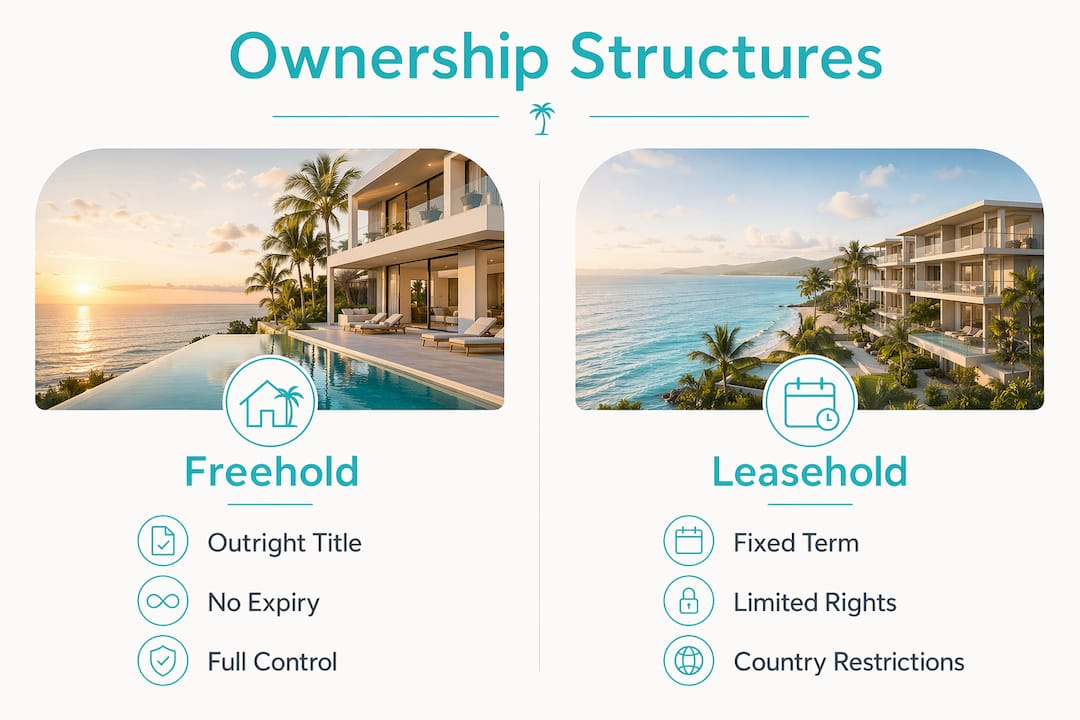
In countries like Indonesia and Thailand, foreigners are restricted to leasehold arrangements for land. This is a legal design, not a workaround. Buyers who understand this upfront can plan accordingly, but those who assume freehold is always available often discover the limitation only after paying a deposit.
Fideicomiso trusts and country-specific structures
Mexico requires foreign buyers in coastal and border zones to purchase through a fideicomiso, a bank trust that holds legal title on the buyer's behalf. Setup costs range from $500 to $1,500, with annual fees of $500 to $700 and a 50-year renewal cycle. The buyer retains full beneficial ownership rights, including the right to sell, rent, or bequeath the property. It is a recognized legal structure, not a loophole.
Pro Tip: Always verify that the fideicomiso or leasehold agreement is registered with the relevant national authority. An unregistered trust or lease offers no legal protection.
Why nominee arrangements are dangerous
Nominee arrangements place legal title in the name of a local citizen on behalf of a foreign buyer. Nominee ownership is legally unenforceable in most jurisdictions and can result in total investment loss if the nominee sells, mortgages, or bequeaths the property. No court in most countries will recognize your claim because the title is not in your name. Avoid this structure entirely, regardless of how it is presented by a seller or agent.
| Ownership type | Key feature | Main risk |
|---|---|---|
| Freehold | Outright title, no expiry | Restricted in many countries for foreigners |
| Leasehold | Fixed-term use right | Value declines as term shortens |
| Fideicomiso | Bank trust holds title | Annual fees and renewal obligations |
| Nominee | Local holds title for buyer | Legally unenforceable, total loss risk |
What restrictions do foreign buyers face when buying property abroad?
Foreign ownership restrictions are more common than most buyers expect. Approximately 15 to 20 countries restrict or prohibit direct foreign ownership of land, often limiting foreigners to condominiums, leaseholds, or trust-based structures. The practical implications vary widely by country.
Common restrictions you will encounter include:
- Thailand: Foreigners can own condominium units outright but cannot own land. Villas are typically held via long-term leasehold or a Thai company structure.
- Indonesia: Foreign buyers are limited to leasehold arrangements. Freehold land ownership is reserved for Indonesian citizens.
- Mexico (coastal zones): The fideicomiso trust is mandatory within 50 kilometers of the coast and 100 kilometers of international borders.
- Egypt: Foreign buyers can purchase property directly, but are limited to two properties per person and must obtain approval from the Council of Ministers for agricultural land.
- New Zealand: Foreign investors face significant restrictions on purchasing existing residential property following 2018 legislation.
Beyond ownership type, some countries require foreign buyers to open a local bank account, obtain a government permit, or demonstrate residency status before completing a purchase. Owning property does not automatically grant permanent residency or unlimited stay rights. This is one of the most frequently misunderstood points among first-time foreign buyers.
Pro Tip: Before viewing a single property, confirm your legal eligibility to own in that country. A 30-minute consultation with a local property lawyer costs far less than a lost deposit.
What are the advantages and challenges of overseas property investment?
Overseas property investment offers genuine financial upside, but it also carries risks that domestic purchases do not.
Investment advantages worth knowing
Rental yields in markets like Portugal, Dubai, and Greece reach 5 to 7%, compared to domestic UK yields that typically sit around 3 to 4%. That gap represents meaningful income potential for investors who manage the property well. Portfolio diversification across currencies and economies also reduces exposure to any single domestic market downturn.
Golden Visa programs in Portugal, Greece, Spain, and the UAE link residency rights to qualifying property investment. For buyers who want the option to live, work, or retire in another country, this adds significant non-financial value to the purchase.
Challenges that reduce net returns
- Currency risk: Exchange rate movements between offer and completion can change the effective purchase price by thousands. Adding a 5% budget buffer is the standard recommendation for managing this exposure.
- Tax obligations: You may owe tax in both the country where the property sits and your home country. Double taxation treaties exist between many nations, but they do not eliminate all liability.
- Operational costs: Management fees, vacancy periods, and compliance charges reduce net rental income significantly. Budget for these before calculating yield.
- Inheritance complications: Foreign inheritance laws override home country wills, potentially distributing your property to heirs differently than you intended. France and Spain both apply forced heirship rules.
"Overseas property ownership is fundamentally a cross-border financial arrangement, not just a simple real estate purchase." — World Property Investor, 2026
This framing matters. Buyers who treat an overseas purchase like a domestic one routinely underestimate legal costs, tax exposure, and the time required to complete the transaction safely.
How to buy property abroad safely: a step-by-step process
The overseas property purchase process follows a predictable sequence, but the timeline is longer than most buyers expect. The full process takes 6 to 18 months from initial research to completion, with deposits typically ranging from 5 to 10%.
- Research the market (1 to 6 months). Identify your target country, region, and property type. Confirm foreign ownership eligibility before committing time or money.
- Engage an independent local lawyer. Hiring a bilingual independent lawyer with no ties to the seller or developer is the single most important step in the process. They verify title, check for debts and encumbrances, and confirm zoning compliance.
- Conduct due diligence (1 to 3 months). Title verification, encumbrance searches, planning permission checks, and seller identity confirmation all happen here. Do not skip or rush this stage.
- Agree terms and pay the reservation deposit. Deposits of 5 to 10% are standard. Confirm the deposit is held in escrow or a protected account, not paid directly to the seller.
- Sign the preliminary contract. This is a legally binding document in most jurisdictions. Your lawyer must review it before you sign.
- Arrange currency transfer. Use a specialist foreign exchange provider to lock in a rate and protect against adverse movements between contract and completion.
- Complete the purchase and register title. Final payment is made, and the property is registered in your name with the local land registry or equivalent authority.
Pro Tip: Never use the seller's recommended lawyer. The conflict of interest is real, and the consequences of a title dispute can be severe. Always appoint your own independent counsel.
| Stage | Key action | Common mistake |
|---|---|---|
| Research | Confirm ownership eligibility | Assuming freehold is available |
| Legal appointment | Hire independent bilingual lawyer | Using seller's recommended lawyer |
| Due diligence | Title search and encumbrance check | Skipping to save time or money |
| Deposit | Confirm escrow protection | Paying directly to seller |
| Currency | Lock in exchange rate | Waiting until completion day |
Key takeaways
Overseas property ownership requires legal, financial, and operational preparation that goes well beyond a standard domestic purchase.
| Point | Details |
|---|---|
| Lex situs governs ownership | The laws of the property's country control all rights, transfers, and inheritance. |
| Ownership structures vary widely | Freehold, leasehold, and fideicomiso each carry different rights and costs by country. |
| Restrictions affect 15 to 20 countries | Confirm foreign ownership eligibility before viewing properties or paying any deposit. |
| Currency risk is a real cost | Budget a 5% buffer for exchange rate movements between offer and completion. |
| Independent legal counsel is non-negotiable | A bilingual local lawyer with no seller ties protects your deposit and your title. |
What Padsabroad has learned from years of overseas transactions
From our experience working with international buyers across Egypt's Red Sea coast, the most consistent mistake we see is buyers treating an overseas purchase like a domestic one. They move fast, skip legal checks, and trust verbal assurances from developers or agents. That approach works in familiar markets where you know the rules. It does not work when you are operating under a foreign legal system you have never encountered before.
The buyers who complete successfully are the ones who slow down at the due diligence stage. They hire their own lawyer, they ask for title documents before paying anything, and they plan their currency transfer well in advance. These are not complicated steps. They are just steps that require patience and discipline.
We have also seen buyers underestimate the ongoing cost of ownership. Management fees, maintenance, local taxes, and periodic compliance requirements add up. A property that looks like a 6% yield on paper can deliver 3% in practice once those costs are factored in. Know your net numbers before you commit.
The opportunity in markets like Hurghada, El Gouna, and Sahl Hasheesh is real. Rental demand is strong, entry prices remain competitive compared to European coastal markets, and the legal framework for foreign buyers in Egypt is clear and workable. But that opportunity rewards preparation, not speed.
— Padsabroad
Ready to explore overseas property with expert guidance?
Buying property in another country is one of the most significant financial decisions you will make. Getting the legal structure right, understanding your ownership rights, and working with people who know the local market makes the difference between a sound investment and a costly mistake.

Padsabroad specializes in helping international buyers purchase and invest in real estate along Egypt's Red Sea coast, covering Hurghada, El Gouna, Sahl Hasheesh, Soma Bay, Marsa Alam, and Port Ghalib. The team combines local market knowledge with practical guidance on legal structures, due diligence, and the full purchase process. If you are ready to take the next step, visit Padsabroad's specialist services to connect with an advisor who knows this market from the inside.
FAQ
What is overseas property ownership in simple terms?
Overseas property ownership is the legal possession of real estate located in a country other than your own. Your rights and obligations are governed by the laws of the country where the property sits, not your home country.
Can foreigners own property outright in any country?
Not in every country. Around 15 to 20 countries restrict or prohibit direct foreign land ownership, limiting buyers to condominiums, leaseholds, or trust-based structures like Mexico's fideicomiso.
How long does buying property abroad take?
The overseas property purchase process typically takes 6 to 18 months from initial research to completion, depending on the country, property type, and how quickly due diligence is completed.
Does owning property abroad give you residency rights?
Owning property does not automatically grant residency or unlimited stay rights. However, Golden Visa programs in countries like Portugal, Greece, Spain, and the UAE do link qualifying property investment to residency eligibility.
What is the biggest legal risk in overseas property ownership?
The biggest legal risks include unverified title, nominee arrangements that are legally unenforceable, and foreign inheritance laws that can override your home country will. Hiring an independent local lawyer before signing anything is the most effective way to manage these risks.