
Yes, a properly drafted, notarized, and legalized power of attorney (POA) can be used to buy, sell, register, or manage property in Egypt. Known in Egyptian legal practice as a tawkeel rasmi (التوكيل الرسمي), this document gives a named agent the legal authority to act on your behalf in real estate transactions Egypt-wide, from signing a sale contract to appearing before the Real Estate Publicity Department (RER) for title registration.
Before you sign anything, take these five steps:
- Define the transaction precisely. Decide whether the POA covers a sale, purchase, registration, management, or a combination, and draft it for that purpose only.
- Identify the property by its full registry details. Get the registration number, plot area, governorate, and full address from the title deed or RER records.
- Select a trusted, named agent. The agent's full name, national ID number, and address must appear in the POA exactly as they appear on their official ID.
- Arrange bilingual wording. Have a qualified Egyptian lawyer prepare the Arabic operative text and a matching English explanatory translation before you approach any notary.
- Choose your legalization route. If you are signing outside Egypt, determine whether your country is a member of the Hague Apostille Convention or whether you need consular legalization through the Egyptian consulate and Ministry of Foreign Affairs authentication.
One legal caution to keep in mind: a POA that is vague, omits the sale price, or grants unlimited authority without property identification risks rejection by Egyptian registries or outright invalidation by Egyptian courts, so precision in drafting is not optional.
Pro Tip: Never sign a POA that authorizes your agent to sell property "to themselves" (sale-to-self) without an explicitly stated price and independent oversight. Egyptian courts have declared such POAs invalid, and the transaction can be unwound.
Key Takeaways
A properly drafted, notarized, and legalized power of attorney is a fully valid instrument for buying, selling, registering, or managing property in Egypt, provided the Arabic operative text is precise, the property is identified by its full registry details, and the agent's authority is explicitly limited to the transaction at hand.
| Point | Details |
|---|---|
| Use the right POA type | A Special/Sale POA is required for sales; a General POA will be rejected by the RER for sale transactions. |
| Arabic text controls | The Arabic operative text is the legally binding version; always have a qualified Egyptian lawyer review it before signing. |
| Legalize correctly | Apostille members use the apostille route; non-members need consular legalization plus MFA authentication in Egypt. |
| Limit powers and duration | Set an expiry date and state the sale price; open-ended or priceless sale POAs risk court invalidation. |
| Use local support | Padsabroad coordinates Egypt-side logistics for overseas buyers across the Red Sea coast while a qualified Egyptian lawyer handles legal drafting. |
Table of Contents
- What types of power of attorney are used in Egypt for property?
- Why exact wording determines whether your POA will be accepted
- How to draft a property POA step by step
- How to notarize and legalize a property POA for use in Egypt
- How an agent uses the POA at the notary, registry, bank, and developer
- How to revoke or cancel a POA in Egypt
- Common risks with property POAs in Egypt and how to protect yourself
- A practical checklist for overseas buyers using a POA in Egypt
- The case for precision over convenience in Egyptian property POAs
- How Padsabroad supports your Egypt property transaction
- Sources
What types of power of attorney are used in Egypt for property?
Egyptian property transactions use several distinct POA categories. Choosing the wrong type is one of the most common reasons a document gets rejected at the notary or registry.
| POA Type | Arabic Term | Typical Use Case | Registry/Authority Preference |
|---|---|---|---|
| General POA | Tawkeel Rasmi Aam | Broad ongoing management, collecting rent, utility matters | Accepted for management; usually insufficient for sale or purchase |
| Special/Sale POA | Tawkeel Khas Bel Bay | Selling a specific property on behalf of the principal | RER requires full property ID, price authority, and receipt powers |
| Purchase POA | Tawkeel Khas Bel Shira | Signing a purchase contract and completing payment | Must name the property and authorize payment and receipt of title |
| Registration POA | Tawkeel Bit-Tasjeel | Appearing before the RER to register title only | Narrowest scope; accepted by RER when property and powers are precise |
| Bank/Funds POA | Tawkeel Masrafi | Handling mortgage drawdown, escrow, or sale proceeds | Banks require explicit funds-handling language and often their own form |
| Developer/Assignment POA | Tawkeel Lil-Mustawrid | Signing developer contracts, assignment agreements, or handover | Developer's legal team usually specifies required wording |
A few practical points on choosing the right type:
- For a straightforward apartment sale in Hurghada or El Gouna, a Special/Sale POA is the correct instrument. A general POA will almost always be rejected by the RER for a sale transaction.
- If you only need someone to register a title you have already signed for, a Registration POA is narrower and therefore lower risk.
- Expat-focused legal guidance confirms that Egyptian authorities routinely reject overly generic POAs and recommends precise wording and full registry identification for sale POAs.
- For ongoing property management in Egypt, a General POA can cover rent collection and utility management, but it should still name the property and limit the agent's authority to defined management tasks.
Why exact wording determines whether your POA will be accepted
The Real Estate Publicity Department and Egyptian notaries routinely require the property to be identified with its full registration number and location. Vague property descriptions are a frequent cause of rejection. Getting the clause language right before legalization saves weeks of delay and avoids the cost of re-executing the document abroad.

Mandatory clause elements for sale, purchase, and registration POAs
Every transaction-ready property POA in Egypt should include:
- Full property identification: Street address, governorate, plot number, registration number, area in square meters, and the name of the relevant RER office.
- Scope of powers: An explicit, numbered list of what the agent may do, such as sign the sale or purchase contract, receive or pay the agreed price, issue and accept receipts, and hand over or take possession of the property.
- Price authority: For a sale POA, the agreed sale price (or a minimum floor price) must be stated. A POA that authorizes a sale "at any price" or omits the price entirely is a red flag and has been the basis for court invalidation.
- Registry appearance authority: Explicit power to appear before the RER, sign all registration documents, pay registration fees, and collect the registered title deed.
- Tax and utility clearance: Authority to obtain tax clearance certificates, settle outstanding utility bills, and sign any government forms required to complete the transfer.
- Bank authority (if needed): Where the transaction involves a mortgage or escrow, explicit authority to deal with the named bank, sign loan documents, and receive or transfer funds.
Common invalidity pitfalls
Legal commentary from Andersen Egypt highlights that courts have declared sale POAs invalid when they are vague or omit essential elements like the sale price. The most frequent problems are:
- Sale-to-self wording: An agent authorized to sell to "any person, including themselves" without a stated price and independent oversight creates a direct conflict of interest that Egyptian courts have used to void transactions.
- Missing price: A sale POA without a stated price or minimum floor gives the agent unchecked discretion and is regularly challenged.
- Overbroad language: Phrases like "all acts necessary" or "full authority over all my property" without naming the specific asset are rejected by the RER.
- Arabic/English mismatch: Where the Arabic operative text grants narrower powers than the English explanatory text suggests, the Arabic controls, and the agent may lack the authority the principal thought they had granted.
Key point: Egyptian property law treats the Arabic text as the operative instrument. Any discrepancy between the Arabic and English versions is resolved in favor of the Arabic. Always have a qualified Egyptian lawyer review the Arabic text before signing.
How to draft a property POA step by step
A well-drafted POA follows a clear workflow. Rushing to a notary before the wording is finalized is the single most avoidable mistake overseas buyers make.
- Define the purpose precisely. Write a one-sentence description of the transaction: "Sale of Apartment No. X, Building Y, Hurghada, for a price of EGP [amount]." This sentence becomes the anchor for every clause that follows.
- Identify the property by registry details. Pull the registration number, plot area, and governorate from the title deed. If you do not have these, request them from the RER or your Egyptian lawyer before drafting begins.
- List the exact powers needed. Work through the transaction step by step and write a numbered list of every action the agent must take: sign the contract, receive the price, issue receipts, appear before the RER, obtain tax clearance, and so on.
- Decide on duration and limits. A time-limited POA (for example, valid for six months from the date of notarization) reduces risk. If the transaction has a known completion date, set the expiry one month beyond it.
- Prepare the Arabic operative text. A qualified Egyptian lawyer drafts the Arabic text first. This is the document that Egyptian authorities will act on.
- Prepare the matching English explanatory text. The English version explains the Arabic to the principal. It should mirror the Arabic clause by clause, but the Arabic controls.
Sample clause headings and what to include under each
- Property Identification Clause: Full address, registration number, area, and RER office name.
- Scope of Powers Clause: Numbered list of authorized acts, specific to the transaction type.
- Price Receipt and Handover Clause: Stated price (for sales), authority to receive or pay, and authority to issue receipts.
- Registry Appearance Clause: Authority to appear before the RER, sign all forms, pay fees, and collect the registered deed.
- Bank Authority Clause (if applicable): Named bank, account details, and specific authorized transactions.
- Tax and Utility Clearance Clause: Authority to obtain and sign all government clearance documents.
Practical drafting notes
- The principal's name, national ID (or passport number for foreigners), and address must match their official ID exactly.
- The agent's name and national ID must also match their official ID exactly.
- Two adult witnesses are typically required at notarization; their names and IDs must be recorded.
- The notarization block must confirm the principal appeared in person (or, for consular execution, appeared before the consular officer).
Pro Tip: Ask your Egyptian lawyer to confirm in writing that the Arabic operative text has been checked against the specific RER office's current acceptance requirements before you travel to a notary or consulate. Requirements can vary slightly by governorate.
According to practical guidance from Egyptian law practitioners, the Arabic operative text should always control the transaction, with the English version serving as an explanatory translation only. This alignment protects both the principal and the agent from disputes over scope.
How to notarize and legalize a property POA for use in Egypt
The legalization route depends on where you sign the POA. There are two main paths.
Path 1: Signing inside Egypt
If you are in Egypt when you sign, the process is straightforward.
- Attend a licensed Egyptian notary (Shahr Aqari or notary public) with your original passport or national ID and two witnesses.
- The notary authenticates your signature and registers the POA.
- For certain formalities, the Ministry of Justice regulates notary practice and may need to authenticate the notary's seal before the document is accepted by banks or some registries.
- The POA is then ready for use at the RER or with the relevant developer or bank.
Path 2: Signing outside Egypt
This path has two sub-routes depending on your country.
If your country is a Hague Apostille Convention member (e.g., the UK, most EU countries):
- Sign the POA before a local notary public in your country.
- Obtain an apostille from the relevant authority in your country (in the UK, this is the Foreign, Commonwealth and Development Office).
- Send the apostilled document to Egypt for a certified Arabic translation by a court-certified translator.
- The Ministry of Foreign Affairs may still need to authenticate the document depending on the receiving authority's requirements.
If your country is not a Hague Apostille Convention member:
- Sign the POA before a local notary public.
- Have the document legalized by your country's foreign ministry.
- Present it to the Egyptian consulate in your country for consular legalization.
- Send the legalized document to Egypt for MFA authentication and certified Arabic translation.
The Egypt Consulate in the UK provides a clear example of how this works in practice. For Egyptian nationals, the consulate can execute a POA in person. For non-Egyptians, the consulate typically legalizes a POA that has already been notarized locally, rather than issuing it. The UK consulate lists fees of GBP 47 or GBP 125 depending on the type of service required.
Pro Tip: Confirm with the specific Egyptian consulate in your country whether they require the English POA to be notarized before or after translation. Some consulates want the Arabic translation attached before legalization; others legalize the English document first.
The Ministry of Foreign Affairs authentication step is often overlooked by overseas buyers. Without it, some Egyptian registries and banks will not accept a consularly legalized document.
How an agent uses the POA at the notary, registry, bank, and developer
Once the POA is legalized and translated, the agent can act. Here is the typical step-by-step timeline for a sale or purchase transaction.
- Present the POA and ID at the notary. The agent brings the original legalized POA, their own national ID, and the principal's ID copy to a licensed Egyptian notary to sign the sale or purchase contract.
- Obtain tax clearance. The agent applies for a tax clearance certificate from the Egyptian Tax Authority, confirming no outstanding property taxes are owed. This is a prerequisite for registration.
- Sign the sale or purchase contract. The agent signs on behalf of the principal, referencing the POA by its notarization date and number in the contract body.
- Pay or receive the agreed price. The agent receives or pays the price as authorized, issues or collects receipts, and retains copies for the principal's records.
- Appear before the Real Estate Publicity Department. The agent presents the original POA, the signed contract, tax clearance, title deed, and their own ID to the RER to initiate title registration.
- Complete registration formalities. The RER reviews the documents, calculates registration fees, and issues a registration receipt. The registered title deed is collected once processing is complete.
Documents the agent typically needs to present
- Original legalized and translated POA (not a photocopy)
- Agent's original national ID
- Copy of the principal's passport or national ID
- Original title deed (or developer's allocation letter for off-plan)
- Property registration number and plot details
- Tax clearance certificate
- Signed sale or purchase contract
- Receipts for any payments made
- Developer approval letter (for resort or compound properties)
Registration timing varies by governorate and RER office workload. In Hurghada and Red Sea governorate offices, registration can take several weeks to a few months. Notary fees and registration fees are set by Egyptian law and vary based on the property value and transaction type; your Egyptian lawyer can provide the current applicable rates for your specific transaction.
For bank-related steps, such as receiving sale proceeds into an Egyptian account or drawing down a mortgage, the bank will usually require the POA to include explicit funds-handling language and may ask for their own supplementary authorization form.
How to revoke or cancel a POA in Egypt
Revocation is straightforward in principle but requires careful execution to protect the principal from ongoing agent authority.
- Prepare a written revocation deed. The revocation must be in writing and should mirror the formality of the original POA. If the original was notarized in Egypt, the revocation should also be notarized by an Egyptian notary.
- Notarize or consularize the revocation. If the original POA was executed abroad and consularly legalized, the revocation should follow the same legalization path so Egyptian authorities recognize it.
- Notify the agent directly. Written notice to the agent is essential. Without it, the agent may continue to act in good faith, and the principal may have limited remedies against third parties who relied on the POA.
- Notify known third parties. If the agent has been dealing with a specific developer, bank, or registry office, notify each of them in writing that the POA has been revoked.
- Register or publish the revocation where needed. For sale or registration POAs, consider registering the revocation with the relevant RER office to create a public record. Legal guidance on revocation mechanics confirms that notifying third parties is a critical step to limit ongoing agent authority.
- Simultaneous attendance: Some revocations, particularly where the agent disputes the revocation or where the original POA required joint execution, may require both the principal and the agent to appear before the notary.
Under Egyptian law, a third party who relied on a POA in good faith before receiving notice of revocation may have a valid claim against the principal. Acting quickly and documenting every notification step is the practical safeguard.
Pro Tip: Keep a timestamped copy of every revocation notice sent to the agent and third parties. If a dispute arises, the date of notice determines whether third-party reliance was in good faith.
Common risks with property POAs in Egypt and how to protect yourself
Property POA fraud and procedural errors are real risks, particularly for overseas buyers who cannot attend transactions in person. The good news is that most risks are preventable with the right precautions.
Red flags to watch for
- An agent who resists a time-limited or property-specific POA and pushes for broad, open-ended authority.
- A POA that does not name the specific property by registration number.
- A sale POA with no stated price or with a price far below market value.
- An agent with a financial interest in the transaction (a developer's employee, a relative of the seller).
- A POA that has not been independently reviewed by an Egyptian lawyer before signing.
Practical contractual protections
- Use a limited-duration POA. Set an expiry date tied to the expected transaction completion. This automatically limits the agent's authority if the deal falls through or is delayed.
- Require escrow or a bank guarantee. For sale proceeds, instruct your agent to deposit funds into an escrow account rather than receiving them directly. This is especially important for overseas buyers purchasing property in Egypt safely.
- Include explicit receipt and settlement clauses. Every payment the agent makes or receives on your behalf should be documented with a signed receipt, and the POA should require the agent to account to you in writing.
- Conduct an independent title search. Before granting any POA for a purchase, verify the title at the RER independently. Egypt's constitutional protections for private property under Article 35 of the 2019 Constitution are meaningful, but they depend on a clean, registered title.
Operational safeguards
- Always instruct a qualified Egyptian lawyer to finalize the Arabic wording and confirm registry acceptance before you sign or legalize.
- Request a written confirmation from the specific RER office that the POA wording and property identification meet their current requirements.
- For buying property in Egypt as a foreigner, consider the five essential trust checks that apply alongside POA safeguards.
A practical checklist for overseas buyers using a POA in Egypt
This checklist covers the full process from pre-signature preparation to Egypt-side completion.
- Confirm the property's registry details. Obtain the registration number, plot area, and RER office name from the title deed or your Egyptian lawyer before drafting begins.
- Instruct a qualified Egyptian lawyer to draft the Arabic operative text. Do not use a generic template. The wording must match the specific transaction and the specific property.
- Prepare the matching English explanatory text. Have the lawyer confirm that the English mirrors the Arabic clause by clause.
- Choose your notary and legalization route. Determine whether your country uses apostille or consular legalization and book the relevant appointment.
- Sign before a notary in your country. Bring your original passport, the draft POA, and any supporting documents the notary requires.
- Obtain apostille or consular legalization. Follow the relevant path for your country (see the legalization section above).
- Ship the legalized document to Egypt. Use a tracked courier service and send the original, not a copy.
- Arrange certified Arabic translation in Egypt. Your Egyptian lawyer or a court-certified translator prepares the translation.
- Confirm MFA authentication if required. Check with your Egyptian lawyer whether the receiving authority (RER, bank, developer) requires MFA authentication in addition to consular legalization.
- Brief your agent in writing. Give the agent a written instruction letter covering the transaction steps, the price, and any limits on their authority.
Where a local specialist adds measurable value
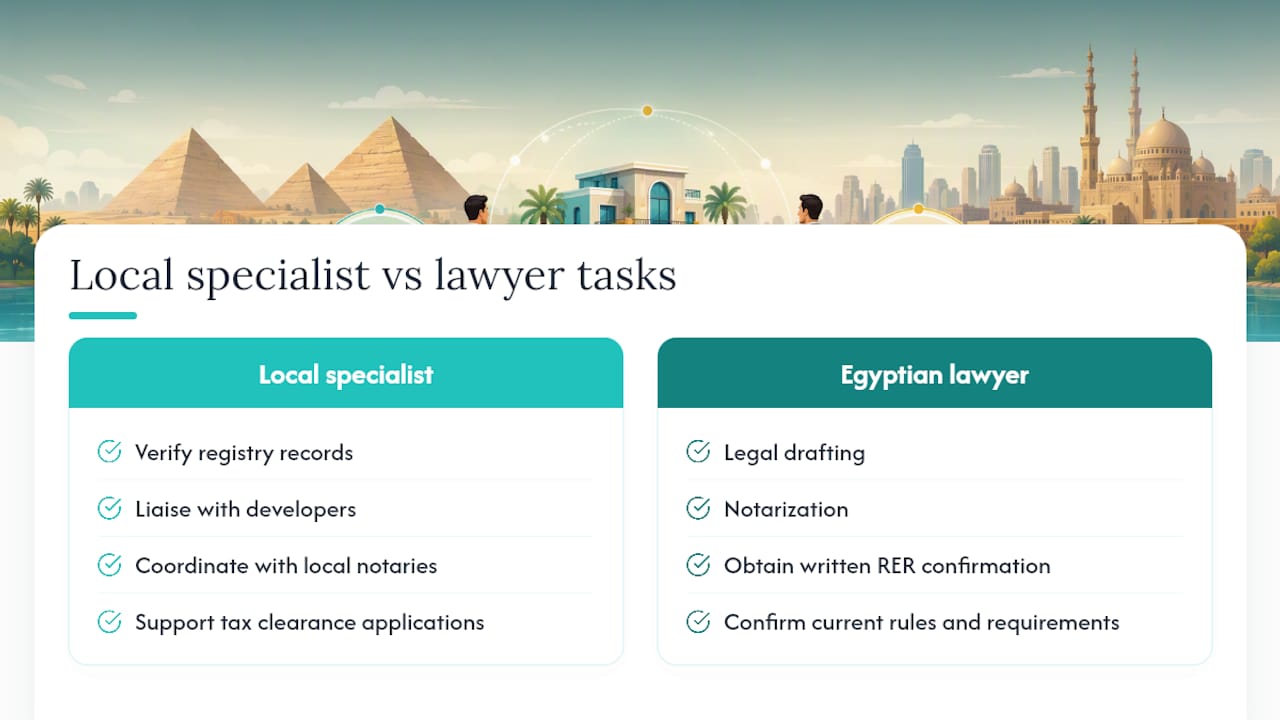
An Egypt-based specialist like Padsabroad can coordinate several of these steps on your behalf: verifying registry records, liaising with developers, coordinating with local notaries, supporting tax clearance applications, and helping set up secure funds workflows. For the legal drafting and notarization itself, a qualified Egyptian lawyer remains the right professional. Padsabroad's role is to handle the Egypt-side logistics so that the legal steps happen correctly and on time.
Pro Tip: Before you finalize the POA wording, ask your Egyptian lawyer to obtain a written confirmation from the specific RER office that handles your property's governorate. Acceptance requirements can differ between, for example, the Red Sea governorate office in Hurghada and offices in Cairo or Alexandria. Getting this confirmation before legalization prevents the most expensive type of delay: re-executing the document from abroad.
This is general information and not a substitute for professional legal advice. Confirm current rules and requirements with a qualified Egyptian lawyer and the relevant Egyptian authorities before signing any power of attorney.
The case for precision over convenience in Egyptian property POAs
The temptation for overseas buyers is to grant broad authority and trust that the agent will act correctly. In practice, the opposite approach works better. A narrow, precisely worded POA with a stated price, a named property, a time limit, and explicit receipt requirements gives the agent everything they need to complete the transaction and nothing more.
Egyptian courts have shown a consistent willingness to invalidate sale POAs that lack essential elements, particularly the sale price and specific property identification. That is not a theoretical risk for Red Sea property buyers. It is a documented pattern in Egyptian legal practice, and it is entirely avoidable with careful drafting.
The other underappreciated point is the Arabic text. Many overseas buyers focus on the English version because it is the one they can read. The Arabic operative text is the one that matters in every Egyptian registry, notary office, and courtroom. Investing in a qualified Egyptian lawyer to review and confirm the Arabic wording is the single highest-return step in the entire process.
How Padsabroad supports your Egypt property transaction

Navigating a property transaction in Egypt from overseas involves more moving parts than most buyers expect: registry checks, developer liaison, tax clearance coordination, and making sure the right documents reach the right offices at the right time. Padsabroad works with overseas buyers across the Red Sea coast, including Hurghada, El Gouna, Sahl Hasheesh, Soma Bay, and Marsa Alam, to handle exactly these Egypt-side logistics.
For the legal drafting and notarization of your POA, Padsabroad will refer you to a qualified Egyptian lawyer. For everything else, including verifying registry records, coordinating with developers, supporting tax clearance applications, and helping structure secure payment workflows, Padsabroad's on-the-ground team is the practical link between you and a completed transaction.
If you are ready to start or are already mid-transaction and need Egypt-side support, browse available properties and get in touch with the Padsabroad team. You can also explore the first-time buyer guide to Red Sea property investment for a broader picture of what buying in Egypt involves.
Sources
These are the primary authorities and legal resources referenced in this article. Each link takes you directly to the relevant page.
- Moj
- Power of Attorney Egypt Property / Proven 2026
- I Live Abroad — Can Someone In Egypt Handle Everything For Me? - Expat Lawyer Egypt