Budget roughly 4% to 11% of the purchase price for closing costs on a Hurghada property, depending on whether it's a resale or off-plan deal and how much currency exchange adds to the bill. Some costs are one-off, like registration and legal fees, while others (maintenance, property tax) recur every year you own the place. Before you transfer a single dollar, ask for an itemized written cost estimate and hire an independent Egyptian lawyer to check the title.
TL;DR:
- Closing costs in Hurghada typically range from 4% to 11% of the purchase price, with FX and developer fees often accounting for the largest share.
- Buyer expenses are staged, with reservation deposits paid upfront, followed by notarization, government approvals, and final registration, often spanning several months to years.
- Currency exchange spreads and bank transfer fees can add 1% to 3% to the total transaction cost, making it crucial to compare providers and keep documented proof.
- A trustworthy lawyer should verify title registration, developer legitimacy, and clear contract terms, as there is no escrow system to protect buyer funds in Egypt.
- Buyers often underestimate total costs by focusing only on registration tax, neglecting legal, FX, and developer fees, which collectively can total up to nearly 10% of the transaction.
Table of Contents
- What Are the Closing Costs When Buying Property in Hurghada?
- When Do You Pay Each Closing Cost?
- How Do Currency and Bank Transfers Affect Your Total Cost?
- What Should Your Lawyer Check Before You Sign?
- What Does a Real Hurghada Purchase Cost All In?
- What Ongoing Costs Should Owners Expect Each Year?
- What Red Flags Should Make You Pause Before Signing?
- Why Most Buyers Underestimate Closing Costs in Hurghada
- Get a Tailored Closing-Cost Estimate Before You Commit
- Sources
What Are the Closing Costs When Buying Property in Hurghada?
Closing costs in Hurghada cover a handful of government charges, professional fees, and developer or agent payments, and each one behaves differently depending on whether you're buying a resale unit or reserving off-plan from a developer. Understanding who charges what, and when, keeps you from getting blindsided at the final registration table.
Registration tax (Tasjeel) is the government charge for recording your ownership. It's commonly cited around 2.5% of the assessed value, not the market price you actually paid. That distinction matters because Egyptian assessed values for resort properties often sit well below market rates, so the real dollar amount can be smaller than buyers expect on a $200,000 or $300,000 unit.
Notarization (Tavtheeq) is a separate step from final registration, and it typically runs 0.5% to 1% of the declared sale value, plus small administrative charges for stamps and processing. Think of tavtheeq as the notarized proof of sale that comes before the title is formally registered under your name.
Lawyer fees vary by firm and scope, but most independent Egyptian real estate lawyers charge either a fixed fee or somewhere in the 1% to 2% range of the property value for full due diligence, contract review, and attendance at registration. Given that Egypt has no standardized escrow system for property transactions, a lawyer's title search and contract redlines are often the only real protection you have before money changes hands.
Developer fees and reservation deposits apply mostly to off-plan purchases. Developers usually ask for a reservation deposit to hold a unit, then bake administrative or "processing" charges into the payment schedule. These aren't always itemized upfront, so ask specifically whether they're included in the headline price or added later.
Agent commission in Hurghada is typically paid by the seller rather than the buyer, though this isn't universal. On resale deals, expect the agent's cut to be built into the asking price rather than billed separately to you as the buyer. Always confirm this in writing before you assume you're off the hook.
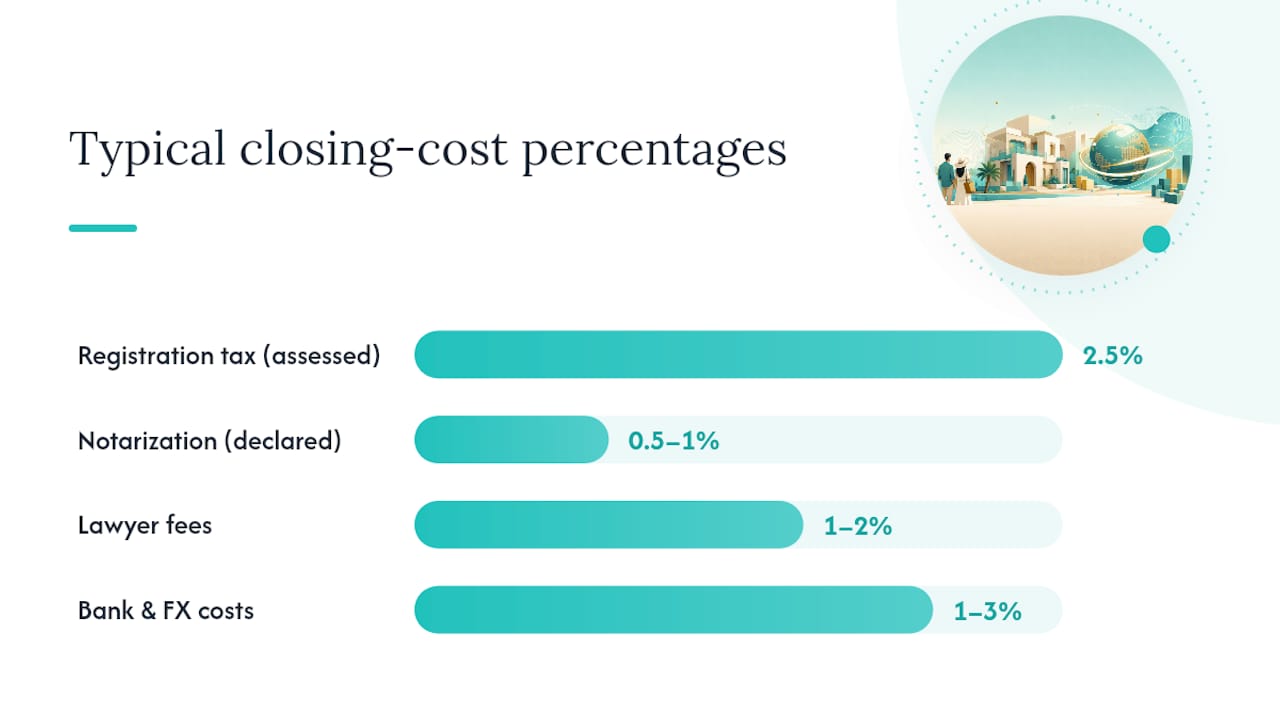
Bank transfer and FX costs are the line item most foreign buyers underestimate. Wiring funds internationally involves your home bank's fee, the receiving bank's fee, and the exchange rate spread, which can easily add 1% to 3% to your total cost depending on the provider and route. A currency converter like XE is useful for checking the market rate before you commit to a bank's quoted rate, since bank spreads frequently run wider than the interbank number.
One-off administrative items round out the list:
- Utility connection fees for electricity and water at handover
- Administrative stamps on contracts and powers of attorney
- Remittance and documentation charges tied to proving the funds came from abroad
- Tax card (Muhsid) registration costs where applicable to foreign buyers
Some local market guides suggest budgeting an additional 5% to 7% of the purchase price for transaction costs on a straightforward deal, rising to 7% to 11% once FX spreads and agent involvement are factored in for international buyers. That range lines up closely with the headline estimate at the top of this guide.
When Do You Pay Each Closing Cost?
Closing costs in Hurghada don't land in one lump sum. They arrive in stages, and knowing which payment triggers which fee helps you plan your cash flow instead of scrambling for a wire transfer at the last minute.
- Reservation stage. You pay a reservation deposit, typically 5% to 15% of the purchase price, to take the unit off the market. Before you send this, check whether it's refundable and under what conditions. Some developers treat it as non-refundable the moment it's paid, which is exactly the kind of clause your lawyer should flag.
- Preliminary contract and notarization (Tavtheeq). This is where the sale gets formally notarized, and it's when tavtheeq fees are due. For resale properties, this stage often happens fairly quickly, sometimes within weeks. For off-plan units, it may be tied to reaching a certain construction milestone rather than a fixed date.
- Government approvals. Foreign buyers may need a tax card (Muhsid) and other approvals processed before the deal can move to final registration. Egypt's government guidance on foreign property ownership outlines the formal steps required, and it's worth having your lawyer confirm current requirements since procedures do shift.
- Final registration (Tasjeel). This is the last step, where the registration tax is paid and the title is formally recorded in your name at the Real Estate Publicity Department. On resale deals, this can happen within a few months of the initial agreement. On off-plan purchases, final registration often doesn't occur until construction is complete and the developer hands over the unit, which can take anywhere from several months to a few years depending on the project's progress.
The practical upshot: resale transactions tend to move from reservation to full registration in a matter of months, while off-plan deals stretch the payment schedule (and the closing-cost timeline) across the construction period. Ask any developer for a written payment schedule tied to construction milestones, not just calendar dates, before you sign anything.
How Do Currency and Bank Transfers Affect Your Total Cost?
Most resort developments in Hurghada price units in USD or EUR, even though daily life and some legal documents run in Egyptian pounds. That mismatch matters because your contract's currency clause determines what you actually owe if the exchange rate moves between signing and final payment.
Banks and money transfer services each take a cut, whether through a flat fee, a percentage charge, or a wider exchange rate spread than the market rate. Realistically, plan for FX and transfer costs to add 1% to 3% of the transaction value, sometimes more if you're using a slower or less competitive transfer route. Comparing two or three FX providers before a large transfer, rather than defaulting to your home bank, often saves a meaningful amount on a six-figure purchase.
Documentation matters as much as the rate you get. Legal professionals in Egypt recommend keeping documented bank transfers rather than cash, specifically because proof of foreign-source funds protects you in disputes and matters later if you ever want to repatriate proceeds from a resale.
A few practical habits go a long way:
- Confirm the payment currency stated in your contract before you transfer anything.
- Compare quoted rates from at least two FX providers against the market rate on XE.
- Keep every transfer receipt and bank confirmation, even for smaller payments like reservation deposits.
- Ask your lawyer whether the contract's currency clause protects you if EGP moves sharply against USD or EUR.
Pro Tip: Never wire a deposit in cash or through an informal transfer service just to "save time." If a dispute arises later, a documented bank transfer is often the only evidence a lawyer can use to argue your case.
What Should Your Lawyer Check Before You Sign?
Egypt doesn't have a standardized escrow system for property deposits, a gap that's drawn renewed calls for mandatory escrow accounts from industry voices concerned about buyer protection. Until that changes, an independent lawyer's due diligence is effectively your escrow substitute, which makes hiring one non-negotiable rather than optional.
A competent lawyer working on your behalf should verify:
- Title registration at the Real Estate Publicity Department, confirming the seller actually owns the unit free of undisclosed mortgages or liens.
- Developer legitimacy, including construction permits, land ownership documents, and a track record of delivering past projects on schedule.
- Contract clauses covering the payment currency, delivery date, penalties for late handover, and how disputes get resolved if something goes wrong.
- Handover conditions, specifying exactly what finish level and included fittings you're entitled to at completion.
Because there's no standardized escrow protection for off-plan deposits, a developer's delivery history carries real weight. A developer that has completed and handed over several previous phases on time is a materially safer bet than one still building its first project, regardless of how polished the sales brochure looks.
A typical lawyer engagement for a Hurghada purchase includes the title search, a full contract review with suggested amendments, and personal attendance at the notarization and final registration steps. Expect this scope to cost somewhere between 1% and 2% of the property value, or a comparable fixed fee for smaller transactions. For background on foreign ownership rules in Hurghada and the Red Sea, it helps to walk into that lawyer conversation already knowing the basics.
What Does a Real Hurghada Purchase Cost All In?
Numbers make more sense with a concrete example attached. Here's how the math plays out for two common buyer scenarios.
- Scenario A: $200,000 resale apartment. Registration tax at roughly 2.5% of an assessed value (often lower than market price) might land around $2,500 to $3,500. Tavtheeq at 0.5% to 1% of declared value adds $1,000 to $2,000. Legal fees at around 1.5% add $3,000. FX and transfer costs at 2% add $4,000. Agent commission is usually seller-paid on resales. All-in additional cost: roughly $10,500 to $12,500, or about 5% to 6% of the purchase price.
- Scenario B: $300,000 off-plan unit with installments. Reservation deposit of 10% ($30,000) is paid upfront. Tavtheeq and registration together might total $9,000 to $12,000 across the assessed and declared values. Legal fees at 1.5% to 2% add $4,500 to $6,000, spread across the contract review and final registration attendance. Developer processing charges and FX costs across multiple installment transfers could add another $6,000 to $9,000. All-in additional cost: roughly $19,500 to $27,000, or about 6.5% to 9% of the purchase price, reflecting the extra transfers and developer administrative charges typical of installment plans.
These figures assume assessed values that sit meaningfully below market price, which is typical but not guaranteed. If a developer or municipality assesses your unit closer to its actual sale price, registration tax rises accordingly, and your all-in percentage shifts toward the higher end of the range.
What Ongoing Costs Should Owners Expect Each Year?
Closing is just the entry fee. Once you own a Hurghada property, a few recurring costs show up annually:
- Compound or service charges vary by tier, from modest fees at basic developments to higher charges at premium resort compounds with pools, security, and landscaped grounds.
- Egypt property tax applies to the assessed rental value of the property, with an exemption threshold and a top rate around 10%, though the nominal amount owed on most resort units tends to be modest.
- Insurance and utility costs are worth confirming directly with the compound management rather than assuming a fixed rate, since these shift year to year.
Always ask for the current maintenance fee schedule in writing, along with a record of past increases, before you buy.
What Red Flags Should Make You Pause Before Signing?
Certain patterns signal trouble before you've committed a single dollar. Watch for a seller or agent who insists on cash-only payment, refuses to itemize fees in writing, or writes a vague currency clause that doesn't specify USD, EUR, or EGP explicitly. Limited access to your own lawyer during negotiations is another warning sign worth taking seriously.
Before signing, request the title extract, the developer's construction license, any relevant permits, prior payment receipts if buying resale, and a fully itemized cost estimate covering every fee discussed in this guide.
Pro Tip: If numbers in the written estimate don't match what you were told verbally, pause all payments immediately and route the discrepancy through your lawyer before proceeding. For a broader safety checklist, Padsabroad's guide to buying safely in Egypt covers additional practical steps.
Why Most Buyers Underestimate Closing Costs in Hurghada
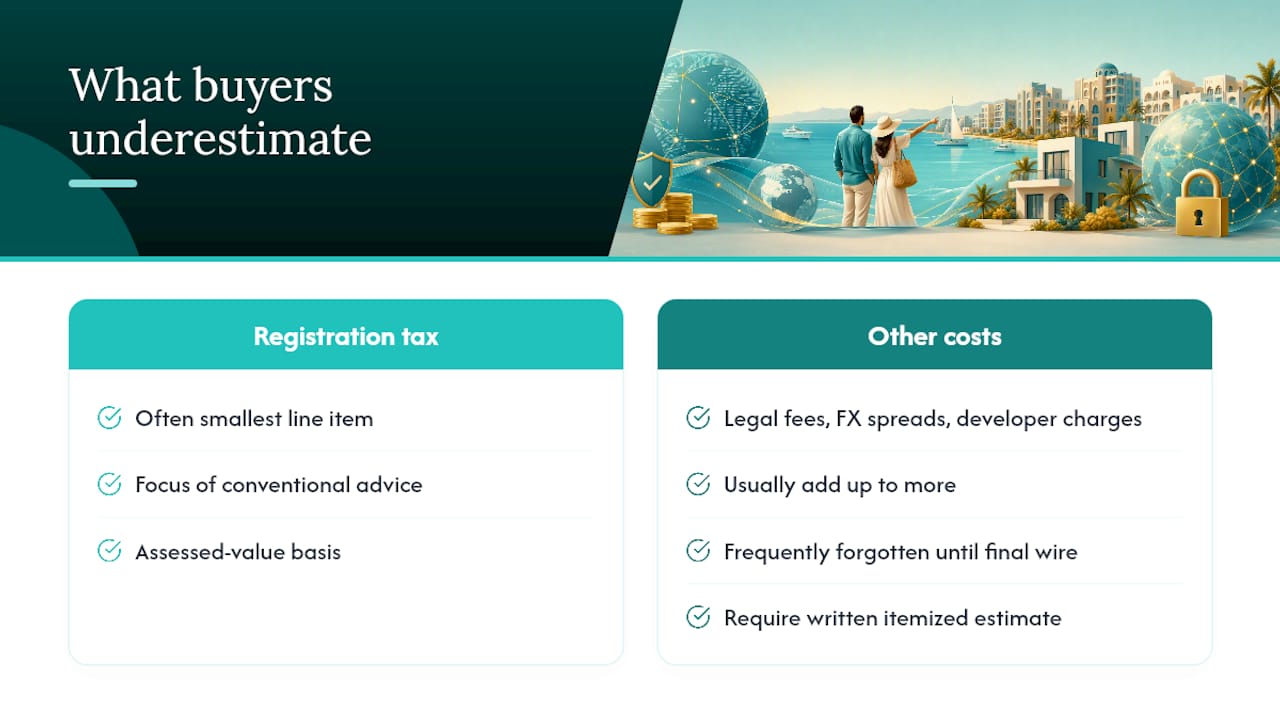
The conventional advice on Egyptian property costs tends to fixate on the registration tax percentage and stop there, which misses where the real money actually goes. Registration tax on an assessed value is often the smallest line item in the whole transaction. Legal fees, FX spreads, and developer processing charges on off-plan deals usually add up to more, and they're the costs buyers consistently forget to budget for until the final wire transfer lands short.
The bigger gap in most guidance is treating Egypt's lack of standardized escrow as a footnote rather than the central fact it is. Without that protection, a developer's delivery record and your lawyer's contract redlines aren't optional extras. They're the substitute mechanism doing the job escrow would normally do elsewhere.
If you take one thing from this guide, prioritize the written itemized estimate before anything else.
— PADSABROAD
Get a Tailored Closing-Cost Estimate Before You Commit
There are services available that provide practical alternatives to guessing at Hurghada closing costs from a generic percentage range. Because some teams work directly with vetted developers and can introduce buyers to independent Egyptian lawyers, you may get an itemized cost estimate specific to your actual property, not a rough average pulled from a blog post.

Before you commit funds to any agent or developer, ask for a written breakdown covering registration, notarization, legal fees, and any FX handling charges, then have it checked against experienced local insights on current Hurghada listings. That comparison alone catches most of the hidden charges buyers run into later.
If you're weighing a resale unit against an off-plan reservation, Padsabroad's first-time buyer guide to Red Sea property investment walks through the decision in more depth, and the team can connect you with a tailored cost estimate for the specific property you have in mind. Reach out through that guide to start the conversation before you send a reservation deposit anywhere.