
USD pricing in Egyptian real estate gives hard-currency buyers a clearer benchmark and a real cost advantage when the Egyptian pound weakens, but it does not eliminate exchange friction, legal complexity, or payment risk. Before you negotiate, verify whether the contract is denominated in USD or EGP because that single clause determines who absorbs any currency movement between signing and final payment.
- Price visibility vs. FX risk: A USD-quoted price locks your budget in dollars, but if the contract converts to EGP at payment date, the seller captures any pound depreciation between signing and settlement.
- Payment friction: Transferring USD internationally into Egypt involves bank clearing, Central Bank of Egypt (CBE) compliance checks, and 2–10 business days for funds to settle, depending on routing.
Pro Tip: Before any negotiation, ask the developer or seller for the exact contract currency clause in writing. Specifically, ask whether the payment obligation is fixed in USD or fixed in EGP at a stated exchange rate. That answer changes your total cost.
Key Takeaways
USD pricing in Egyptian property gives hard-currency buyers cost clarity, but the contract currency clause, FX-indexed instalments, and transaction costs determine the true all-in dollar price.
| Point | Details |
|---|---|
| Contract currency is decisive | Verify whether the contract fixes payment in USD or floats in EGP before negotiating any price. |
| Dec 2025 exchange rate | Global Property Guide records EGP ≈ 47.54 per USD as the December 2025 average for price conversions. |
| Rental yields favor EGP buyers | Q4 2025 gross yields average 6.72% nationally and 8.3% in Cairo, but dollar yields are lower when rents are EGP-linked. |
| Transaction costs add 6–10% | Registration tax, lawyer fees, agency commission, and FX conversion costs typically add 6–10% above the headline USD price. |
| Padsabroad | Provides contract currency review, payment facilitation, and escrow guidance for international buyers across Egypt's Red Sea coast. |
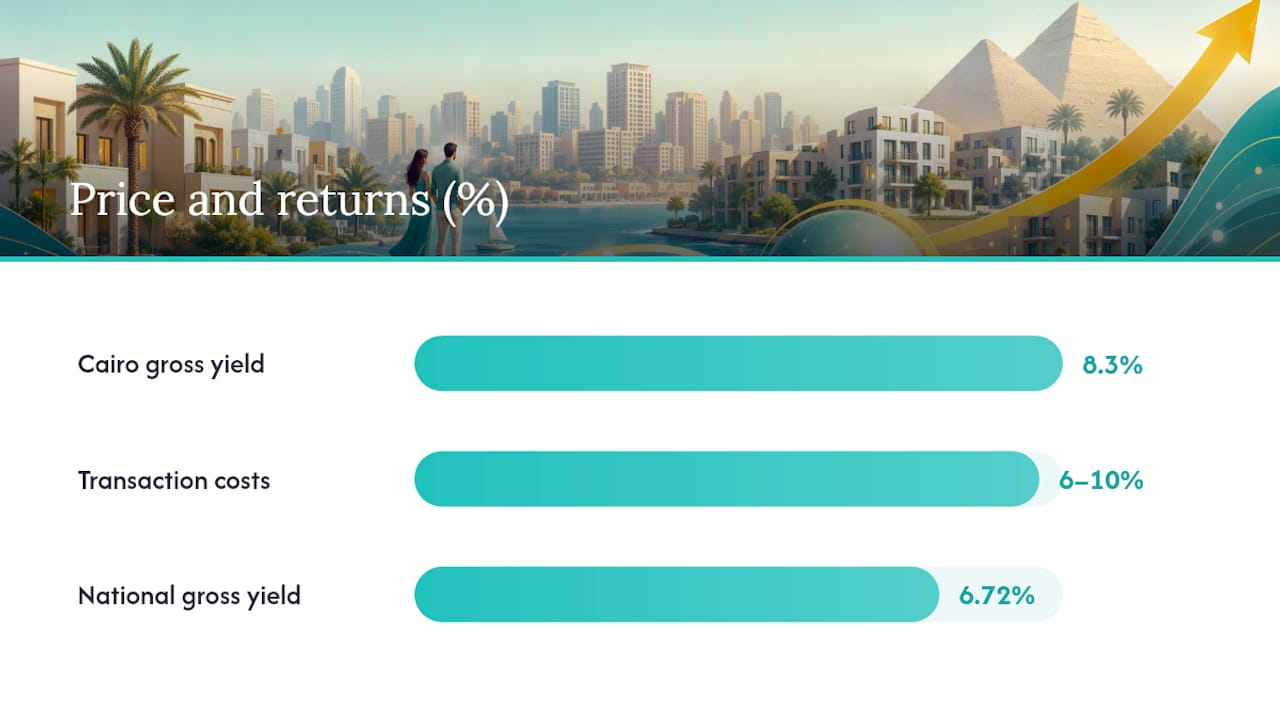
Table of Contents
- Why some Egyptian listings are quoted in USD
- How the EGP–USD rate has moved since 2016
- Dec 2025 property prices per sqm across major Egyptian markets
- How USD movements push Egyptian property prices higher
- What USD pricing means for your investment returns
- Mortgages, payment plans, and transaction costs in USD deals
- Practical checklist for international buyers dealing with USD pricing
- Red flags to watch for in USD-priced contracts
- Padsabroad's perspective on USD-priced deals in Egypt
- How Padsabroad helps you buy safely with USD pricing in Egypt
- Sources
Why some Egyptian listings are quoted in USD
Developers and sellers quote in USD for practical reasons, not just marketing preference. Most large-scale resort and new-city projects import construction materials, finishes, and equipment priced in dollars. Quoting in USD lets developers align their sales revenue with their cost base.
Three contract scenarios are common in the Egyptian market:
- USD-denominated contract, USD payment: The price, instalments, and final payment are all stated and paid in US dollars. This is typical for resort developments in Hurghada, El Gouna, and Sahl Hasheesh targeting overseas buyers. The buyer carries no EGP conversion risk.
- EGP contract with USD reference price: The contract states an EGP amount calculated from a USD price at a fixed or floating CBE rate. If the rate is floating, the EGP amount due at each instalment is recalculated at the prevailing rate, meaning the buyer pays more EGP if the pound weakens.
- Mixed instalment plan: Early instalments are in EGP, later ones (often tied to delivery milestones) are in USD or indexed to the CBE rate. This structure is common with developers who have phased foreign-currency debt obligations.
A practical example: a property listed at $150,000 USD costs roughly EGP 7,131,000 at a rate of EGP 47.54 per USD (the Global Property Guide Dec 2025 average). At EGP 50.60 per USD, the same dollar price would require EGP 7,590,000. The seller in a floating-rate EGP contract captures that EGP 459,000 difference automatically.
Pro Tip: If the contract is EGP-denominated with a floating rate, negotiate a rate cap or a fixed CBE rate at the signing date. Developers often accept this for buyers paying a significant deposit upfront.
How the EGP–USD rate has moved since 2016
Egypt's exchange-rate history explains why USD pricing became standard in certain market segments. The timeline matters for any buyer modeling future costs or resale values.
- November 2016 float: The CBE floated the pound, which dropped from roughly EGP 8.8 to EGP 18 per USD almost immediately. Property prices in EGP roughly doubled over the following two years, while dollar-denominated values held relatively steady.
- 2022 devaluations: Pressure from the global commodity shock and rising US interest rates triggered multiple CBE devaluations. The pound fell from around EGP 15 to EGP 24 per USD across 2022.
- 2023 continued pressure: The pound weakened further toward EGP 30–31 per USD by late 2023 as foreign-currency reserves tightened.
- March 2024 major devaluation: The CBE allowed a sharp adjustment, moving the rate to approximately EGP 47–50 per USD. This coincided with the IMF's 46-month, $3 billion extended arrangement for Egypt, which required greater exchange-rate flexibility as a condition of the program.
- 2024–2025 stabilization: The rate stabilized in the EGP 47–51 range. Global Property Guide records the average rate at approximately EGP 47.54 per USD in December 2025.
The cumulative depreciation since 2016 means a buyer who purchased at $100,000 in 2016 and held through 2025 saw their EGP-denominated asset value rise substantially in nominal terms, even if real (inflation-adjusted) gains were more modest. For new hard-currency buyers entering in 2025–2026, the stabilized rate reduces near-term devaluation risk compared to the 2022–2024 period.
The IMF raised Egypt's economic growth outlook to 5.4% for FY 2026/27, and TradingEconomics tracks the macro indicators that underpin that stabilization. A stronger growth trajectory generally supports currency confidence, though Egypt's exchange rate remains sensitive to global dollar strength and domestic inflation.
Dec 2025 property prices per sqm across major Egyptian markets
The figures below are sourced from the Aqarmap index and Global Property Guide, converted at EGP 47.54 per USD (December 2025 average). All figures are approximate residential averages; luxury and branded-resort units command premiums above these ranges.

Conversion note: USD figures use EGP 47.54 per USD, the December 2025 average reported by Global Property Guide. Figures are rounded to the nearest dollar. Resort and branded-community units in Ain El Sokhna, Hurghada, and the North Coast can exceed these ranges significantly.
Three observations worth noting:
- Red Sea and Ain El Sokhna offer the widest USD value range. Entry-level units start below $300 per sqm, making them among the most accessible dollar-denominated markets in the region for buyers with budgets under $100,000.
- New Cairo and the New Administrative Capital carry the highest per-sqm costs in dollar terms, reflecting demand from domestic high earners and government-linked development activity.
- North Coast seasonal resort pricing can spike well above the average range for beachfront or branded-community units, so always verify the specific project's price list rather than relying on area averages.
How USD movements push Egyptian property prices higher
When the dollar strengthens against the pound, Egyptian developers face higher costs almost immediately across several channels. Understanding this mechanism helps buyers anticipate price changes and negotiate more effectively.
The main cost channels are:
- Imported construction materials: Steel, aluminum, glass, and specialist finishes are priced in USD on global markets. A weaker pound raises the EGP cost of every imported input.
- Foreign-currency debt servicing: Developers who borrowed in USD or euro to finance land acquisition or infrastructure face higher EGP repayment costs when the pound falls.
- Imported fixtures and finishes: Kitchen systems, elevators, HVAC units, and branded fittings are typically imported and dollar-priced.
- Developer margin repricing: Developers routinely adjust asking prices upward after a devaluation to protect their dollar-equivalent margin, even on units not yet under contract.
Contract indexing is the mechanism that passes these costs to buyers. A typical clause reads something like: "The purchase price shall be adjusted in accordance with the official CBE exchange rate prevailing at the date of each instalment payment." That language means the buyer's EGP obligation rises automatically if the pound weakens between signing and delivery.
Watch for clauses that give the developer the right to revise the price unilaterally if "construction costs increase materially." This language is common in off-plan contracts and can be triggered by a devaluation even after you have signed. Ask for a fixed-price guarantee or a defined cost-escalation cap before signing.
According to JLL's Cairo living market dynamics report (Q3 2025), developer activity in new cities and resort corridors continues to be driven by demand from both domestic and international buyers, with pricing in new-city projects increasingly reflecting dollar-indexed cost structures.
What USD pricing means for your investment returns
For investors, the currency structure of a deal shapes both yield and capital-return outcomes in ways that are not always obvious from the headline price.
-
Gross rental yield baseline: Global Property Guide reports a Q4 2025 national average gross rental yield of approximately 6.72% and a Cairo average of approximately 8.3%. These figures are calculated on EGP rental income against EGP purchase prices.
-
The USD buyer's yield calculation: If you buy at a USD price and rent in EGP, your dollar yield depends on the exchange rate at the time you convert rental income. At EGP 47.54 per USD, a unit generating EGP 60,000 per year in rent converts to roughly $1,262. On a $50,000 purchase price, that is a 2.5% dollar yield, well below the EGP headline figure. The gap narrows if rents rise in EGP terms (which they have, tracking inflation) or if the pound holds steady.
-
Capital gain scenario: A buyer who purchased at $80,000 in early 2022 (when EGP was around 15 per USD) and sold in late 2025 at the same EGP price would see their dollar return eroded by the devaluation. Conversely, a buyer who purchased in USD at a fixed dollar price and sold in USD retains the dollar value regardless of EGP movements.
The most favorable scenario for a hard-currency investor is a USD-denominated purchase with USD-denominated resale, in a market where EGP rents are rising faster than inflation. Red Sea resort properties with strong short-term rental demand (Hurghada, El Gouna, Sahl Hasheesh) tend to fit this profile better than primary residential markets where rents are more EGP-linked.
Key risk: Rental income in Egypt is almost always collected in EGP, even for properties marketed to tourists. Converting that income to USD at a weaker rate reduces your effective dollar yield.
Mortgages, payment plans, and transaction costs in USD deals
Most Egyptian bank mortgages are issued in EGP. Following the CBE's surprise rate hike to 27.25% in March 2024, local borrowing became expensive for domestic buyers. International buyers rarely qualify for Egyptian bank mortgages anyway, so the practical financing options are:
- Developer payment plans: The most common route for international buyers. Plans typically require 10–30% down, with the balance spread over 3–7 years, sometimes interest-free for the first 1–2 years. USD-priced projects usually accept USD instalments directly.
- Cash purchase: Straightforward but requires full USD transfer to an Egyptian bank account, with CBE compliance documentation.
- Home-country financing: Some buyers refinance or draw equity from a UK or European property to fund an Egyptian purchase in cash or near-cash.
Typical transaction costs for a USD-priced purchase:
Source: Sands of Wealth housing price guidance and general market practice. Figures are estimates; confirm current rates with your legal advisor.
Cross-border USD payments typically clear in 2–10 business days, depending on the sending bank, correspondent routing, and CBE documentation requirements. Egyptian banks require proof of the property transaction (a signed preliminary contract) before accepting large inbound foreign-currency transfers. Plan for this documentation step before initiating any wire.
For a full walkthrough of the legal steps, Padsabroad's guide to buying property in Egypt safely covers the compliance and documentation sequence in detail.
Practical checklist for international buyers dealing with USD pricing
Use this checklist from the pre-offer stage through title registration. Each step is designed to reduce currency, legal, and payment risk.
- Confirm the contract currency clause. Ask for the draft contract before making an offer. Identify whether the price is fixed in USD, fixed in EGP, or floating at CBE rate. This is the single most important document check.
- Verify the developer's registration and track record. Check that the developer is registered with the Egyptian Real Estate Regulatory Authority (RERA) and has delivered previous projects on time. Padsabroad's trust-check guide outlines the five checks that matter most.
- Request a fixed-price or capped-escalation addendum. For off-plan purchases, negotiate a maximum price-escalation clause before signing.
- Use an escrow or staged-payment structure. Where possible, route payments through an escrow account held by a licensed Egyptian lawyer or notary. Release funds in stages tied to construction milestones, not calendar dates.
- Open an Egyptian bank account early. Most developers require payment from an Egyptian account. Opening one takes 1–4 weeks for non-residents and requires passport, proof of address, and sometimes a tax registration number.
- Model two FX scenarios before signing. Calculate your total cost at the current rate and at a rate 15% weaker. If the deal still works at the weaker rate, you have a reasonable margin of safety.
- Confirm the payment-clearing timeline with your bank. International USD transfers to Egypt typically need 2–10 business days. Align your payment schedule with the contract's instalment due dates, allowing buffer time.
- Engage a local Egyptian lawyer independently. Do not rely solely on the developer's legal team. An independent lawyer reviews the title deed (tabu), checks for encumbrances, and confirms the contract terms are enforceable.
- Clarify the rental income currency. If you plan to rent the property, confirm with the developer or local agent whether rental contracts will be in EGP or USD, and model your yield accordingly.
- Get a currency-aware quote from your agent. Ask Padsabroad or your agent to provide a total-cost breakdown in both USD and EGP at the current CBE rate, so you can compare listings on a like-for-like basis.
Pro Tip: For escrow, ask your Egyptian lawyer to hold the deposit in a client account and release it to the developer only after title verification is complete. This is standard practice in the UK and increasingly accepted by Egyptian developers working with international buyers.
Additional questions to ask the seller or developer:
- What exchange rate is used for EGP conversion, and is it fixed at signing or floating?
- Is there a completion guarantee, and what happens if delivery is delayed?
- Are there any outstanding mortgages or liens on the title?
- What is the maintenance fee structure, and is it quoted in EGP or USD?
Red flags to watch for in USD-priced contracts
Most problems in USD-priced Egyptian property deals come from contract ambiguity, not outright fraud. These are the patterns that create the most risk.
Top red flags:
- Ambiguous currency clause: The contract states a USD price but does not specify whether payment must be in USD or can be settled in EGP at an unspecified rate. This creates room for dispute at payment time.
- No escrow or staged-payment structure: A developer who insists on full payment upfront, with no milestone-linked releases, carries higher delivery risk.
- Unilateral indexing rights: Language that allows the developer to revise the price based on "market conditions" or "cost increases" without a defined cap or buyer consent.
- Unclear completion guarantee: No penalty clause for late delivery, or a penalty so small it does not incentivize the developer to complete on time.
- Unregistered title: The developer sells on a preliminary contract (contract of sale) rather than a registered title deed. This is common and legal in Egypt, but it means you do not hold a registered title until the developer completes the project and transfers ownership.
- Developer insolvency risk: No information on the developer's financing structure, outstanding debt, or project completion percentage.
Quick contract review checklist:
- Is the payment currency explicitly stated (USD or EGP)?
- Is there a fixed exchange rate or a rate cap for EGP conversion?
- Does the contract include a delivery date with a penalty clause?
- Is there an escrow or milestone-payment structure?
- Has the title been checked for encumbrances by an independent lawyer?
- Is the developer registered with RERA?
Pro Tip: Ask for the developer's project financing documentation or a bank guarantee letter. Reputable developers working with international buyers will provide evidence of project financing. If a developer refuses, treat that as a material risk signal.
For a broader set of due-diligence checks, the Padsabroad Egypt real estate investment checklist for 2026 covers the full pre-purchase verification process.
Padsabroad's perspective on USD-priced deals in Egypt
The most common mistake international buyers make in USD-priced Egyptian deals is treating the listed dollar price as the final cost. It rarely is. Buyers who model only the listing price consistently underestimate what they need to transfer.
A practical example: a buyer approached Padsabroad after signing a preliminary contract on a Red Sea apartment listed at $95,000. The contract was EGP-denominated with a floating CBE rate. Between signing and the second instalment six months later, the pound had moved enough to add roughly EGP 180,000 to the buyer's obligation, equivalent to approximately $3,800 at the new rate. The buyer had not budgeted for that movement. Padsabroad's team renegotiated a fixed-rate addendum for the remaining instalments, capping the buyer's exposure.
The lesson is straightforward: currency risk in Egyptian property is manageable, but only if you identify it in the contract before you sign. Padsabroad reviews every contract for currency clause risk as a standard part of the purchase process. If you want a currency-aware quote on a specific listing, reach out directly for a no-obligation assessment.
How Padsabroad helps you buy safely with USD pricing in Egypt
Buying property in Egypt with a USD budget is genuinely accessible, and the Red Sea coast offers some of the most competitive dollar-per-sqm values in the Mediterranean and Middle East region. The friction is real, but it is manageable with the right support.

Padsabroad specializes in exactly this: helping international buyers from the UK and Europe purchase apartments and villas in Hurghada, El Gouna, Sahl Hasheesh, Soma Bay, Marsa Alam, and Port Ghalib, with full visibility on contract currency terms, payment routing, and total costs before you commit. The service covers property search by budget and area, contract currency review, payment facilitation, escrow guidance, and coordination with independent Egyptian lawyers. You get a clear, currency-aware cost breakdown in USD before any money moves.
If you are a first-time buyer in the Red Sea market, the first-time buyer guide to Egypt Red Sea property investment is the right starting point. For buyers ready to review current listings, browse all properties for sale across the Red Sea coast to see what your USD budget buys right now. To move forward with a specific property or get a currency-aware quote, contact Padsabroad directly through Padsabroad.
Sources
- IMF press release: Egypt — Executive Board approves 46‑month USD3b arrangement
- Egypt Residential Property Market Analysis 2026
- Aqarmap index
- JLL — Cairo living market dynamics Q3 2025
- Egypt unexpectedly hikes interest rate to 27.25 (Bloomberg)
- TradingEconomics — Egypt GDP growth (annual)
All price and exchange-rate data in this article reflects December 2025 figures. Exchange rates and property prices change; always verify current rates with the CBE or a licensed financial institution before transferring funds.
This article is general information, not a substitute for advice from a qualified financial advisor. Consult a qualified financial professional about your own circumstances before acting on anything here.