
Choose a manager based on three things, in this order: proven local performance in your exact market, total-cost transparency once every markup and pass-through is counted, and how fast they respond when you're vetting them. That last one is not a soft signal. A slow reply during the sales process usually means slow guest support later, and industry analysis on property manager selection backs that pattern up.
You can verify most of this in a weekend. Ask each finalist for a sample profit-and-loss statement from a comparable property, plus their service-level agreement and three current owner references. Time how long it takes them to answer.
Before you call anyone, get organized:
- List your property's specifics: bedrooms, location, amenities, current condition.
- Define your must-have services versus what you're willing to outsource entirely.
- Request a standard fee schedule, in writing, from three to five candidate managers.
Key Takeaways
Selecting the right manager comes down to verified local performance, total-cost math instead of headline fees, and response speed during vetting.
| Point | Details |
|---|---|
| Shortlist three to five | Compare local, specialized candidates before you interview anyone in depth. |
| Calculate true cost | Convert headline fees plus markups into total annual cost as a percentage of revenue. |
| Require written SLAs | Get maintenance response time and guest support commitments in the contract, not verbally. |
| Verify with references | Call three owner references directly and ask specifically about payout timing. |
| Consider Padsabroad | Padsabroad offers local Red Sea management services plus contract review support for foreign owners. |
Table of Contents
- Holiday Home Rental Management Company Selection: Service Models Explained
- How Do Rental Management Companies Charge Fees?
- Which Services Should You Require Versus Consider Optional?
- How Do You Vet and Interview Rental Management Candidates?
- Contract Clauses That Protect (Or Expose) Your Income
- What Performance Metrics Should You Actually Expect?
- How Do You Compare Multiple Management Offers Side by Side?
- Practical Signals That Predict Good Long-Term Service
- What Legal and Regulatory Rules Apply to Holiday Home Rentals?
- What Insurance Do You Need for a Holiday Rental Property?
- An Owner's 30-Minute Interview-Day Checklist
- How Padsabroad Helps You Choose and Onboard the Right Manager
- Sources
Holiday Home Rental Management Company Selection: Service Models Explained
Every management company sells one of three service models, and picking the wrong one is the most common first mistake owners make. Full-service management handles everything: guest messaging, cleaning coordination, dynamic pricing, maintenance dispatch, and financial reporting. Marketing-only management lists your property across booking channels and handles reservations, but leaves cleaning, maintenance, and guest issues to you. Hybrid models sit in between, and they're growing in popularity along Red Sea coastal markets because they let owners keep control of pricing and financial approvals while outsourcing the labor-heavy work: turnovers, 24/7 guest support, and emergency repairs.
The trade-off is straightforward: full-service models generally have higher fees with lower owner time and risk; marketing-only models have lower fees but require more owner time and carry higher risk if you're not local; and hybrid models fall between these extremes in fees and owner involvement.
Hybrid arrangements let owners keep pricing and financial approvals while outsourcing high-labor operations like turnovers and emergency response, often lowering fees without fully sacrificing passive income.
Coastal property owners who don't live near their unit tend to regret marketing-only arrangements. Someone still has to coordinate a plumber at 11 p.m., and that someone is you unless a manager owns that responsibility contractually.
How Do Rental Management Companies Charge Fees?
Fee structures in this industry are deliberately confusing, and that's not an accident. That's why the only honest comparison metric is total annual cost as a percentage of gross revenue, not the headline rate.
Here's what typically shows up on an invoice:
- Base management fee: usually a percentage of booking revenue.
- Setup or onboarding fee: a flat charge to list your property and build out photos and profiles.
- Per-booking or guest service fee: sometimes charged to the guest, sometimes deducted from your payout.
- Cleaning and turnover fees: passed through, often with a markup.
- Vendor markups: maintenance, repairs, and linen services billed above cost.
Full-service vacation rental managers have historically charged in the 18 to 30 percent range in many markets because that fee bundles dynamic pricing, guest support, and full operational coordination. A lower headline rate from a marketing-only provider looks cheaper until you add back everything you're now paying contractors to do yourself.
Run the math with real numbers. That's $6,000 in base fees.
Pro Tip: Ask every finalist for a sample annual profit-and-loss statement from an actual property they manage. If they hesitate or can't produce one, that hesitation tells you more than their pitch deck.

The most reliable comparison method remains total annual cost as a share of revenue, calculated from a real sample statement rather than a marketing brochure.
Which Services Should You Require Versus Consider Optional?
Not every service on a manager's glossy brochure matters equally. Some are non-negotiable operational baselines. Others are genuine upgrades you pay extra for, and whether they're worth it depends entirely on your goals.
Must-have operational items:
- 24/7 guest support with a published response-time commitment.
- Cleaning and turnover completed on a documented SLA, not "we'll get to it."
- Emergency maintenance response time in writing, ideally under 2 to 4 hours for urgent issues.
- A clear damage-handling and security-deposit process.
- Inventory management so linens, toiletries, and welcome supplies don't run out mid-season.
Must-have commercial items:
- Dynamic pricing tied to local demand, not a flat nightly rate set once a year.
- Distribution across multiple booking channels, not a single OTA.
- Active review management and response protocols.
- Regular owner reporting with real booking and revenue data.
- Clear controls over who can approve bookings, block dates, or change your rate floor.
Nice-to-have extras:
- Concierge upsells (airport transfers, excursions, private chefs).
- Repeat-guest loyalty programs.
- Premium linen or in-room amenity upgrades.
- Professional in-house photography refreshed seasonally.
- Local partnerships with restaurants or tour operators for guest perks.
Owners chasing maximum passive income should weight the must-have list heavily and treat the nice-to-haves as tie-breakers between two otherwise equal finalists. A manager who nails 24/7 support and maintenance response but skips the concierge upsells is still doing the job right.
How Do You Vet and Interview Rental Management Candidates?
Start narrow. Search locally, ask other owners in your area for referrals, and build a shortlist of three to five candidates before you interview anyone. Property management guidance consistently points to this range as the sweet spot: enough options to compare fairly, few enough that you can actually do the homework on each.
- Pre-vet by phone or email. Confirm they operate in your specific area, manage a similar property type, and can send references within a day. Slow replies here are your first data point.
- Interview on market knowledge. Ask how many properties they manage within your immediate area and their average occupancy last season. A vague answer is a red flag; a specific number with context is a good sign.
- Interview on operations. Ask about maintenance emergency response time, tenant or guest screening, and damage handling. A strong answer names a specific response window and a named local vendor network, not "we handle it."
- Interview on reporting and insurance. Ask what financial reports you'll receive and how often, and whether they carry liability coverage separate from your own homeowner policy.
- Check references independently. Call the owner references yourself rather than relying on written testimonials, and ask specifically about payout timing and communication during problems.
A candidate who scores well on paper but takes three days to answer a simple email should lose points immediately. Responsiveness during the sales process is one of the better predictors of how they'll treat you once you've signed.
Contract Clauses That Protect (Or Expose) Your Income
The contract is where good sales pitches go to die, and where hidden costs live. Read every clause with the assumption that anything not explicitly stated favors the manager, not you.
Require clarity on these before signing:
- Termination and notice period: how much notice must you give to exit, and does the manager owe you the same courtesy?
- Exclusivity: are you locked into using only their vendors, or can you bring in your own cleaner or handyman?
- Liability and insurance: whose policy covers guest injury or property damage, and what's excluded?
- Payout schedule: when does revenue actually land in your account after a guest checks out?
- Vendor markup disclosure: does the contract state markup percentages explicitly, or just "market rate"?
- Performance SLAs: are response times and turnover windows written into the contract, or only mentioned verbally?
- Owner portal and data access: do you retain access to your own booking and financial history if you leave?
Watch for auto-renewal clauses that silently extend a one-year contract into another year without a fresh conversation, and minimum repair-spend clauses that let a manager approve maintenance work above a threshold without asking you first.
Pro Tip: Negotiate for a shorter initial notice period, even 30 to 60 days, before committing to a longer contract. It costs the manager nothing if they're confident in their service, and it protects you if the relationship sours.
What Performance Metrics Should You Actually Expect?
Numbers cut through sales talk faster than anything else. Ask every finalist to project these figures for your specific property type and season, then hold them to it after month three.
- Occupancy rate: the percentage of available nights actually booked.
- ADR (average daily rate): what a night in your property typically sells for.
- RevPAR: revenue per available night, the single best combined metric.
- Booking lead time: how far in advance guests typically reserve.
- Rebooking speed: how fast a canceled date gets refilled.
- Guest response SLA: how quickly guest messages get answered, day or night.
- Owner payout lag: how many days after checkout you actually receive funds.
Benchmarks vary heavily by property type, location, and season, so treat any manager's projection as a starting point you'll verify against real performance after 90 days. A manager with an established local vendor network can dispatch cleaning and repairs faster during peak season, which shows up directly in occupancy and guest review scores.
Consider terminating early if you see a pattern, not a single bad month: consistently missed response-time SLAs, vendor invoices with markups you were never told about, or a maintenance backlog that keeps growing instead of shrinking.
How Do You Compare Multiple Management Offers Side by Side?
Once you've interviewed three to five candidates, put their offers into a single framework instead of trusting memory or a stack of separate PDFs. Score each finalist on the same seven dimensions:
- Services included, from full management down to marketing-only.
- Fee model and true total expected annual cost.
- Best fit for your property type and how hands-on you want to be.
- Realistic performance benchmarks for occupancy and ADR.
- Contract terms, especially notice period and exclusivity.
- Technology and reporting, including owner portal access.
- Maintenance and emergency SLA commitments.
Score each dimension from 1 to 5, then weight them by what matters most to you. An owner who lives near the property might weight technology lower and fee transparency higher. An absentee owner should weight maintenance SLA and communication heavily.
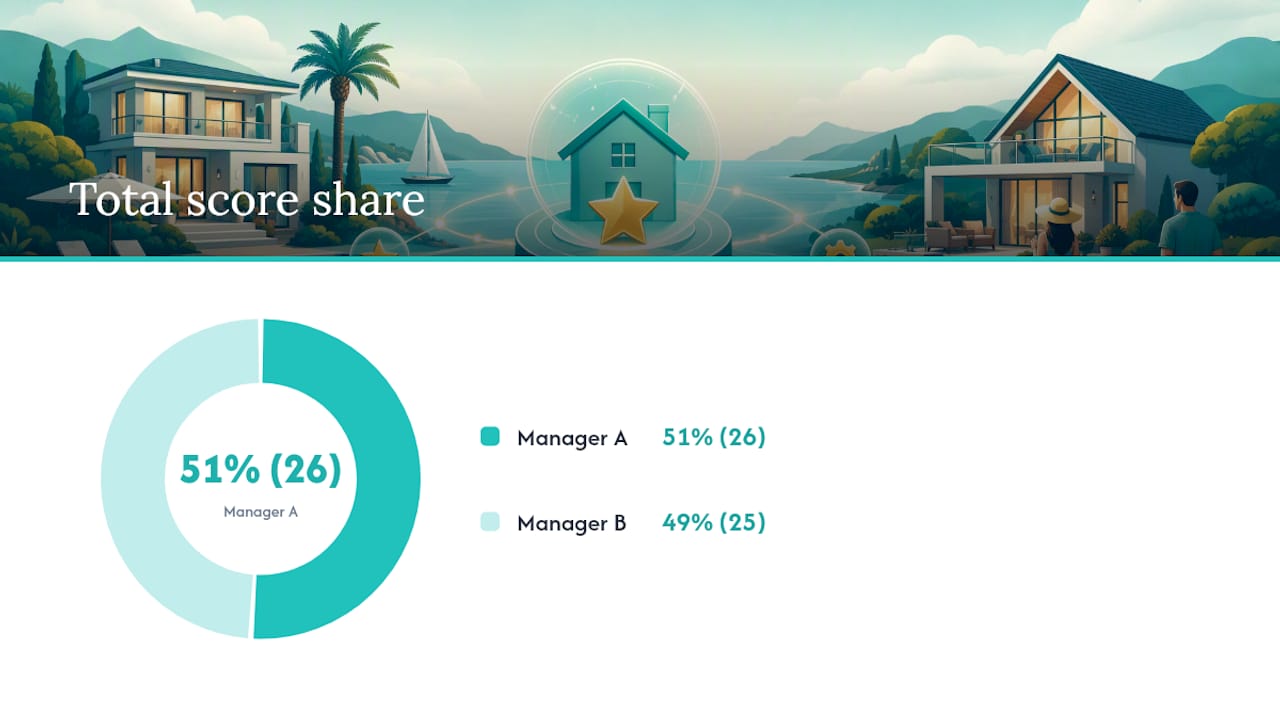
Say Manager A scores a 4 on services, 3 on cost, 5 on local fit, 3 on benchmarks, 4 on contract terms, 3 on technology, and 4 on maintenance. Manager B scores 3, 4, 3, 4, 3, 5, and 3 on the same dimensions. The weighted totals often land close together, which is exactly when reference calls and stated ramp-up timelines become the real tie-breaker, not the spreadsheet.
Practical Signals That Predict Good Long-Term Service
Two research-backed signals matter more than most owners realize. First, how fast a company responds during the sales process predicts how fast they'll respond once you're a paying client. Second, vendor markups are close to universal in this industry, and the honest managers are the ones who disclose the percentage without being asked twice.
Managers who treat your property as their own reputation on the line tend to answer faster, staff turnovers better, and disclose costs before you ask. That posture shows up in the sales conversation long before it shows up in a contract.
Watch for three recurring pitfalls: fixating on the lowest headline fee while ignoring total cost, skipping local permit and regulatory research before signing, and underestimating how long onboarding actually takes before your listing performs at full occupancy. Ask any local operator, including Padsabroad's own management team, for a live owner-portal demo before you sign anything. Seeing real booking and revenue dashboards beats a sales deck every time.
What Legal and Regulatory Rules Apply to Holiday Home Rentals?
Regulatory requirements for short-term and holiday rentals vary enormously by country, region, and sometimes by municipality within the same country, so treat any manager's claim of "it's all handled" with healthy skepticism until you see documentation. Licensing requirements, tourism registration, occupancy taxes, and zoning restrictions on short-term letting are all local matters, and a manager unfamiliar with your specific jurisdiction's rules is a genuine liability, not a minor inconvenience.
Ask candidates directly whether they handle rental licensing or registration on your behalf, and request to see a copy of any permit or registration certificate tied to your property once management begins. A manager operating across a specific coastal region should know the tourism registration process cold, including timelines and renewal cycles. If they can't explain the process without checking, that's worth flagging.
Tax treatment of rental income also differs by country, and owners are often responsible for their own reporting even when a manager collects rent on their behalf. Confirm in writing whether the manager withholds or reports any taxes for you, and whether you'll need separate local tax representation. Never assume a management contract covers your personal tax obligations unless that's explicitly stated in writing. Buyers considering a first purchase abroad should also review broader ownership and due-diligence guidance before committing, since ownership structure often affects which regulations apply to your rental activity.
What Insurance Do You Need for a Holiday Rental Property?
Standard homeowner's insurance almost never covers short-term rental activity, and this is one of the most commonly overlooked gaps in the entire selection process. You need a policy specifically written for short-term or vacation rental use, covering guest liability, property damage from paying guests, and often loss of rental income if the property becomes uninhabitable.
Ask every management candidate two direct questions: do they carry their own liability coverage as the operating manager, and does that coverage protect you as the property owner, or only them? These are frequently two separate policies, and owners who assume one covers both often discover the gap only after a claim gets denied.
Confirm coverage limits are adequate for your market. A single slip-and-fall claim or major water-damage incident can easily exceed a policy's minimum limits if you've underinsured to save on premiums. Ask whether the manager requires guests to accept a damage waiver or security deposit as a first line of defense before any insurance claim gets filed, since that structure reduces how often you'd need to rely on your policy at all.
Get all of this in writing before signing, not as a verbal assurance during the sales pitch.
An Owner's 30-Minute Interview-Day Checklist
Most owners wish they'd asked about payout timing and vendor markups before signing, not after the first confusing invoice. Use interview day to verify, in order: sample P&L, three reference calls, written SLA for maintenance response, portal demo, and exact notice period. If any of those five feels rushed or vague, treat that as your answer.
How Padsabroad Helps You Choose and Onboard the Right Manager
Comparing local operators, hybrid setups, and full-service management companies on your own takes real hours, especially if you're not based near your property. Padsabroad shortens that process for owners along Egypt's Red Sea coast by combining local market presence with hands-on help reviewing contracts and comparing fee structures before you commit to anyone.

Padsabroad's property management and holiday rental services for foreign owners cover the ground this article just walked through: local vendor relationships, transparent fee schedules, and owner reporting you can actually see rather than take on faith. If you want an outside read on a contract you've already been offered, or a live look at what an owner portal should show, Padsabroad can walk you through both. And if you're still shopping for the property itself before you even get to the management question, start with the first-time buyer guide to Red Sea property investment to see how location and property type shape your rental options from day one.
Whichever manager you shortlist, request their sample financial statement before you sign anything. That single document tells you more than any sales call will.
Sources
Owner references and a sample profit-and-loss statement remain the two strongest trust signals available before you sign anything, stronger than any brochure or star rating.
- The Do’s And Don’ts Of Choosing Property Management
- How to choose a property management company
- How to Choose the Best Vacation Rental Management Company for Your Property
This article is general information, not a substitute for advice from a qualified financial advisor. Consult a qualified financial professional about your own circumstances before acting on anything here.