Yes, foreigners can get mortgages in Egypt, but the route that works depends heavily on your residency status. Buyers with an Egyptian residency permit and verifiable local income have a realistic shot at a bank mortgage. Everyone else typically leans on developer installment plans, which need no local income proof, or offshore and asset-backed lending that keeps money outside Egypt. The trade-offs are consistent across all three: EGP interest rates run high, non-residents face bigger down payments, and no financing works unless the property itself is legally mortgageable.
TL;DR:
- Foreigners with Egyptian residency and local income can access bank mortgages, but non-residents must rely on developer installment plans or offshore financing.
- Mortgage interest rates in Egypt for foreigners remain high, around 18% to 26% annually, making developer plans often more cost-effective despite higher upfront costs.
- Verifying property registration, developer approvals, and ensuring the property is mortgageable are crucial steps before committing funds or signing agreements.
- Applying for a mortgage requires comprehensive documentation, including Egyptian ID, bank statements, income proof, and early establishment of local bank accounts.
- Currency fluctuations and developer default risks must be carefully managed, as they can significantly elevate total costs or cause financial loss.
Table of Contents
- Bank Mortgage vs Developer Instalments vs Offshore Financing
- Who Qualifies for a Foreign Mortgage in Egypt?
- How Much Can You Borrow, and What Will It Cost?
- What Documents Do You Need, and How Do Banks Verify Your Income?
- How Do You Check If a Property Is Mortgageable?
- Application Timeline and Fees to Budget For
- Strategies to Improve Your Approval Odds
- What's the Real Total Cost After Fees, Taxes, and Hidden Charges?
- The Step-by-Step Checklist From First Contact to Keys in Hand
- What Are the Biggest Risks Foreign Buyers Face?
- PADSABROAD's Take on What Actually Trips Up Foreign Buyers
- How PADSABROAD Helps You Navigate Financing and Purchase
- Where to Verify These Rules Yourself
- Sources
Bank Mortgage vs Developer Instalments vs Offshore Financing
Each financing route fits a different buyer profile, and picking the wrong one wastes months.
A bank mortgage in Egypt for foreigners makes sense only when you hold a residency permit, have a documented local income history, and already bank locally. Institutions like CIB Egypt extend financing to non-Egyptians, but the underwriting is noticeably stricter than for citizens.
Developer installment plans dominate the Red Sea and North Coast market for a simple reason: they skip bank paperwork entirely. Buyers pay a deposit, then spread the balance over 5 to 10 years directly to the developer, often at low or no apparent interest.
Offshore or asset-backed lending is the fallback for buyers who want to keep cash liquid rather than lock it into a large deposit. It costs more in fees and structuring but avoids exposure to Egypt's high domestic mortgage rates.
- Bank mortgage: best with residency and local income; strictest documentation
- Developer plan: most accessible; no local income required; typical 5 to 10 year terms
- Offshore/asset-backed: higher setup cost; preserves liquidity; ideal for non-residents
Who Qualifies for a Foreign Mortgage in Egypt?
Banks apply a consistent set of gates before they'll consider a foreign applicant, and knowing them upfront saves wasted applications.
- Residency or verified local income. A residency permit paired with a salary paid into an Egyptian account is the single biggest factor separating approvals from rejections.
- Age limits. Most lenders cap borrowers around 60 to 65 at loan maturity, so older applicants get shorter tenors by default.
- Debt-to-income caps. Monthly installments generally can't exceed 35% to 40% of verified income, a standard ratio across most Egyptian mortgage products.
- Property type restrictions. Banks will only finance registered, freehold units, never property in restricted or military-adjacent zones such as parts of the Sinai Peninsula, according to Lawyer Secretary's mortgage guide.
- Ownership limits. Foreign buyers face restrictions on the number of properties and total land area they can hold, which lenders factor into their risk assessment.
Applicants without residency aren't automatically shut out. Specialist lenders like AMF offer foreign-national products built specifically around this gap.
How Much Can You Borrow, and What Will It Cost?
Loan-to-value ratios for foreigners in Egypt generally range in the moderate to high portion of the property's value, with down payments correspondingly higher than in some other countries, reflecting stricter lending norms for non-residents.
By the numbers: Mortgage interest rates for foreign borrowers in Egypt currently sit in a high band, roughly 18% to 26% annually. These rates are driven by Central Bank of Egypt policy rates. On a mid-size loan, that rate range can double the effective cost of the property over a standard term.
That rate environment is exactly why so many foreign buyers gravitate toward developer plans instead. The official property portal confirms some banks push financing up to 80% to 85% in specific cases, but the monthly payment math at 20%+ interest rarely favors a bank loan over an interest-free developer schedule.
Currency choice matters just as much as the rate. EGP loans expose you to further devaluation risk, while dollar-linked developer plans shift that risk onto the developer's pricing instead of your monthly payment.
What Documents Do You Need, and How Do Banks Verify Your Income?
Egyptian lenders verify foreign income conservatively, and incomplete paperwork is the most common reason applications stall.
Start with identity documents: your passport, residency permit or valid visa, and certified translations of anything not in Arabic or English. Income evidence comes next, and banks want depth here, not just a summary letter.
- Payslips or employment contracts covering recent months
- Audited accounts for self-employed or business-owner applicants
- 6 to 12 months of bank statements, a baseline most lenders require according to AMF's guidance
- Foreign-credit references or embassy-attested income documents
- Egyptian tax card, where applicable
- Reservation contract and title evidence for the property itself
Pro Tip: Open an Egyptian bank account and transfer a few months of salary into it before applying. Lenders view domestic account history far more favorably than a stack of foreign statements, and it can turn a marginal application into an approved one.
Some banks will also accept a pledged deposit as informal collateral when foreign income alone doesn't fully satisfy their comfort level.
How Do You Check If a Property Is Mortgageable?
A property looking finished and market-ready tells you nothing about whether a bank will actually lend against it. Confirm mortgageability before you pay any reservation deposit, not after.
- Check registration status. Search the unit's title and land registration through the official mortgage portal or the Land Registry directly.
- Request the developer's bank approvals. Ask specifically which banks have pre-approved the project, since off-plan units are sometimes eligible for developer financing only.
- Verify escrow arrangements. A developer using an escrow account for buyer payments signals stronger financial controls and reduces your exposure if the project stalls.
- Rule out encumbrances and restricted zones. Confirm there's no lien on the unit and that it doesn't fall in a military or restricted coastal area.
PADSABROAD's guide to buying safely walks through these checks in more detail if you want a reference before committing funds.
Application Timeline and Fees to Budget For
A bank mortgage application in Egypt typically moves through four stages: pre-approval (1 to 2 weeks), property valuation (1 to 2 weeks), credit committee review (2 to 4 weeks), and final signing plus registration (2 to 4 weeks). Plan on 6 to 10 weeks total if your documents are complete on the first submission.
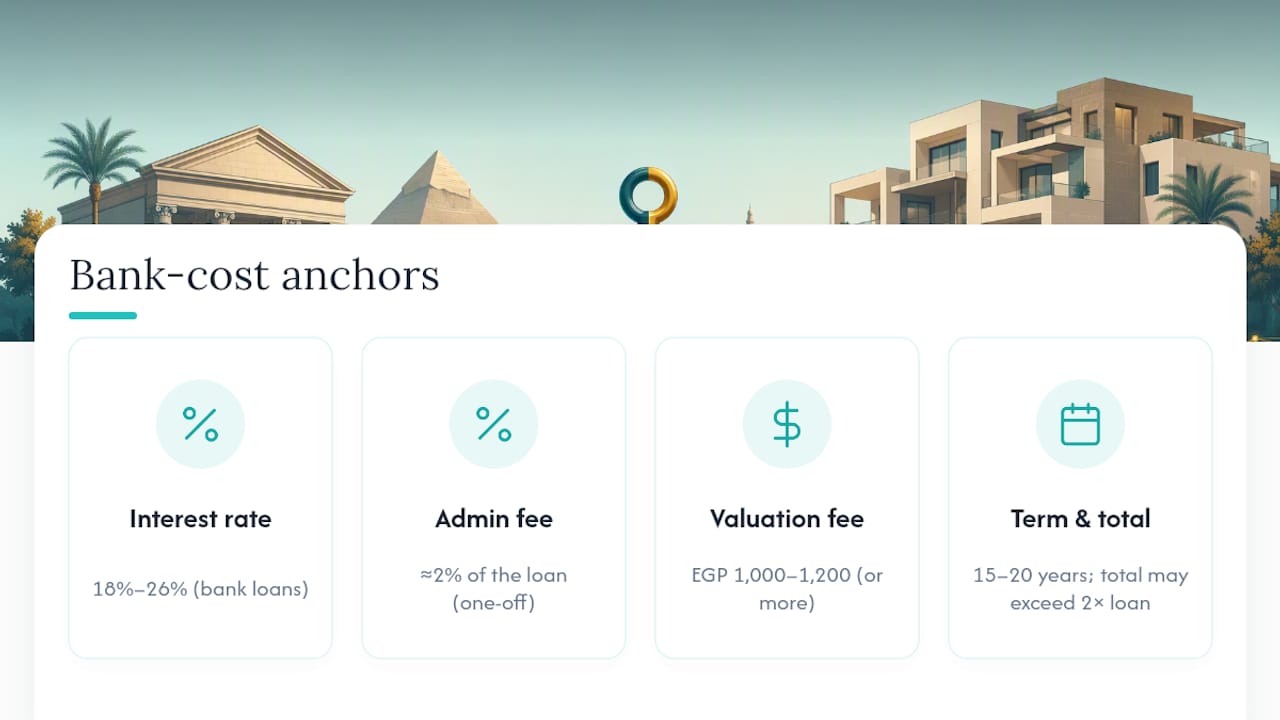
Cost snapshot: Expect admin fees around 2% of the loan amount, valuation fees starting at EGP 1,000 to 1,200, plus separate legal and registration costs on top.
- Get pre-approved before you sign a reservation contract with any developer
- Open a local bank account early to speed income verification
- Submit translated and authenticated documents on the first pass, not the second
Strategies to Improve Your Approval Odds
Your best move depends on which side of the residency line you fall on, but both groups have real levers to pull.
If you hold residency, build a local banking relationship months before applying, and get pre-approved so you know your ceiling before shopping for property. Specialist products from lenders like AMF are worth comparing against standard bank offers, since they're built around foreign-national applicants specifically.
If you're a non-resident, developer installments remain your most realistic path, followed by asset-backed lending if you want to avoid tying up cash in a large deposit. A bigger down payment, sometimes above the 40% baseline, can also unlock terms that wouldn't otherwise be offered.
- Transfer salary into an Egyptian account well before applying
- Use a lawyer or broker to verify mortgageability before paying any deposit
- Consider escrow-protected payment structures with developers, not direct transfers
Pro Tip: A broker who works Egypt's Red Sea market daily can flag whether a specific project has bank approval before you waste weeks on an application that was never going to clear underwriting.
What's the Real Total Cost After Fees, Taxes, and Hidden Charges?
The advertised price on a Red Sea listing is never the number you'll actually pay. Add the following before you calculate your real budget.
Bank-side costs include the admin fee (around 2% of the loan), valuation fee (EGP 1,000 to 1,200 or more depending on property size), and legal and registration fees that vary by governorate. If you're financing through a bank, factor in the interest cost too. At rates between 18% and 26%, the total repaid over a 15 to 20 year term can exceed double the original loan.
Developer plans carry different hidden costs. Maintenance deposits, club membership fees for gated communities, and utility connection charges are common in Red Sea developments and rarely appear in the headline price. Ask for a full itemized schedule before signing, not just the per-square-meter rate.
Currency conversion is its own hidden cost. If your income is in GBP, EUR, or USD and your mortgage or installments are EGP-denominated, currency swings between signing and each payment date change your real cost every time you transfer money. Dollar-linked developer plans avoid this on the payment side but usually price the property higher to begin with.
Finally, budget for property registration tax and any transfer fees due at the point title passes to you. These are separate from the bank's own fees and get missed by buyers focused only on the mortgage side of the transaction.
The Step-by-Step Checklist From First Contact to Keys in Hand
Treat this as your working order of operations, not a rough guide.
1. Confirm residency and income documentation status before contacting any bank, so you know which route you actually qualify for.
2. Shortlist mortgageable properties. Cross-check registration status through realestate.gov.eg and confirm developer bank approvals.
3. Get pre-approved with at least one bank (or AMF, if you fit their foreign-national product) before signing any reservation contract.
4. Submit full documentation, including translated ID, 6 to 12 months of bank statements, and income evidence, in one complete package.
5. Wait through valuation and credit committee review, typically 3 to 6 weeks combined.
6. Review the offer terms carefully, particularly LTV, tenor, and whether the rate is fixed or variable.
7. Sign and register, factoring in the admin, legal, and registration fees covered above.
8. If pursuing a developer plan instead, confirm the payment schedule, currency denomination, and escrow protections in writing before the first deposit leaves your account.
For a broader walkthrough of the purchase process itself, PADSABROAD's complete guide for foreign buyers covers the steps that sit around the financing piece.
What Are the Biggest Risks Foreign Buyers Face?
The most damaging mistakes in this market happen before financing even enters the picture. Buyers reserve a unit, pay a deposit, then discover the project isn't registered or the bank never approved it for mortgage lending.
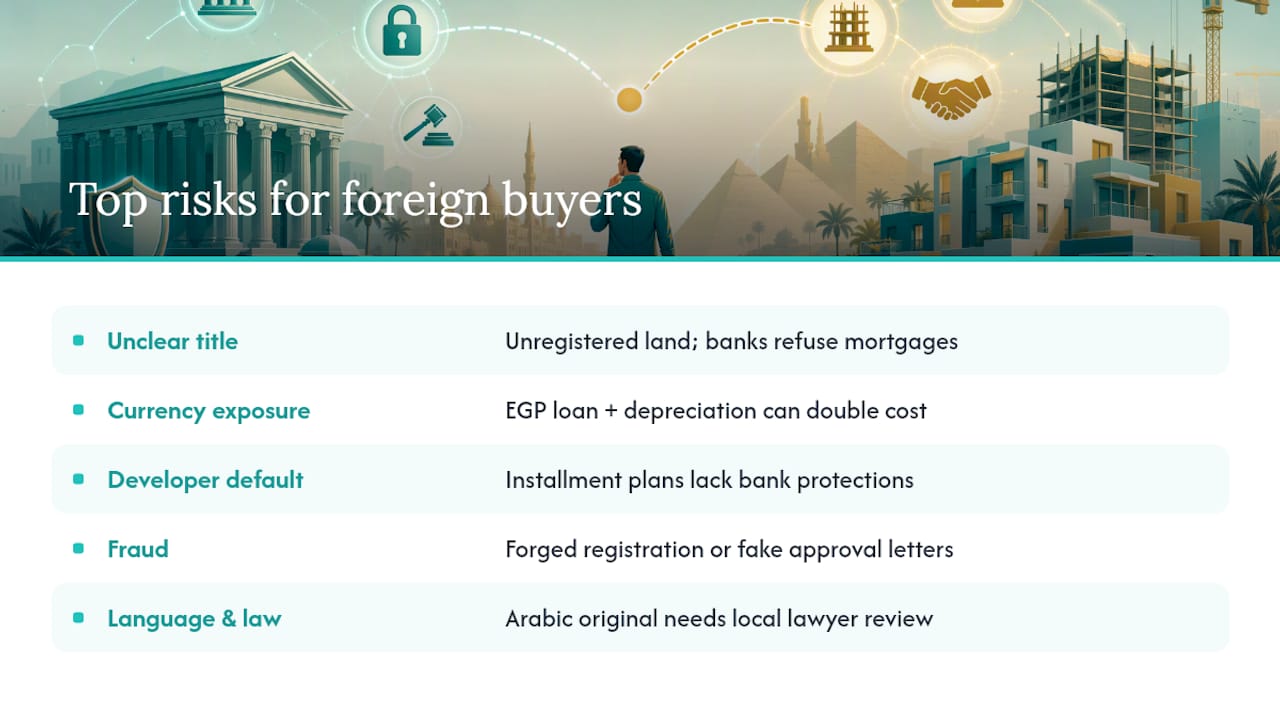
Unclear title is the top legal risk. Some units marketed heavily to foreign buyers sit on land with unresolved registration, meaning no bank will touch them regardless of your income or residency status. Confirm registration through official channels before any money changes hands.
Currency exposure is the top financial risk. An EGP-denominated mortgage at 18% to 26% interest, paired with further currency depreciation, can quietly double your effective cost over the loan term. Buyers who assumed a fixed monthly payment often find themselves recalculating within the first year.
Developer default is a real, if less discussed, risk with installment plans. Because these plans run outside the banking system, protections are weaker if a developer runs into financial trouble mid-project. Escrow arrangements reduce this risk but don't eliminate it entirely.
Watch too for outright fraud, including forged registration documents or fake bank approval letters used to pressure a faster deposit. This guide to mortgage fraud red flags covers warning signs worth knowing before you sign anything, and they apply just as much to Egypt's market as anywhere else.
Language and legal complexity compound all of the above. Contracts are often drafted in Arabic first, with English versions sometimes losing precision in translation. A local lawyer reviewing the Arabic original, not just the English summary, is worth the fee every time.
PADSABROAD's Take on What Actually Trips Up Foreign Buyers
The gap between what gets marketed and what a bank will actually finance is wider than most first-time buyers expect. We regularly see off-plan units sold with polished renderings and confident sales pitches, only for the project's registration to turn out incomplete or the bank approval to have lapsed months earlier. It's rarely dishonesty. It's more often a developer moving faster than the paperwork.
That's why we run the same checks on every project we recommend: confirmed developer track record, verified land registration, and transparent escrow or accounting practices for buyer payments. None of that shows up in a brochure, and none of it is optional if you want financing to actually go through later.
If you're weighing a bank mortgage against a developer plan, do the mortgageability check before you reserve anything, not after. A five-minute registration search saves months of frustration compared to discovering the problem once you're already committed.
— PADSABROAD
How PADSABROAD Helps You Navigate Financing and Purchase
Real estate specialists work the Red Sea and North Coast markets daily, providing information on projects that clear bank approval and those that are developer-finance only. They assist with property discovery, mortgageability checks before deposits, and negotiation support once a unit is found.

Whether you're chasing a bank mortgage, weighing a developer installment plan, or just trying to figure out which route fits your residency status, reach out before you sign anything. Our first-time buyer guide to Red Sea property investment walks through exactly what to check at each stage, and it's the resource we point most new clients to first. Get in touch through our Hurghada real estate page to start the conversation with someone who can look at your specific situation.
Where to Verify These Rules Yourself
- Realestate: official mortgage calculators and registration checks
- AMF foreign-national guidance: specialist expat mortgage documentation
- CIB Egypt mortgage page: example bank product terms and fees
- PADSABROAD's buying guide: full purchase process for foreign buyers
This article is general information, not a substitute for advice from a qualified financial advisor. Consult a qualified financial professional about your own circumstances before acting on anything here.
Sources
- Mortgage — CIB Egypt
- Realestate
- Egypt - Property Financing - Expat Focus
- AMF — Foreign national mortgage guidance