
Foreigners can buy residential property in Egypt, and the process is more accessible than many buyers expect. Egyptian Law No. 230/1996 sets the framework: non-Egyptians may own a limited number of residential properties with area restrictions, though agricultural land and properties near military or border zones remain off-limits. The key is knowing the rules before you transfer a single dollar.
Your first steps, in order:
- Hire an independent bilingual lawyer (Arabic/English) before signing anything. Avoid lawyers recommended by the developer or agent.
- Request the title documents — specifically the Tabu (registered deed) or Green Contract — and verify them through the Real Estate Publicity Department.
- Plan your bank transfer carefully. A March 2024 circular requires purchase funds to be transferred from abroad in foreign currency to an authorized Egyptian bank. Keep your SWIFT receipts.
- Arrange an on-site inspection or a verified video walkthrough before committing to any deposit.
- Check the GOV.UK guidance for British nationals, and consult the official Egyptian real estate platform for government-issued process guides.
- Browse verified listings through Padsabroad for Red Sea properties with documented ownership and developer credentials.
Table of Contents
- Where do foreign buyers look in Egypt right now?
- Can foreigners legally own property in Egypt?
- How does the buying process work, step by step?
- What does it actually cost to buy in Egypt?
- How do foreigners typically finance an Egyptian property purchase?
- What are the biggest risks, and how do you check them?
- When should you work with a specialist agent?
- Key Takeaways
- Our perspective on buying property in Egypt as a foreigner
- Ready to find your property on Egypt's Red Sea coast?
- Useful sources and documents to request
Where do foreign buyers look in Egypt right now?
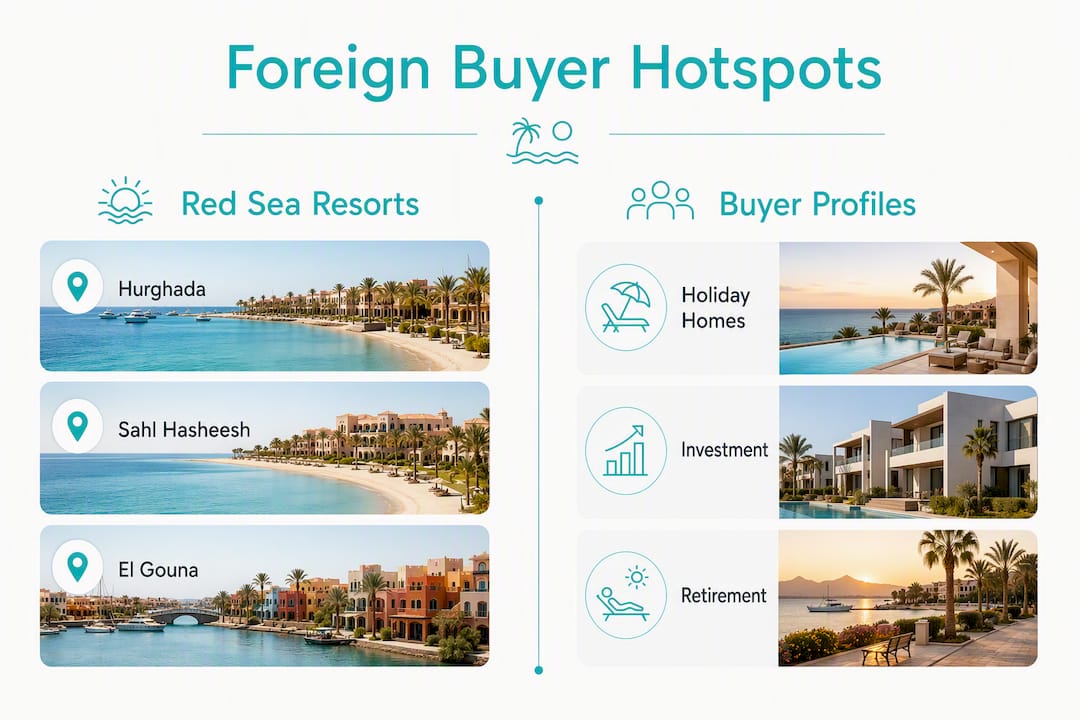
Egypt's property market draws international buyers for a clear reason: hard-currency prices remain low compared to comparable Mediterranean or Gulf destinations, and the Red Sea coast in particular offers strong rental demand from tourism. The market broadly splits into three buyer types: those seeking a holiday home or retirement base on the Red Sea, those chasing capital growth in Cairo's new urban developments, and investors targeting short-term rental income in resort areas.
| Location | Typical Buyer Profile | What to Expect |
|---|---|---|
| Hurghada / Sahl Hasheesh / El Gouna | Holiday home, retirement, rental income | Established resale market, strong rental demand, resort-managed compounds |
| Soma Bay / Marsa Alam / Port Ghalib | Lifestyle buyers, quieter resort living | Lower entry prices, growing infrastructure, less liquid resale |
| North Coast (Ras El Hekma, Sidi Abdel Rahman) | Summer holiday, Egyptian diaspora, speculative | Seasonal demand, off-plan dominant, limited year-round rental |
| New Cairo / 5th Settlement | Long-term investors, expat residents | Established compound living, EGP-denominated pricing, less foreign buyer activity |
| New Administrative Capital / New Alamein | Speculative investors | Off-plan heavy, longer timelines, higher developer risk |
The Red Sea resorts, particularly Hurghada and Sahl Hasheesh, represent the most active market for foreign buyers. Padsabroad's listings cover this corridor in detail, from affordable apartments to gated resort villas. When checking any advertised listing, ask the agent to show you the title document preview, the developer's registration number, and whether an escrow account exists for off-plan payments. Those three checks alone will filter out the majority of problematic listings.
Can foreigners legally own property in Egypt?
Yes, with conditions. Law No. 230/1996 is the governing statute for foreign residential ownership, and it has remained the foundation of the legal framework for nearly three decades. Here is what it means in practice:
What foreigners can own:
- Up to two residential properties in Egypt
- Combined area typically capped at 4,000 m²
- Freehold title in most urban and resort areas
What foreigners cannot own:
- Agricultural land
- Properties in Sinai (with limited exceptions for Egyptian-majority joint ventures)
- Land near military installations or designated border zones
- Properties where the seller holds an unregistered or disputed title
Ownership types matter. A fully registered title deed (Tabu) is the strongest form of ownership and the one that holds up cleanest in court. In resort areas, many transactions use a Green Contract or municipal certificate instead. These are widely accepted in practice and commonly used in Hurghada and Sahl Hasheesh, but they carry different legal weight from a Tabu. In resort markets, buyers should understand exactly which document they are receiving and what it means for future resale or mortgage use.
Residency and visa implications are a separate matter entirely. GOV.UK guidance is direct on this point: owning property in Egypt does not automatically entitle you to residency. Egyptian authorities can refuse or revoke permits at their discretion. Investment thresholds have been used by authorities in connection with renewable residency permits, but these are not guaranteed pathways. Confirm current visa rules with the Egyptian consulate or an immigration lawyer before treating a property purchase as a residency strategy.
US citizens are treated identically to other foreign nationals under Egyptian property law. US-specific considerations relate mainly to tax reporting obligations back home, including FATCA and FBAR requirements for foreign bank accounts and rental income.
How does the buying process work, step by step?
The full process from property search to completed registration typically takes several months, depending largely on the project's registration status and administrative procedures. Here is the standard sequence:
- Property search and shortlisting. Use verified listing portals and specialist brokers. Request title document previews before visiting.
- Reservation and deposit. Pay a reservation fee (typically a small fixed amount or 5%–10% of the purchase price) to take the property off the market. Get this in writing with a receipt.
- Legal due diligence (3–14 days). Your independent lawyer checks the chain of title, building permits, outstanding liens, and utility clearances. Do not skip this step or compress the timeline.
- Preliminary contract (Compromis de Vente or equivalent). A bilingual contract signed by both parties, setting out the full price, payment schedule, and conditions. Your lawyer drafts or reviews this.
- Fund transfer. Transfer purchase funds from your overseas bank account to an authorized Egyptian bank in foreign currency. Retain all SWIFT documentation.
- Notary authentication. Both parties (or their Power of Attorney holders) appear before a notary. A sworn translator must be present if you do not read Arabic. The notary authenticates the sale deed.
- Handover. Physical possession of the property, with a snagging inspection and utility meter readings recorded.
- Registration at the Real Estate Publicity Office (2–10 months). The final registered title (Tabu) is issued here. Timeline varies significantly based on whether the developer's master title is already registered.
Remote buyers: If you cannot attend in person, you will need a properly apostilled and translated Power of Attorney. This document must be checked by your independent lawyer to confirm it contains the exact authorities needed for sale completion and registration. Do not use a generic POA template from the internet.
Pro Tip: Never pay the full purchase price up front for an off-plan property. Structure payments in stages tied to verified construction milestones, and retain a final installment until the project reaches practical completion and handover.
For a deeper walkthrough of this process, Padsabroad's step-by-step guide for foreign buyers covers each stage with document checklists.
What does it actually cost to buy in Egypt?
Beyond the headline purchase price, buyers should budget for a range of transaction costs. Practical estimates put buyer-side closing costs at roughly 2%–6% of the purchase price, and round-trip transaction costs (buying and eventually reselling) at approximately 9%–14% of property value.
| Fee Category | Typical Range | Who Pays |
|---|---|---|
| Real estate transaction levy | 2%–6% of purchase price | Negotiable (often buyer) |
| Notary / authentication fees | — | Buyer |
| Registration fees | Variable by property value | Buyer |
| Stamp duty | Nominal | Buyer |
| Independent lawyer fees | Negotiable flat fee or % | Buyer |
| Agent commission | Typically 2%–3% | Buyer or seller (negotiable) |
| Developer handover charges | Varies by project | Buyer |
Ongoing costs to factor in:
- Annual property tax is calculated on the rental value of the property after allowable deductions, not on the capital value. Rates are generally low by international standards.
- Service charges and maintenance fees apply in gated compounds and resort developments. These vary widely by project and management company.
- Utility connection and transfer fees apply at handover.
Warning: Always verify final fee amounts with your local lawyer and accountant before signing any contract. Fee structures in Egypt can shift, and some developers or agents bundle costs in ways that obscure the true total. The Egypt Real Estate Investment Checklist from Padsabroad is a useful budgeting reference.
How do foreigners typically finance an Egyptian property purchase?
Cash from abroad is by far the most common payment method for foreign buyers, and for good reason: mortgages from Egyptian banks are rarely available to non-residents, and when they are, they typically require higher down payments, strict collateral terms, and come with interest rates that make them unattractive compared to developer financing.

| Payment Method | Available to Foreigners? | Typical Down Payment | Key Considerations |
|---|---|---|---|
| Cash (foreign currency transfer) | Yes | — | Most common; requires SWIFT documentation for registration |
| Developer instalment plan | Yes (most developers) | 5%–10% | Tied to project; check resale restrictions and completion risk |
| Egyptian bank mortgage | Rarely | 3–10 years | High rates, strict eligibility, limited non-resident access |
| Company / corporate structure | Yes (for larger portfolios) | Varies | Legal complexity; requires specialist advice |
Developer instalment plans are the practical alternative to cash for buyers who do not want to commit the full amount upfront. Plans typically run for 3–10 years depending on the developer and project stage. Read the terms carefully: some developer loans restrict your ability to resell before the loan is repaid, and others tie you to the developer's own management company for rentals.
The currency transfer requirement is non-negotiable. Funds must arrive in Egypt from an overseas account in foreign currency, transferred to an authorized Egyptian bank. Your notary will likely ask for SWIFT receipts when authenticating the sale deed. For practical guidance on opening a bank account in Egypt to facilitate this, Padsabroad has a dedicated resource. US buyers should also be aware of FATCA and FBAR reporting obligations for any foreign accounts opened during the process.
What are the biggest risks, and how do you check them?
Egypt's property market carries real risks for foreign buyers, and most of them are avoidable with the right checks. Real estate agents and developers in Egypt are not regulated the way they are in the UK or US, which means the burden of verification falls almost entirely on the buyer and their lawyer.
Top risk categories:
- Unregistered title (urfi deals). Some sellers hold informal contracts rather than a registered Tabu. These are legally weak and can be challenged.
- Building permit violations. Unauthorized construction is common in some areas. A property with permit violations can be subject to demolition orders or fines.
- Unpaid utility bills or tax liens. These transfer with the property if not cleared before sale.
- Developer insolvency or project delays. Off-plan buyers in new cities face the highest exposure here.
- Restricted locations. Sinai and military zone properties carry title and transferability risks that standard due diligence may not catch without specialist local knowledge.
Your due-diligence checklist:
- Request the Tabu or Green Contract and verify it against the Real Estate Publicity Department's records.
- Ask your lawyer to obtain a title-chain extract showing all previous ownership transfers.
- Confirm the developer's registration number and check for any pending court cases.
- Obtain utility clearance receipts and proof of paid property taxes from the seller.
- Check for any bank mortgage or encumbrance registered against the property.
- For off-plan: confirm an escrow account exists and that your payments go into it, not directly to the developer's operating account.
Red flags that should stop the process:
- The seller cannot produce a registered title or refuses to allow your lawyer to verify it independently.
- The developer has unresolved court cases or cannot show a valid construction permit.
- The agent pressures you to pay in cash or outside normal banking channels.
- No escrow arrangement exists for an off-plan project.
Pro Tip: All payments should go through banking channels only. Retain every SWIFT receipt and a notarized copy of your contract. You will need these documents for registration and for any future resale.
For a structured checklist of trust checks for overseas buyers, Padsabroad has published a dedicated guide.

When should you work with a specialist agent?
A specialist agent adds the most value in two situations: when you are buying remotely and cannot visit multiple times, and when you are purchasing off-plan from a developer you cannot independently verify. For straightforward resale purchases where you are on the ground and have your own lawyer, a good agent is still useful but less critical.
What a qualified specialist agent should provide:
- A curated shortlist of properties that match your budget, location preference, and ownership-type requirements
- Verified walkthroughs (video or in-person) with documented ownership evidence
- Introductions to independent local lawyers and notaries (not their own recommended list)
- Coordination of the negotiation, contract review, and payment schedule
- After-sales support including property management if you are not living in Egypt year-round
Questions to ask any agent before engaging:
- How long have you operated in this specific region?
- Can you provide references from foreign buyers who have completed purchases?
- Do you have an on-site office and local staff in the area?
- How do you verify title and developer credentials independently?
- Do you receive referral fees from developers, and if so, how do you disclose them?
The last question matters more than most buyers realize. An agent who exclusively recommends developer-managed projects without disclosing a referral arrangement is not acting in your interest. A good agent will be transparent about their fee structure from the first conversation.
Pro Tip: Even if you use a specialist agent, always hire your own independent bilingual lawyer. The agent's job is to find and facilitate; the lawyer's job is to protect you. These are not interchangeable roles.
Padsabroad operates with on-the-ground presence across the Red Sea coast, covering Hurghada, El Gouna, Sahl Hasheesh, Soma Bay, Marsa Alam, and Port Ghalib, as well as the North Coast. Services include property discovery, verified listings, legal introductions, escrow and payment guidance, and after-sales property management for international buyers.
Key Takeaways
Foreigners can buy residential property in Egypt under Law No. 230/1996, but safe completion requires independent legal verification, proper bank transfers, and a clear understanding of which ownership document you are receiving.
| Point | Details |
|---|---|
| Ownership is permitted but capped | Foreigners may own up to two residential properties with a combined area limit of 4,000 m². |
| Title type determines your security | A registered Tabu is the strongest title; a Green Contract is common in resorts but carries different legal weight. |
| SWIFT receipts are mandatory | Funds must transfer from abroad in foreign currency; keep all bank documentation for notary and registration. |
| Budget 2%–6% above the sale price | Closing costs typically add this percentage on top; if budgeting for an eventual sale and repurchase, allow for round-trip transaction costs of approximately 9%–14% of property value. |
| Padsabroad for verified Red Sea listings | Padsabroad provides verified listings, legal introductions, and buyer support across Hurghada, El Gouna, and Sahl Hasheesh. |
Our perspective on buying property in Egypt as a foreigner
The single biggest mistake foreign buyers make in Egypt is treating the purchase like a transaction in their home country. They find a property they like, they trust the agent's recommendation for a lawyer, and they move fast because they are worried about losing the deal. That combination is exactly how buyers end up holding an unregistered contract on a property with a disputed title.
The good news is that Egypt's property market genuinely rewards buyers who do the work. The legal framework under Law No. 230/1996 is clear. The documentation requirements are specific and checkable. And the Red Sea coast, in particular, offers a combination of hard-currency pricing, established rental demand, and resort infrastructure that is difficult to find elsewhere at comparable price points.
What the market does not offer is the regulatory safety net that buyers from the UK, US, or EU are accustomed to. There is no equivalent of the Property Ombudsman or a state-backed title insurance system. That gap is real, and it means the quality of your independent lawyer and the thoroughness of your title checks are not optional extras. They are the entire foundation of a safe purchase.
Buyers who approach Egypt with that mindset, who verify before they pay and use banking channels for every transfer, consistently report straightforward experiences. Those who skip steps because the agent seemed trustworthy or the price was too good to wait on are the ones who end up in disputes.
Ready to find your property on Egypt's Red Sea coast?
Padsabroad is a UK and Egypt based overseas property specialist with on-the-ground presence across Hurghada, El Gouna, Sahl Hasheesh, Soma Bay, Marsa Alam, and the North Coast. For international buyers who want verified listings, transparent pricing, and a guided path through the legal and payment process, Padsabroad offers a concrete alternative to navigating the market alone.

The service covers property search by budget and location, verified ownership documentation, introductions to independent bilingual lawyers, escrow and payment guidance, and after-sales property management. Whether you are a first-time buyer or adding to an existing portfolio, the starting point is the same: browse the current inventory and get a clear picture of what is available at your budget.
- Browse Red Sea apartments and villas across all price points
- Start with the first-time buyer guide for a structured introduction to the Red Sea market
- Request a verified video walkthrough or book a consultation through padsabroad.info
Useful sources and documents to request
Documents to ask for at every stage:
- Tabu (registered title deed) or Green Contract / municipal certificate, verified against Real Estate Publicity Department records
- Developer registration certificate and valid construction permit
- Title-chain extract from the Real Estate Publicity Department showing all prior ownership transfers
- Utility clearance certificates confirming no outstanding water, electricity, or gas bills
- Property tax payment receipts from the seller covering recent years
- SWIFT transfer receipts and bank statements confirming foreign-currency transfer to an authorized Egyptian bank
- Notary-authenticated contract copies (bilingual Arabic/English)
- Power of Attorney (apostilled and translated) if signing remotely
Who issues each document:
| Document | Issuing Authority |
|---|---|
| Tabu / registered title deed | Real Estate Publicity Department (Shar al-Aqari) |
| Developer registration | New Urban Communities Authority or relevant governorate |
| Construction permit | Local municipality |
| Utility clearance | EGPC / local utility provider |
| Property tax receipts | Egyptian Tax Authority (incometax.gov.eg) |
Recommended reading:
- GOV.UK: Buying Property in Egypt — practical guidance for British nationals, including legal checks and agent warnings
- Official Egyptian Real Estate Platform Blog — government-issued step-by-step guide for foreign buyers
- GOV.UK: List of Lawyers in Egypt — vetted list of English-speaking lawyers for independent legal advice
- Padsabroad: Buy Property in Egypt Safely — trust checks and verified listings for overseas buyers
- How to buy a house in Spain — useful process comparison for buyers considering multiple overseas markets
This article is general information, not legal or financial advice. Confirm current rules, fees, and eligibility requirements with a qualified Egyptian lawyer and your own financial advisor before transferring funds or signing any contract.