
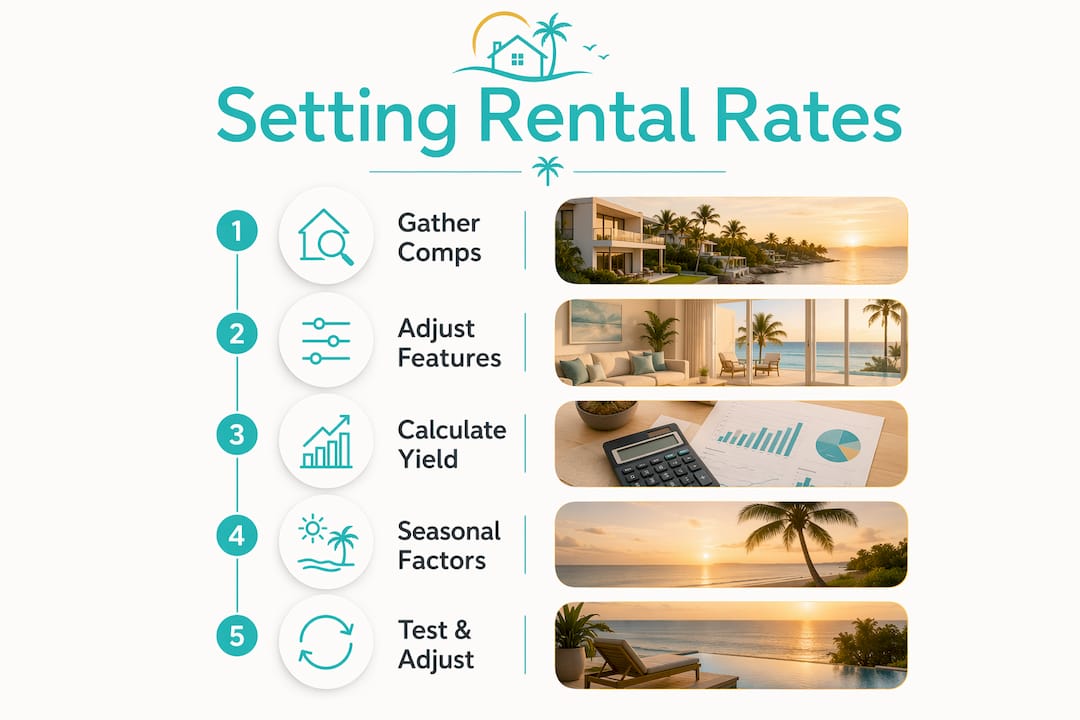
Start with a realistic mid-point from achieved rents in your district over the last 3–6 months, not asking prices. That single rule is the foundation of every effective pricing decision for Red Sea property. To set rental rates for your Red Sea property, pull 5–7 comparable listings from platforms like Airbnb, Booking.com, VRBO, and Padsabroad's local listings, calculate your net yield floor, then launch at 5–10% below the top of your district range to build bookings and reviews before adjusting upward.
Key starting actions:
- Choose your rental model first: short-term nightly or long-term monthly.
- Collect comps from the last 3–6 months in the same district and unit type.
- Price at the mid-point of achieved rents, not the ceiling.
- Apply a first-month promotional rate of 5–10% below the top of range to build momentum, then adjust based on demand signals.
- Verify the rate clears your net yield floor after management fees, cleaning, vacancy, and taxes.
Pro Tip: Overpricing is the single most common reason listings sit empty. A unit priced 15% above district comps will often sit vacant longer than the premium is worth.
Table of Contents
- Should you rent short-term or long-term on the Red Sea?
- Where to find reliable comparable rents for Red Sea properties
- How to calculate your target rate with a worked yield example
- How seasonality and location affect what you can charge
- How to test your pricing and know when to adjust
- What to ask a local property manager before signing anything
- Legal and tax checklist for U.S. owners of Egyptian rental property
- Sample pricing worksheet you can use right now
- Key Takeaways
- Why achieved rents matter more than asking prices
- Padsabroad can help you price and set up your Red Sea rental
- Useful sources and next reading
Should you rent short-term or long-term on the Red Sea?
The answer shapes every pricing and cost assumption you make. Short-term (nightly) rentals suit seafront and resort-grade units in tourist corridors like Sahl Hasheesh, El Gouna, and Hurghada Marina, where holiday home demand is strong and nightly rates can reach multiples of a long-term monthly equivalent. Long-term monthly leases work better for residential units in El Kawther, El Ahyaa, or Dahar, where tenant demand is steadier and turnover costs are lower.
Operational tradeoffs that affect net yield:
- Short-term: Platform commissions of 15–20% on Airbnb and Booking.com, cleaning fees per turnover, higher management intensity, but peak-season nightly rates that can significantly lift gross income.
- Long-term: Management fees of 8–12% of monthly rent, minimal cleaning costs, lower vacancy risk, but a fixed monthly ceiling with limited upside.
Pro Tip: If your unit is in a resort compound with a pool and sea view, short-term almost always wins on gross yield. If it's a standard apartment in a residential district, long-term gives you more predictable cash flow with less operational overhead.
Where to find reliable comparable rents for Red Sea properties
Comps are only useful when they reflect what tenants actually paid, not what landlords hoped to receive. Use these sources, filtered to the last 3–6 months:
- Padsabroad listings and buyer guides: District-level achieved rents and local property examples for Hurghada, Sahl Hasheesh, and El Gouna.
- Airbnb and Booking.com: Filter by your district, bedroom count, and unit type. Check calendar availability to infer occupancy.
- VRBO: Useful for larger units and family-oriented resort properties.
- FlatSwipe: A local Egyptian rental portal with Hurghada-specific listings and landlord guides.
Practical sourcing checklist:
- Collect 5–7 comps that match your district, bedroom count, and furnishing level.
- Record listing type (nightly vs. monthly), any visible booking dates, and whether promotions or bundled services are included.
- Exclude introductory developer pricing and listings that have been active for more than 90 days without updates.
Pro Tip: A practical comps process requires 3–5 close matches with systematic adjustments for features like in-unit laundry, parking, and updated kitchens. Prefer booked or archived listings over active ones when you can access them.

How to calculate your target rate with a worked yield example
Use this formula chain: Projected gross revenue → subtract platform fees, management, cleaning, utilities, maintenance reserve, and vacancy → Net Operating Income (NOI) → Net yield = NOI ÷ purchase price.
Red Sea gross rental yields typically sit between 7–12% depending on location, furnishing level, and occupancy. Your net yield will be lower after costs.
Benchmark: Red Sea gross yields generally range from 7–12% depending on area and specifics, but net yield after realistic costs is typically lower depending on your rental model and management structure.
Worked example: 1-bedroom in Sahl Hasheesh (short-term)
| Line Item | Assumption | Amount (USD) |
|---|---|---|
| Purchase price | unknown | |
| Nightly rate (peak) | moderate rate | |
| Nightly rate (off-peak) | lower rate | |
| Occupancy (blended annual) | typical for market | |
| Gross annual revenue | estimated | |
| Platform fees | Airbnb/Booking | estimated |
| Management fees | Short-term rate | estimated |
| Cleaning & utilities | Per turnover | estimated |
| Maintenance reserve | Annual | estimated |
| Vacancy reserve | estimated | |
| Net Operating Income | estimated | |
| Net yield | NOI ÷ purchase price | estimated |
Substitute your own numbers into this structure. If the net yield falls below your floor, either the purchase price is too high or the rental model needs to change.
Note: In expensive coastal markets, the 1% monthly rent rule often falls to 0.5–0.7%. Treat it as a sanity check, not a target.
How seasonality and location affect what you can charge
Red Sea demand follows a clear seasonal pattern. High season runs roughly October through April, when European visitors and Gulf nationals drive strong occupancy. May through September is quieter, with heat reducing short-term demand significantly.
Pricing strategy by season:
- October–April (high season): Price to demand. This is when short-term nightly rates justify the turnover costs.
- May–September (low season): Offer mid-term discounts (weekly or monthly rates) or switch to a short-term long-stay model to maintain occupancy. Pricing year-round to peak-season rates is the fastest way to increase vacancy and reduce annualized returns.
Location premiums to factor in:
- Seafront/resort compound: Add 20–35% above the district median for direct sea access, private beach, or pool.
- Walking distance to promenade or marina: Add 10–15%.
- Residential district (El Kawther, El Ahyaa): Price at or slightly below the district median unless the unit has standout features.
Fully furnished, western-ready units consistently rent faster and command higher nightly ceilings than partial or dated units. Budget for quality furnishing before listing. For investors thinking about value-add improvements, increasing a property's appeal before listing directly affects both rental velocity and achievable rate.
How to test your pricing and know when to adjust
The 30-day time-to-lease benchmark is your primary signal. For short-term rentals, aim to fill your first booking within 7–14 days of listing. For long-term, target a signed lease within 30 days.
Adjustment triggers:
- Fewer than 3 inquiries in the first 7–14 days: Reduce by 3–5% and relist.
- Multiple immediate bookings or 50+ inquiries: Raise by 5–10% at the next available gap.
- Consistent 30-day gaps between bookings: Review your minimum-stay rules and consider shorter minimums or last-minute discounts.
Dynamic tactics for short-term listings:
- Set a 3-night minimum during high season, 1–2 nights during low season.
- Offer a 10–15% discount for weekly stays and 20–25% for monthly stays to reduce turnover costs.
- Use last-minute pricing (drop 10–15% for stays within 72 hours) to fill gaps.
Pro Tip: Check platform metrics weekly for the first month after listing. Track time-to-book, conversion rate, and effective nightly income after fees. Monthly reviews are sufficient after that.
What to ask a local property manager before signing anything
A good local manager protects your yield. A poor one quietly erodes it. Before committing, get answers to these questions:
- Which platforms do you list on, and do you manage Airbnb, Booking.com, and VRBO simultaneously?
- Who sets and approves rate changes, and how often are they reviewed?
- What is your reporting cadence, and will I receive monthly P&L statements?
- How do you handle maintenance issues, and what is the expense cap before you need my approval?
- Can you share a sample P&L from a comparable unit you currently manage?
Typical fee structures:
- Short-term management: 15–25% of gross rental income, plus separate cleaning and maintenance pass-throughs.
- Long-term management: 8–12% of monthly rent, often with a one-month setup fee.
Red flags to watch for:
- Refuses to share booking data or occupancy reports.
- Insists on unilateral rate control with no approval process.
- Pushes large up-front marketing packages without documented past performance.
- Cannot provide references from current overseas clients.
Legal and tax checklist for U.S. owners of Egyptian rental property
This is a high-level overview only. Always get country-specific legal and tax advice before listing your property.
Key items to verify with qualified professionals:
- Title clarity: Confirm the property title is clean and registered correctly under Egyptian law. Padsabroad's legal guide for foreign buyers is a useful starting point.
- Rental licensing: Short-term lettings in some Egyptian resort developments require registration or a tourism license. Confirm requirements with a local lawyer.
- VAT and tourist taxes: Egypt applies VAT to certain commercial rental activities. Verify whether your rental structure triggers a collection obligation.
- U.S. tax reporting: Foreign rental income must be reported on your U.S. tax return. A U.S. CPA experienced in foreign property income can help you claim applicable foreign tax credits and structure income efficiently.
- Currency and repatriation: Rental income collected in Egyptian pounds (EGP) may be subject to exchange controls. Pricing in USD or EUR for international guests can simplify repatriation, though local banking arrangements will still apply.
Sample pricing worksheet you can use right now
Copy this structure into a spreadsheet before you list. Fill in your own numbers where the example values appear.
What to gather before you start:
- 5–7 district comps (unit type, bedroom count, achieved rent, furnishing level)
- Your unit's floor area and photos
- Expected furnishing standard (basic, standard, western-ready)
- Estimated management fee quotes from at least two local managers
Sample comp table (1BR, Sahl Hasheesh, short-term):
| Comp | District | Bedrooms | Nightly Rate | Occupancy Est. | Furnishing | Notes |
|---|---|---|---|---|---|---|
| Comp 1 | Sahl Hasheesh | 1BR | — | — | Western-ready | Sea view |
| Comp 2 | Sahl Hasheesh | 1BR | — | ~50% | Standard | Pool access |
| Comp 3 | Sahl Hasheesh | 1BR | — | — | Western-ready | Beachfront |
| Comp 4 | Sahl Hasheesh | 1BR | — | — | Basic | No sea view |
| Your unit | Sahl Hasheesh | 1BR | $72 (mid-point) | — | Western-ready | Starting rate |
Run the gross-to-net yield calculation from Section 4 against your starting rate. If the net yield clears your floor, list at that price. If not, revisit the purchase price assumption or switch rental models.
Key Takeaways
Anchoring your Red Sea rental rate to achieved district comps from the last 3–6 months, then verifying it clears your net yield floor, is the most reliable way to reach occupancy and income targets.
| Point | Details |
|---|---|
| Use achieved rents, not asking prices | Pull 5–7 comps from Airbnb, Booking.com, VRBO, and Padsabroad listings filtered to the last 3–6 months. |
| Calculate net yield before committing | Subtract management fees, cleaning, vacancy, and taxes from gross revenue; Red Sea gross yields typically range from 7–12%. |
| Match rental model to unit type | Short-term suits seafront/resort units; long-term suits residential districts like El Kawther or El Ahyaa. |
| Use the 30-day benchmark | If no bookings or lease within 30 days, reduce price by 3–5% and relist promptly. |
| Padsabroad for district comps | Contact Padsabroad for local achieved-rent data, vetted manager introductions, and purchase-to-rental support. |
Why achieved rents matter more than asking prices
The most common mistake overseas investors make is pricing to what they see listed, not what tenants actually paid. Asking prices on any platform carry developer optimism, seasonal wishful thinking, and listings that have sat unsold for months. Achieved rents strip all of that out.
Padsabroad's listings footprint across Hurghada, El Gouna, Sahl Hasheesh, and other Red Sea locations gives buyers access to ground-level data that reflects real tenant willingness to pay. That distinction matters practically: an investor who prices to a stale asking price risks sitting vacant through an entire high season, while one anchored to achieved rents fills the unit and starts compounding returns immediately.
[Insert proprietary sales data and client testimonials here.] [Insert author credentials or team expertise details here.]
Padsabroad can help you price and set up your Red Sea rental
Knowing the right rate is one thing. Having local support to implement it is another. Padsabroad gives overseas buyers direct access to district-level comp data, vetted local property manager introductions, and managed listing setup across Hurghada, Sahl Hasheesh, El Gouna, Soma Bay, Marsa Alam, and Port Ghalib.

For U.S.-based buyers, Padsabroad also provides currency guidance, local contracting support, and post-sale rental setup so you're not navigating Egyptian market logistics alone. Whether you're still evaluating a purchase or ready to list, the first-time buyer guide is the right place to start. To browse available inventory and build your comp baseline, view all Red Sea properties currently listed. Contact Padsabroad directly for a pricing consultation tailored to your district and unit type.
Useful sources and next reading
- FlatSwipe Hurghada Landlord Guide: Practical rental advice for Egyptian properties, including the 5–10% introductory pricing rule.
- RedSeaListings Investment Guide: Yield benchmarks, furnishing standards, and area-specific data for the Red Sea market.
- CapRateCity Pricing Framework: The 30-day time-to-lease benchmark and adjustment triggers.
- HonestCasa Comps Guide: Step-by-step comp adjustments for features and condition.
- Rentlane Expense Floor Guide: Floor calculation methodology and the 1% rule reality check.
- Padsabroad District Listings: Local achieved-rent data, buyer guides, and property management introductions.
Recommended professionals to engage before listing:
- A licensed Egyptian real estate lawyer for title and rental licensing confirmation.
- A U.S. CPA with foreign property income experience for tax reporting and foreign tax credit planning.
- A vetted local property manager sourced through Padsabroad for on-the-ground rate setting and guest management.
For district-specific comps and a manager introduction, contact Padsabroad directly.