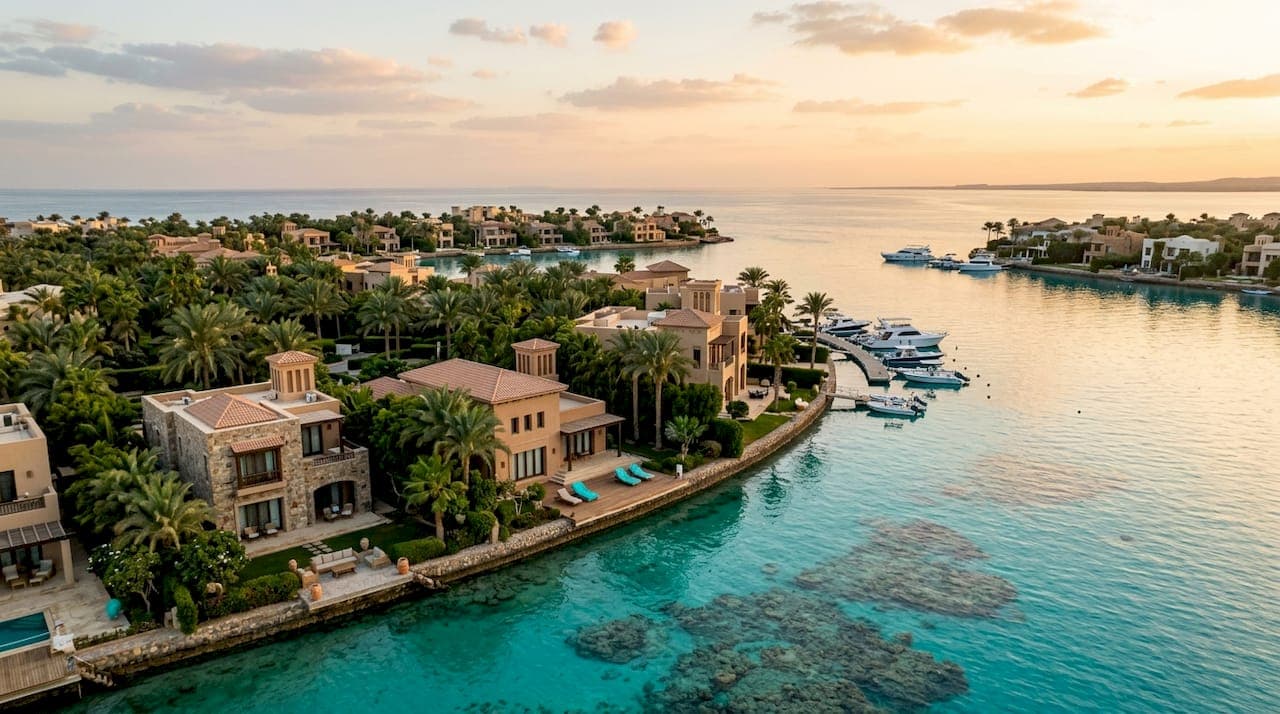
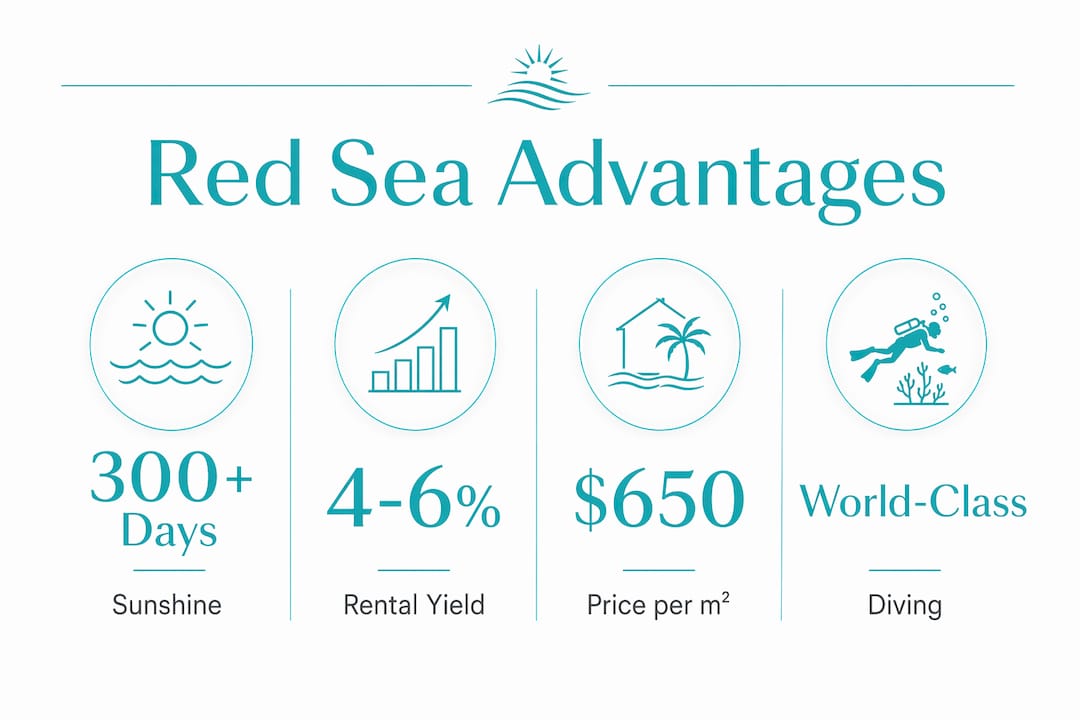
Red Sea holiday homes are popular because they combine abundant sunshine with some of the world's most accessible coral reef diving, property prices well below Mediterranean alternatives, and strong rental yields in prime locations. For buyers and investors looking at 2026, the region offers something genuinely rare: a coastal lifestyle that is affordable, secure, and backed by growing infrastructure.
Here is a quick summary of what makes Red Sea holiday homes stand out:
- Natural beauty: Crystal-clear water, coral reefs, and dramatic desert scenery
- Climate: Warm and sunny year-round, with mild winters averaging 22–26°C
- Affordability: Property prices range from $650 to $2,500 per square meter depending on location and amenity level
- Rental income: Well-located properties with sea views generate rental yields of 8–12%.
- Security: Gated compounds with private security and low crime rates appeal to families and retirees
- Community: Expats from Europe and the Middle East have built vibrant, multicultural communities
- Incentives: Developers offer interest-free installment plans, and Egypt allows foreign property ownership
The top resort areas drawing buyers right now include El Gouna, Sahl Hasheesh, Hurghada, Makadi Bay, and Soma Bay, each with its own character and price point. Saudi Arabia's Red Sea Project adds another dimension, with luxury resorts like Six Senses Southern Dunes, The St. Regis Red Sea Resort, and Ritz-Carlton Reserve setting a new benchmark for the region.
Top Red Sea resorts to buy a holiday home in 2026
The Red Sea coast stretches across hundreds of kilometers, and not every location suits every buyer. These are the areas drawing the most serious interest from international buyers and investors right now.
El Gouna
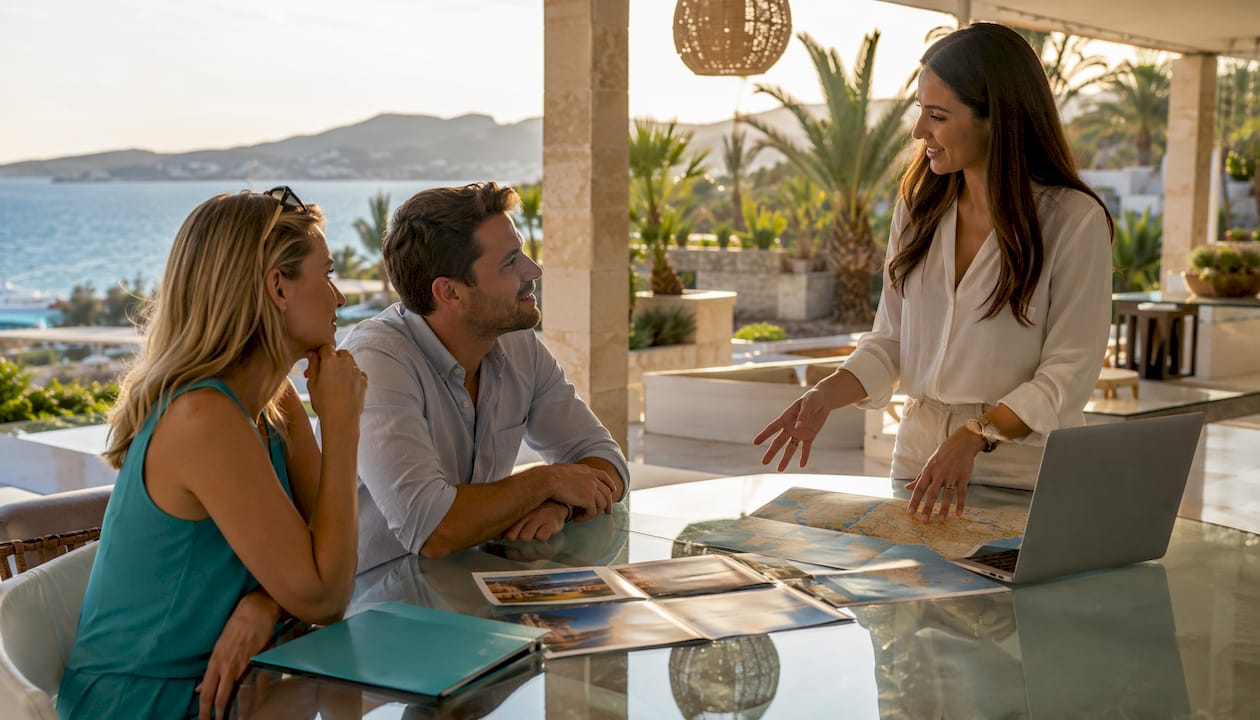
El Gouna is the most self-contained resort town on Egypt's Red Sea coast. Built on a series of islands and lagoons about 25 kilometers north of Hurghada, it has its own hospital, international schools, a marina, golf courses, and an airport shuttle. The property market here skews toward villas and townhouses with lagoon or sea views, and prices reflect that premium positioning. Rental demand is consistent year-round, driven by European visitors, long-stay expats, and remote workers who appreciate the town's walkability and services.
Sahl Hasheesh
Sahl Hasheesh is a master-planned luxury resort about 18 kilometers south of central Hurghada. It has private beaches, high-end hotels, and exclusive residential compounds set along one of the longest natural bays on the Egyptian coast. Prices typically run $1,800–$2,500 per square meter, and occupancy rates average above 75%. The atmosphere is quieter and more resort-like than Hurghada proper, which attracts buyers who want a premium setting without the city noise.
Pro Tip: If sea views are a priority, Sahl Hasheesh offers some of the best unobstructed waterfront positions on the Egyptian coast. Properties with direct sea views command both higher rental rates and stronger resale values.
Hurghada
Hurghada is the most established and accessible city on Egypt's Red Sea coast. It has a large international airport with direct flights from most major European cities, a broad range of property types across all price points, and one of Egypt's largest expat communities. Families from Germany, the UK, Russia, and the Netherlands have settled here, creating a genuinely multicultural environment. Property prices in central locations start from $650 per square meter, making it the most accessible entry point on the coast.
Makadi Bay
Makadi Bay sits about 30 kilometers south of Hurghada and offers a more relaxed, family-oriented setting. Developments here tend to be newer, with good beach access and resort-style amenities at prices below Sahl Hasheesh. Many developments offer 5–7 year interest-free payment plans, which makes Makadi Bay a practical choice for first-time buyers or those who want a vacation home without a large upfront commitment.
Soma Bay
Soma Bay is a peninsula resort about 45 kilometers south of Hurghada, known for its world-class kitesurfing, diving, and an 18-hole championship golf course. The buyer profile here leans toward sports enthusiasts and active retirees. The peninsula setting gives it a distinct sense of seclusion, and the quality of the beach and water is consistently rated among the best on the Egyptian coast.
Six Senses Southern Dunes, The St. Regis Red Sea Resort, and Ritz-Carlton Reserve
These three properties represent the top tier of the Red Sea region's luxury offering, located within Saudi Arabia's Red Sea Project. Six Senses Southern Dunes, The St. Regis Red Sea Resort, and Ritz-Carlton Reserve each integrate sustainability practices into their operations while delivering international-grade luxury. Their presence signals the region's ambition to compete with the Maldives and Seychelles for high-net-worth travelers and property buyers.
Key reasons tourists and investors choose Red Sea properties
The demand for Red Sea vacation rentals and holiday homes is not driven by one factor alone. It is the combination of climate, lifestyle, infrastructure, and financial returns that keeps pulling buyers back.
Natural beauty and water quality
The Red Sea contains some of the world's most biodiverse coral reef systems, with visibility in the water regularly exceeding 30 meters. Snorkeling and diving are accessible directly from many resort beaches, not just from boats. The surrounding landscape of desert mountains and turquoise water creates a visual contrast that is genuinely striking. For buyers, this natural setting is not just a lifestyle perk. Properties with unobstructed sea views command rental and resale premiums that meaningfully affect investment returns.
Year-round climate
The Red Sea coast gets over 300 days of sunshine per year, which turns it from a seasonal destination into a year-round market. Winter temperatures stay mild, rarely dropping below 20°C, while summer heat is moderated by sea breezes. This climate profile matters for rental income because it eliminates the low-season vacancy problem that affects Mediterranean properties. A well-managed Red Sea holiday home can generate bookings in January just as reliably as in July.
Recreational activities
Popular activities in the Red Sea area range from world-class scuba diving and snorkeling to kitesurfing, golf, desert safaris, and glass-bottom boat tours. El Gouna and Soma Bay both have championship golf courses. Hurghada's Mamsha promenade offers waterfront dining and nightlife. The diversity of activities means the region attracts a wide range of visitor types, from families and retirees to adventure travelers and digital nomads, which broadens the potential rental audience for property owners.
Rental market strength
- Rental yields of 8–12% are achievable on well-located properties with sea views.
- Net yields exceeding 10% are possible in active markets during peak demand periods driven by events and winter tourism.
- Occupancy rates for well-managed properties in Sahl Hasheesh and Hurghada average above 75%
- Homes with kitchens, privacy, and workspace attract longer-stay guests who prefer holiday homes to hotels, which boosts rental income and reduces turnover costs
Infrastructure and accessibility
Modern infrastructure across the Red Sea region now includes international airports, private hospitals, international schools, and well-maintained road networks. Hurghada International Airport receives direct flights from London, Berlin, Amsterdam, Warsaw, and Moscow, with flight times from Central Europe averaging 4–5 hours. This connectivity makes the Red Sea practical for part-time residents and holiday homeowners who need to travel back and forth regularly.
Statistic: Properties in prime Red Sea areas like Sahl Hasheesh and El Gouna have seen consistent price appreciation, with annual rental yields of 8–12% reported across well-managed vacation rentals.
Affordability compared to other coastal markets
Holiday home prices in Hurghada are significantly lower than comparable destinations in Spain, Greece, or Croatia. The cost of living follows the same pattern, with dining, groceries, and services all considerably cheaper than Western Europe. For buyers coming from the US, UK, or Europe, the currency advantage amplifies purchasing power further. A two-bedroom apartment that would cost several times more on the Spanish coast is accessible at a fraction of that price here.
Safety and security
The Red Sea region is known for its secure gated compounds, low crime rates, and family-friendly residential developments. Developments like El Gouna and Sahl Hasheesh have private security, gated access, and on-site services. It is common to see children playing outside and people walking at night, which reflects the genuine community feel that attracts families and retirees looking for a safe environment.
How luxury and regenerative tourism are shaping the Red Sea
The Red Sea region is not just growing. It is growing in a specific direction: toward high-end, sustainability-focused development that protects the natural environment while delivering premium lifestyle experiences.
Saudi Arabia's Red Sea Project is the clearest example of this approach. The project's regenerative tourism strategy focuses on preserving natural coral reefs while promoting luxury tourism that benefits local communities. The goal is not just to attract visitors but to leave the environment in better condition than it was found.
The luxury resorts anchoring this vision include:
- Six Senses Southern Dunes: Integrates wellness programming with desert landscape architecture and sustainability practices
- The St. Regis Red Sea Resort: Delivers international five-star service within an environmentally conscious development framework
- Ritz-Carlton Reserve: Positions itself as an ultra-luxury retreat that uses the natural Red Sea setting as its primary asset
For property buyers, these developments matter beyond their headline appeal. Their presence raises the profile of the entire region, attracts high-net-worth visitors, and sets a quality benchmark that lifts values across nearby residential projects.
On the Egyptian side of the Red Sea, similar principles are shaping newer developments. Developers in Sahl Hasheesh and El Gouna are increasingly incorporating green building standards, solar energy systems, and water conservation measures into residential projects. This is partly driven by buyer demand from European purchasers who expect sustainability credentials, and partly by Egypt's own tourism development goals.
Pro Tip: When evaluating a Red Sea property for investment, check whether the development sits within or adjacent to a luxury resort zone. Proximity to branded five-star hotels consistently supports higher short-term rental rates and stronger resale demand.
What real estate experts say about the Red Sea market
The investment case for Red Sea holiday homes is backed by specific, practical advice from people who operate in this market daily.
Ahmed Elbatrawy, a well-known Red Sea property specialist, offers a clear framework for maximizing rental returns:
This insight aligns with a broader trend in the Red Sea rental market: guests who stay for a week or longer actively seek out holiday homes over hotel rooms because they want the flexibility of a kitchen, the privacy of their own space, and the ability to work remotely without paying hotel business-center rates.
Industry analysts also point to infrastructure as a key driver of year-round demand. International-grade schools and hospitals in Hurghada and El Gouna attract expat families who sustain rental demand during the off-season months when purely tourist-driven markets go quiet. This expat layer is what separates the Red Sea from purely seasonal beach destinations.
Pro Tip: Obtaining a holiday home license in Egypt legitimizes your rental operation and gives you access to official tourism platforms. This differentiates your property from unlicensed listings and can meaningfully improve occupancy rates.
The price premium for sea views is another factor analysts consistently highlight. Properties with unobstructed direct sea views outperform equivalent units with less favorable positions, both in rental rates and resale value. For investors focused on returns, beachfront and sea-view properties are not just a lifestyle upgrade. They are a financially distinct asset class within the same resort.
Government policies and incentives for holiday home buyers
Egypt has put real effort into making foreign property ownership straightforward and financially accessible. The legal framework allows non-Egyptian nationals to purchase property in most Red Sea resort areas, and the process is well-established enough that international buyers have been completing transactions here for decades.
Several specific incentives make the buying process more accessible:
- Interest-free installment plans: Developers across Hurghada, Makadi Bay, and Sahl Hasheesh offer 3–7 year payment plans with no interest, which reduces the upfront capital required significantly
- Foreign ownership rights: Egypt permits foreigners to own property outright in designated tourist and resort zones, with title deeds issued in the buyer's name
- Holiday home licensing: The Egyptian government has established a licensing framework for short-term rentals that legitimizes operations and provides access to official tourism booking channels
- Tourism investment support: Egypt's broader tourism development strategy includes ongoing infrastructure investment along the Red Sea coast, which directly supports property values and rental demand
For buyers coming from the US or Europe, the currency dynamic also works in their favor. Purchasing in Egyptian pounds while earning rental income in euros or dollars creates a natural hedge against local currency fluctuation. Many developers price their properties in US dollars or euros for international buyers, which simplifies the transaction further.
Understanding the legal framework for foreign buyers is the most important step before committing to a purchase. Egypt's property laws are buyer-friendly in resort zones, but the specifics of title registration, ownership structures, and rental licensing vary by location and development type.
How the Red Sea compares to other holiday home destinations
The Red Sea's advantages over Mediterranean and Gulf alternatives come down to three things: price, climate consistency, and rental yield potential.
Price: Property in Hurghada starts from $650 per square meter. Comparable coastal properties in Spain, Greece, or Croatia cost considerably more, often three to five times higher for similar amenity levels. Even within the Middle East, the Red Sea undercuts Dubai and Abu Dhabi by a wide margin.
Climate consistency: The Mediterranean has a genuine low season. Winters in Spain and Greece are mild by northern European standards, but they are cool enough to suppress tourism and rental demand from October through March. The Red Sea does not have this problem. Its year-round warmth keeps tourist arrivals and rental bookings steady across all twelve months, which is the single biggest structural advantage for rental income investors.
Rental yields: Mediterranean holiday homes typically generate gross yields in the 4–6% range in established markets. Red Sea properties in well-managed locations with sea views can reach 8–12%, a gap that compounds meaningfully over a five to ten year holding period.
Lifestyle offer: The Red Sea's diving and water sports scene is genuinely world-class in a way that most Mediterranean destinations cannot match. The coral reef systems here are among the most biodiverse on the planet, and the water clarity is exceptional. For buyers who plan to use their property personally, this matters as much as the financial case.
The Gulf markets offer luxury and infrastructure, but at price points that eliminate the affordability advantage entirely. Dubai property prices have risen sharply, and the cost of living removes the budget appeal that makes the Red Sea attractive to a broad international buyer base.
For buyers considering holiday home investment options across multiple markets, the Red Sea's combination of low entry cost, high yield potential, and year-round demand makes it one of the most compelling coastal markets available to international buyers in 2026.
Key Takeaways
Red Sea holiday homes are popular in 2026 because they deliver year-round rental income, affordable entry prices, and a lifestyle that Mediterranean alternatives cannot match at the same cost.
| Point | Details |
|---|---|
| Year-round climate advantage | Abundant annual sunshine helps eliminate the low-season vacancy problem common in Mediterranean markets. |
| Strong rental yields | Well-located sea-view properties generate strong rental yields, outperforming many European coastal markets. |
| Affordable entry prices | Property prices are significantly below comparable Mediterranean destinations. |
| Buyer-friendly incentives | Developers offer 3–7 year interest-free payment plans, and Egypt allows full foreign property ownership in resort zones. |
| Padsabroad expertise | Padsabroad specializes in helping international buyers find and purchase Red Sea holiday homes in Hurghada, El Gouna, Sahl Hasheesh, and Soma Bay. |
The Red Sea is still underpriced for what it delivers
The conventional wisdom on emerging property markets is to wait until the infrastructure catches up before buying. The Red Sea has already crossed that threshold. Hurghada has an international airport, private hospitals, international schools, and a decades-old expat community. El Gouna has its own utilities, medical center, and golf courses. Sahl Hasheesh has gated compounds with occupancy rates above 75%. The infrastructure argument for waiting no longer holds.
What the Red Sea still has, which most established coastal markets have lost, is price. A buyer who purchases in Sahl Hasheesh or El Gouna today is entering a market that has the lifestyle credentials of a mature destination but the pricing of an emerging one. That window does not stay open indefinitely. As Saudi Arabia's Red Sea Project raises the region's international profile and more European buyers discover the Egyptian coast, the gap between Red Sea prices and Mediterranean equivalents will narrow.
The buyers who will look back most satisfied are the ones who acted while the entry cost was still low, the rental yields were still high, and the competition for the best sea-view units was still manageable. The Red Sea is not a speculative bet. It is a market with real demand, real infrastructure, and real returns. The question is not whether to consider it. It is how soon.
Find your Red Sea holiday home with Padsabroad
Padsabroad is a UK and Egypt-based overseas property company focused entirely on helping international buyers purchase and invest in Red Sea coastal properties. The concrete advantage over searching independently is direct access to vetted listings in Hurghada, El Gouna, Sahl Hasheesh, Soma Bay, Marsa Alam, and Port Ghalib, combined with on-the-ground expertise that covers legal title checks, developer due diligence, and rental management options.
For buyers coming from the US or Europe, the process of buying in Egypt raises practical questions: which developments have clean title deeds, which areas deliver the strongest rental returns, and how do interest-free payment plans actually work in practice. Padsabroad handles all of that, so buyers can focus on choosing the right property rather than navigating unfamiliar paperwork.
The first-time buyer guide on the Padsabroad website walks through every stage of the purchase process, from initial search to title registration. If you are ready to take the next step, browse current listings or get in touch with the Padsabroad team directly to discuss your budget, preferred location, and investment goals.