
Notarisation is a notary public's official verification that a signature, an identity, or a document copy is genuine. For anyone buying property abroad, this one step usually decides whether a Power of Attorney, an ID copy, or a signed deed will be accepted by a foreign land registry, bank, or lawyer.
Three documents come up again and again in overseas property deals:
- A Power of Attorney (POA), letting a local representative sign on your behalf when you cannot travel
- A certified copy of your ID or passport, used to open bank accounts or register title
- A deed or sale contract signed outside the destination country
Notarisation alone rarely finishes the job. Most foreign registries also want an apostille or consular legalisation stamped on top before they will recognize the document as valid.
Key Takeaways
Notarisation verifies that a signature, identity, or copy is genuine, but overseas property documents almost always need an apostille or consular legalisation on top of it to hold legal weight abroad.
| Point | Details |
|---|---|
| Notarisation is step one, not the finish line | A notarised POA or deed usually still needs an apostille or consular legalisation before a foreign registry will accept it. |
| POA wording must be exact | List the specific acts authorized, such as signing a named deed or registering title at a specific registry, to avoid rejection. |
| Hague status determines your path | Hague Convention countries need an apostille only; non-Hague countries require a final consular stamp at the destination embassy. |
| Engage a lawyer before drafting | Getting destination-lawyer approval on wording before notarisation prevents the weeks-long delay of re-executing rejected documents. |
| Padsabroad supports the paperwork sequence | Padsabroad offers buyer guides, POA guidance, and legal introductions to help buyers get documents accepted on the first attempt. |
Table of Contents
- What Does Notarisation Mean for Property Abroad Buyers?
- Notarisation vs Apostille vs Consular Legalisation: Which Do You Need?
- How to Get Property Documents Notarised and Accepted Abroad
- Common Pitfalls That Get Property Documents Rejected
- Questions to Ask Your Overseas Lawyer or Notary Before Notarisation
- What Notarisation Means for Legal Validity and Enforceability
- How Notarisation Interacts With Local Property Registration Rules
- Padsabroad's Perspective: Why Early Legal and Notarial Engagement Matters
- How Padsabroad Helps You Get Documents Right the First Time
- Sources
What Does Notarisation Mean for Property Abroad Buyers?
A notary's job is narrower than most buyers assume, and understanding exactly what it covers saves a lot of confusion later. The notary checks your identity against official ID, watches you sign the document in person, and then certifies that the signature is yours and that any attached copy matches the original. That is the entire scope of the act.
For property specifically, this matters because notarisation services typically cover three things buyers actually need:
- Certified true copies of a passport or national ID, used to satisfy a foreign bank's or registry's identification rules
- Witnessed signatures on a POA, sale contract, or mortgage document signed outside the property's home country
- Certification of understanding, confirming the signatory read and understood what they signed
Civil-law countries (most of continental Europe, much of the Middle East and North Africa) tend to give notaries a formal, almost judicial role in property transfers. Common-law countries (the UK, US, most of the Commonwealth) treat the notary as more of a signature witness. That difference is why a notarised document that works fine at home can still get rejected abroad: the receiving registry expects a level of formality your local notary never had to meet.
Notarisation alone is not enough once a document crosses a border. It proves the signature is real, but it does nothing to prove the notary who signed off is legitimate to a foreign official who has never heard of them. That gap is exactly what apostilles and consular legalisation exist to close.
Notarisation vs Apostille vs Consular Legalisation: Which Do You Need?
Here's the simplest way to think about it: notarisation proves your signature is genuine, an apostille proves your notary's authority is genuine, and consular legalisation proves both to a country that does not recognize apostilles at all.
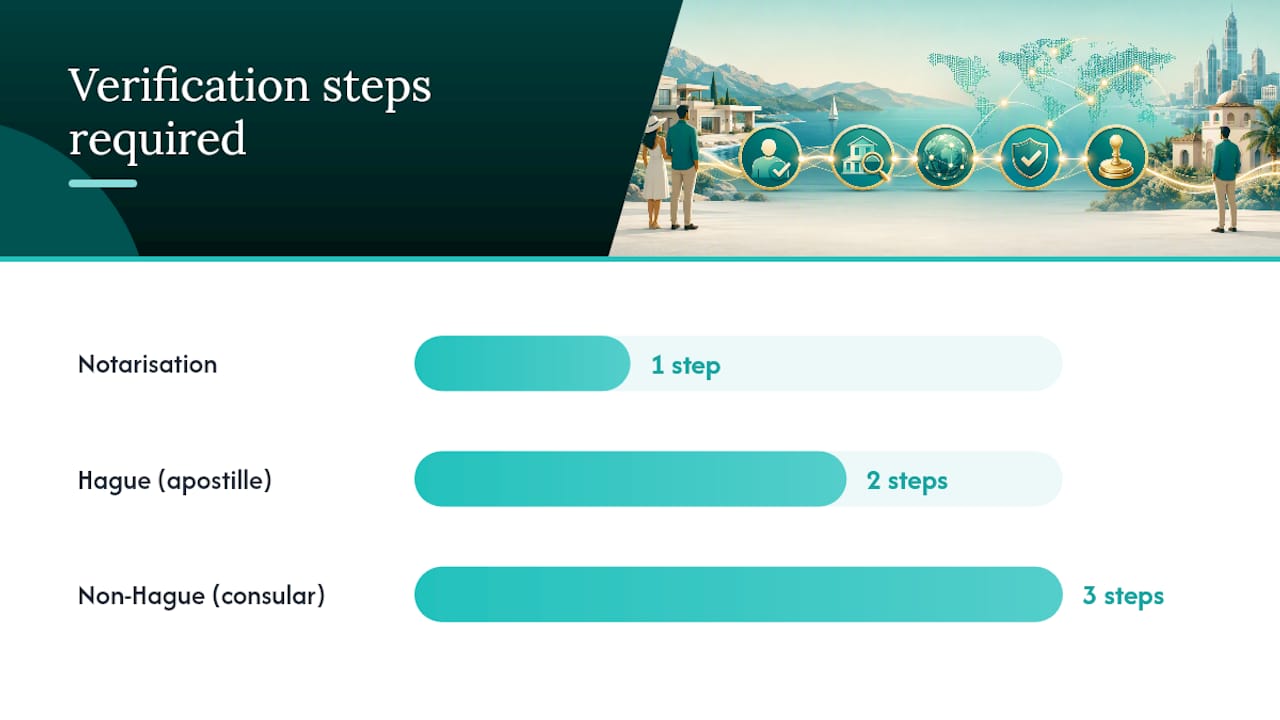
Legalisation is a multi-stage verification process that follows notarisation, and which stage you land on depends entirely on the destination country's treaty status.
- Hague Apostille Convention member countries (over 125 states, including most of the EU, the UK, and the US) accept a single apostille certificate issued by a designated authority, usually a foreign office or court, with no embassy visit required
- Non-Hague countries require the extra step of consular legalisation: the destination country's embassy or consulate physically stamps the document after the apostille (or in place of it) before it holds any legal weight locally
A notarised POA for a French apartment purchase, for instance, typically just needs an apostille from the relevant French authority once notarised at home. A POA destined for a non-Hague jurisdiction in the Middle East follows a longer chain: notarisation, then apostille, then a final stamp from that country's embassy or consulate.
Rule of thumb: if the destination country is on the Hague member list, plan for notarisation plus apostille. If it is not, budget extra time and expect to visit or courier documents to the destination's embassy for the final consular stamp. Skipping that last stamp is one of the most common reasons buyers end up re-doing paperwork weeks into a transaction.
How to Get Property Documents Notarised and Accepted Abroad
Getting a document from your kitchen table to a foreign land registry is a sequence, not a single appointment, and skipping a step almost always means starting over.
- Contact an overseas lawyer or notary first, before drafting anything. They know exactly what wording the destination registry requires and can flag problems before you ever sit down with a notary.
- Draft the POA or contract and send it for approval. Have the destination lawyer review the wording before you notarise it. Revisions after notarisation mean repeating the whole process.
- Book a notary appointment and bring valid photo ID, the approved draft, and any witnesses the destination country requires.
- Sign in front of the notary, who verifies your identity, witnesses the signature, and certifies any copies.
- Apply for an apostille through the correct issuing authority, typically a foreign office, court, or state department, depending on where you live.
- Arrange consular legalisation if the destination country is not a Hague signatory. Book an embassy appointment early since processing windows can run several weeks.
- Get certified translations if the destination requires the document in a different language. Confirm whether the translator needs to be officially accredited in that country, not just fluent.
- Send the finished package to your local representative or lawyer, allowing enough time before any signing deadline on the property side.
Pro Tip: Ask your destination lawyer for a sample POA they've had accepted before. Working from a document that has already cleared the local registry is far faster than drafting from a generic template and hoping it fits.
Common Pitfalls That Get Property Documents Rejected
Most rejections trace back to the same handful of avoidable mistakes, and each one is fixable if you catch it before the notary appointment.
- Vague POA wording. A POA that says "manage my property affairs" gets rejected. Precise language listing exact acts, such as signing a specific deed of sale or registering title at a named registry, gets accepted.
- Missing apostille or consular stamp. Confirm with the destination registry or lawyer exactly which stamps they require before you notarise anything, not after.
- Translation and certified copy errors. Some countries only accept translations from court-accredited translators. A fluent but uncertified translation can be rejected outright.
- Wrong signatories or witnesses. Some jurisdictions require two witnesses in addition to the notary; showing up without them means rescheduling.
Pro Tip: Loop in the destination notary or conveyancer while you're still drafting the POA, not after it's notarised. They will tell you the exact phrasing their registry expects, and that single conversation can save weeks of back-and-forth.
Questions to Ask Your Overseas Lawyer or Notary Before Notarisation
A short call before you book anything can save an entire month of rework. Bring these questions:
- Does this specific document need an apostille, consular legalisation, or both?
- What exact wording must the POA include, and which acts does it need to authorize by name?
- Are certified translations required, and does the translator need specific accreditation?
- Who must physically sign and witness the document, and can they do it in one appointment?
- What is the realistic timeline, including embassy processing, and what should the total cost run?
Getting straight answers here, before you draft anything, is the single best predictor of whether your documents clear on the first attempt.
What Notarisation Means for Legal Validity and Enforceability
A notarised, properly legalised document is not just a formality. It is often the difference between a property transaction that a foreign court will actually enforce and one that collapses the moment it is challenged.
When a POA or deed lacks proper notarisation and legalisation, a foreign registry, bank, or court can simply refuse to recognize it. That is not a minor administrative hiccup. It can mean a sale falls through at the final stage, a bank account cannot be opened to receive funds, or a title transfer never registers, leaving the buyer holding a contract with no legal standing in the country where the property actually sits.
The enforceability question also cuts the other way. A buyer who granted a representative broad, poorly worded POA powers may find that document gets used well beyond what they intended, because the document itself is what a foreign court reads, not the buyer's private understanding of it. Precise drafting protects the buyer as much as it protects the transaction.
In civil-law jurisdictions, notaries often function as quasi-judicial officers whose acts carry direct legal weight, which is why a correctly notarised and apostilled document is routinely accepted without further dispute. That legal weight is exactly why cutting corners on notarisation, however small the shortcut feels at the time, carries outsized consequences later.
How Notarisation Interacts With Local Property Registration Rules
Every country's land registry has its own list of acceptable documents, and notarisation is usually the entry ticket rather than the whole requirement. A registry official checking a foreign buyer's paperwork is looking for a specific chain: a notarised document, the correct authentication (apostille or consular stamp), and often a certified translation into the local language, all bundled together in a form the registry's own rules recognize.
This is where buyers most often underestimate the process. A POA notarised perfectly under your home country's rules can still be rejected at the destination registry if the format, wording, or authorization chain does not match local expectations. Some registries require the notary's seal to appear on every page. Others require the apostille to reference the specific document by title. These details rarely show up in generic guides, which is exactly why involving the destination lawyer early, before drafting, catches problems a template never would.
Registration timelines also depend on this chain being complete. A registry will typically not begin processing a title transfer until every authentication step is verified, so a missing consular stamp does not just delay the paperwork. It stops the property registration itself from moving forward, which can hold up fund transfers, mortgage releases, and closing dates that depend on that registration completing on schedule.
Padsabroad's Perspective: Why Early Legal and Notarial Engagement Matters
We see the same pattern repeatedly: buyers who bring in a notary or destination lawyer only after a document gets rejected lose weeks re-drafting and re-executing paperwork that could have been right the first time. Buyers who engage early, before drafting a POA or signing anything, tend to close faster and with far fewer surprises.
Padsabroad works with buyers on exactly this timeline. That means guidance on POA wording, introductions to local legal contacts, and a buyer's guide to the property agent's role in coordinating these documents with the seller's side. Getting the paperwork sequence right at the start is the single biggest lever a buyer has over how smoothly a purchase closes.
How Padsabroad Helps You Get Documents Right the First Time
Padsabroad exists for exactly the moment this article describes: the point where a buyer has a property they want and a stack of paperwork standing between them and closing. Rather than leaving you to figure out POA wording, apostille requirements, and translation rules on your own, Padsabroad connects buyers with the practical support that keeps a purchase moving.

That support includes buyer guides written specifically for overseas purchasers, help thinking through POA wording before you approach a notary, introductions to legal contacts familiar with local registration requirements, and a document check before you send anything for apostille or consular legalisation. If you are early in the process, the first-time buyer guide to Red Sea property investment walks through exactly where notarisation fits into the wider purchase timeline. If you already have a property in mind and want to make sure your paperwork holds up, the guide to buying property safely is the next page to read, and reaching out through Padsabroad's contact page is the fastest way to get specific answers before you book a notary appointment.
Sources
- Phelan Solicitors: Notary for international property purchase
- ARG Notary: Notarisation, apostille or legalisation — what do you actually need?
- Notary Public London: Notarisation services
This article is general information, not a substitute for advice from a qualified lawyer. Consult a qualified legal professional about your own circumstances before acting on anything here.