
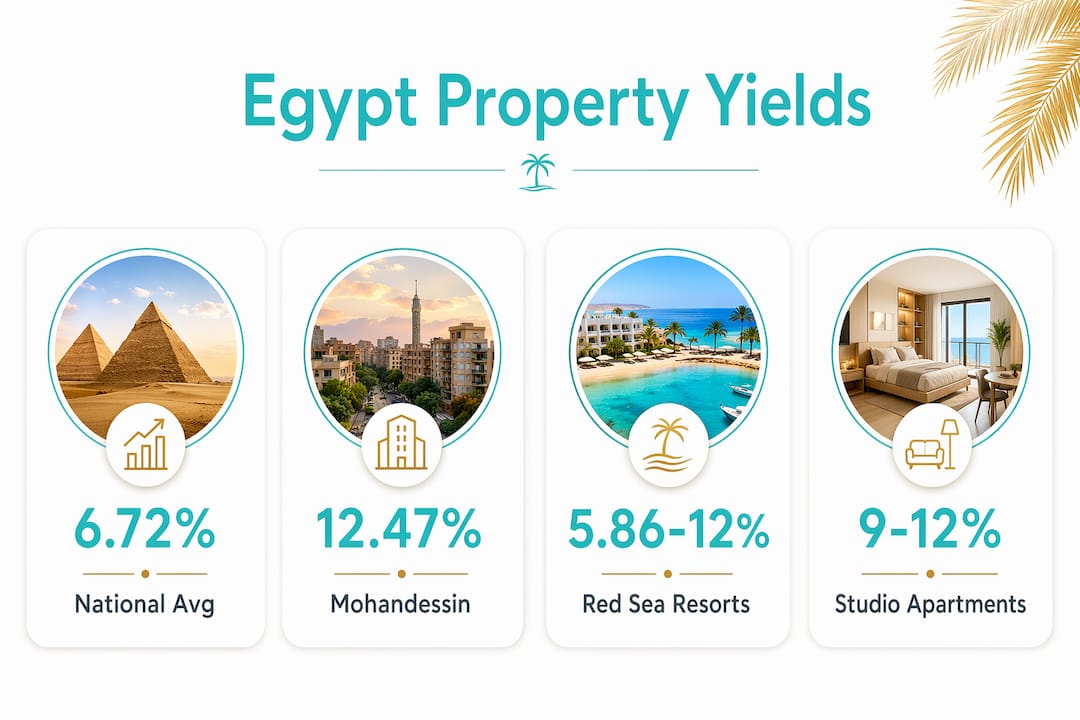
Egypt's real estate market delivers some of the highest rental yields in the Middle East and North Africa, with Cairo averaging 8.3% gross and select neighborhoods like Mohandessin reaching 12.47% gross yield in Q4 2025. That figure puts Egypt well above most European and Gulf markets. The reasons why Egypt property yields attractive to international investors come down to three converging forces: structural housing demand from a fast-growing population, a macroeconomic environment that pushes savings into real estate, and a Red Sea tourism corridor that generates short-term rental income year-round. Understanding each factor helps you decide where and how to invest.
Why are egypt property yields attractive compared to other markets?
Egypt's gross rental yield of 6.72% nationally is not an accident. It reflects a market where property prices remain relatively low compared to rental demand, creating a favorable price-to-rent ratio that investors in London or Dubai rarely see. The national average yield of 6.72% in Q4 2025 means that for every $100,000 invested, you can expect roughly $6,720 in annual gross rental income before costs.
Gross yield is defined as annual rental income divided by the purchase price, expressed as a percentage. Net yield goes further by subtracting operating costs such as maintenance, service charges, and vacancy losses. Both figures matter, but net yield is the number that actually reaches your bank account.
Egypt stands out because its entry prices are low relative to rental rates. A two-bedroom apartment in Hurghada that costs $60,000 to purchase can rent for $500–$700 per month to a long-term tenant, producing gross yields well above the national average. That gap between purchase price and rental income is what makes Egypt real estate investment compelling for buyers coming from higher-cost markets.

How do regional differences affect property yields in egypt?
Egypt's yields vary significantly by location, and the Red Sea region tells a different story than Cairo's urban core.
Cairo neighborhoods: high yields in dense urban areas
Cairo's residential market produces some of the strongest gross yields in the country. Mohandessin reaches up to 12.47%, while the city average sits at 8.3%. Neighborhoods like Nasr City and Maadi attract a mix of Egyptian professionals and expats, keeping vacancy low and rents competitive. Zamalek, known for its diplomatic and expat tenant base, records occupancy rates near 95%, which translates directly into yield stability even when purchase prices are higher.
Red sea region: tourism drives a different yield model
The Red Sea corridor, covering Hurghada, El Gouna, Sahl Hasheesh, Soma Bay, Marsa Alam, and Port Ghalib, operates on a tourism-driven rental model. Hurghada gross yields range from 5.86% to 12%, with the upper end achievable through short-term holiday lets during peak season. That range is wide because occupancy rates vary sharply depending on property quality, management, and platform visibility.
Short-term holiday rentals on platforms like Airbnb and Booking.com can push yields toward the 10–12% range in prime Red Sea resorts. Long-term rentals to expats or Egyptian residents produce more predictable income in the 6–8% range. The key variables are:
- Occupancy rate: A resort apartment sitting empty for three months loses significant yield.
- Management quality: Professional property management in Hurghada typically costs 15–20% of rental income but protects occupancy.
- Property type: Beachfront units and those inside managed resort compounds consistently outperform standalone apartments.
For a detailed look at why Hurghada attracts foreign buyers at this scale, the demand drivers go beyond yield alone.
What is the difference between gross and net yield in egypt?
Net yield is more useful than gross yield because it accounts for realistic costs, vacancy losses, and maintenance. This distinction is critical in Egypt, where the gap between gross and net can be substantial.
Gross yields reduce by 1.5–2.4 percentage points when you factor in service charges, maintenance, and management fees. A property advertising a 10% gross yield may deliver only 7.6–8.5% net. In newer gated compounds along the Red Sea, annual service charges can run $800–$2,000 per unit. Older urban buildings in Cairo carry lower service charges but often require more frequent maintenance spending.
To calculate net yield accurately, use this approach:
- Start with annual gross rental income.
- Subtract annual service charges and compound fees.
- Subtract estimated maintenance (typically 1–2% of property value per year).
- Subtract management fees if using a property manager.
- Subtract an estimate for vacancy (even 2–4 weeks per year matters).
- Divide the result by the purchase price and multiply by 100.
Pro Tip: Always request the last 12 months of service charge statements before purchasing in a gated compound. Charges can increase annually and are rarely negotiable after purchase.
Calculating net yield in Egypt also requires factoring in renovation costs for older buildings, which can add $5,000–$15,000 to your initial outlay and reduce effective yield in the first year.
Why is egypt's macroeconomic environment favorable for investment in 2026?
Egypt's macroeconomic conditions create a structural case for real estate that goes beyond rental income alone.
"Real estate acts as a favored inflation hedge in Egypt, protecting local savings against currency depreciation, which sustains demand meaningfully." — Sands of Wealth, 2026
Four macroeconomic factors reinforce Egypt's appeal as a property investment destination in 2026:
- Currency volatility: Egypt's pound has experienced significant devaluation over the past decade. Foreign buyers purchasing in dollars or euros effectively acquire assets at a discount relative to local replacement costs, while rental income in local currency tracks inflation upward.
- Inflation hedge: Egypt's inflation and currency volatility drive Egyptians and foreign investors alike to hold real estate as a store of value. This structural demand keeps prices resilient even during economic uncertainty.
- Interest rate easing: Interest rate cuts in 2026 are expected to make developer installment plans more attractive, lowering the effective cost of entry for buyers who purchase off-plan or through phased payment structures.
- Demographics and urbanization: Egypt's population exceeds 105 million and continues to grow. Urban migration into Cairo, Alexandria, and Red Sea resort towns sustains rental demand across all property types.
The New Administrative Capital is a concrete example of this demand shift. With 48,000 government employees now based there, the area has moved from speculative investment to genuine occupier demand, supporting rental yields in a previously untested market.
How do property types and tenant profiles affect yield potential?
Not all properties in Egypt produce equal yields. The type of unit and the tenant pool it attracts determine both the level and stability of your return.
Studios and two-bedroom apartments outperform villas in rental yield and occupancy across Egypt's major markets. Smaller, efficient units attract a larger pool of tenants, fill faster, and generate higher income relative to their purchase price.
| Property Type | Typical Gross Yield | Occupancy Rate | Best Market |
|---|---|---|---|
| Studio apartment | 9–12% | 90%+ | Nasr City, Hurghada |
| 2-bedroom apartment | 7–10% | 85–90% | Maadi, Hurghada, El Gouna |
| 3-bedroom apartment | 6–8% | 80–85% | Zamalek, Sahl Hasheesh |
| Villa or townhouse | 4–7% | 70–80% | Soma Bay, Marsa Alam |
Zamalek's tenant profile of diplomats and expats produces near-95% occupancy and consistent rent payments, which justifies its higher purchase prices. Maadi attracts corporate tenants and international school families, creating stable long-term demand. Nasr City offers the highest yield potential for budget-conscious investors willing to manage a more transient tenant pool.
In the Red Sea region, studios and one-bedroom units in resort compounds perform best for short-term holiday lets. Larger villas generate strong absolute rental income but lower percentage yields because their purchase prices are proportionally higher.
Pro Tip: In resort markets like Hurghada and Sahl Hasheesh, prioritize properties inside managed compounds with on-site reception and rental management services. Self-managed units in the same area typically achieve 20–30% lower occupancy.
For a broader view of how property values compare across Egyptian cities, the yield differences between Cairo and the Red Sea are part of a larger pattern worth understanding before you commit.
What strategies help investors maximize returns in egypt?
Turning attractive headline yields into real returns requires deliberate choices about location, property type, and management structure.
- Target smaller units in high-demand neighborhoods. Studios and two-bedroom apartments in Nasr City, Maadi, or central Hurghada consistently outperform larger properties on yield and occupancy. Your capital goes further and your tenant pool is wider.
- Use short-term holiday rental strategies in Red Sea resorts. Properties in Hurghada, El Gouna, and Sahl Hasheesh can reach yields up to 12% through short-term lets, but only with professional management and strong platform presence. Factor in management fees before comparing to long-term rental options.
- Always calculate net yield before committing. Gross yield figures in marketing materials look attractive. Net yield after service charges, maintenance, vacancy, and fees tells the real story. A 10% gross yield in a high-charge compound may underperform a 7.5% gross yield in a well-maintained older building.
- Consider REITs for managed exposure. Regulated vehicles like the Halan-Azimut fund are professionalizing Egypt's real estate sector. For investors who prefer income without direct ownership responsibilities, REITs offer a credible alternative to buying physical property.
- Work with specialists who know the local market. Legal structures, payment plans, and title registration processes in Egypt differ from Western markets. A local agent or overseas property specialist reduces the risk of costly mistakes and helps you access off-market deals with better yield profiles.
For a detailed breakdown of how Egypt real estate ROI works in practice, the numbers behind these strategies become clearer with real transaction examples.
Key takeaways
Egypt's property yields are attractive because low entry prices, strong rental demand, and inflation-driven structural buying combine to produce returns that consistently outperform most comparable markets.
| Point | Details |
|---|---|
| National yield benchmark | Egypt's gross rental yield averaged 6.72% nationally in Q4 2025, with Cairo reaching 8.3%. |
| Red Sea yield range | Hurghada gross yields run from 5.86% to 12%, with short-term lets at the upper end. |
| Gross vs. net gap | Expect yields to reduce by 1.5–2.4 percentage points after service charges and management fees. |
| Best-performing unit type | Studios and two-bedroom apartments deliver the highest yields and occupancy across all major markets. |
| Macroeconomic tailwind | Currency devaluation, inflation hedging, and rate cuts in 2026 all support sustained property demand. |
What Padsabroad has learned about egypt's yield market
The headline numbers are real. Egypt does produce yields that make investors from the UK, Germany, and the Gulf stop and look twice. But the gap between a good investment and a disappointing one comes down to details that no yield table captures.
The Red Sea region holds genuine long-term potential that Cairo's urban market does not replicate. Tourism infrastructure in Hurghada and El Gouna is maturing, not declining. New direct flight routes, upgraded resort facilities, and growing demand from Eastern European and Gulf visitors are extending the rental season. That means the 10–12% yields achievable through short-term lets are not a temporary spike. They reflect a structural shift in how international travelers use the Red Sea coast.
The mistake most first-time investors make is treating gross yield as the final answer. A 12% gross yield in a compound with $2,000 annual service charges, 20% management fees, and a 10-week vacancy window delivers something closer to 7%. That is still a strong return, but it is not what the brochure said. Always model the net figure before you sign anything.
The other factor worth watching is tenant quality in resort markets. A well-managed unit in Sahl Hasheesh with a professional operator attracts repeat guests and maintains condition. A self-managed unit in the same building often deteriorates within two seasons, reducing both yield and resale value. The management decision is as important as the location decision.
Egypt's market is not without risk. Currency exposure, regulatory changes, and political uncertainty are real factors. But for investors who do their homework, price in the costs accurately, and choose the right location and unit type, the returns are among the most compelling available in any emerging market today.
— Padsabroad
Start your egypt property investment with Padsabroad
Padsabroad specializes in helping international buyers find, purchase, and manage income-generating properties across Egypt's Red Sea coast, including Hurghada, El Gouna, Sahl Hasheesh, Soma Bay, Marsa Alam, and Port Ghalib.

Whether you are targeting short-term holiday rental yields or stable long-term income from expat tenants, Padsabroad provides guidance on legal processes, developer payment plans, and property management options that protect your return. The team operates from both the UK and Egypt, giving you local knowledge and international standards in one place. Visit Padsabroad to explore current listings and speak with a specialist who understands the Red Sea market from the inside.
FAQ
What is the average rental yield in egypt?
Egypt's national average gross rental yield reached 6.72% in Q4 2025, with Cairo averaging 8.3% and top neighborhoods like Mohandessin reaching up to 12.47%.
Are red sea properties good for rental income?
Yes. Hurghada and other Red Sea resorts produce gross yields between 5.86% and 12%, with short-term holiday lets at the upper end when occupancy is managed professionally.
What is the difference between gross and net yield in egypt?
Gross yield is rental income divided by purchase price. Net yield subtracts service charges, maintenance, management fees, and vacancy, typically reducing the gross figure by 1.5–2.4 percentage points.
Which property type delivers the best yield in egypt?
Studios and two-bedroom apartments consistently outperform villas and larger units on both yield percentage and occupancy rate across Cairo and Red Sea markets.
Is egypt real estate a safe investment for foreign buyers?
Egypt allows foreign ownership with clear title registration processes. Currency risk and service charge costs are the primary variables to manage, and working with a specialist reduces both risks significantly.