
Yes, Egypt recognizes joint ownership, known legally as shuyu, but foreign buyers stay bound by Law No. 230's two-property limit and must move purchase funds through Egypt's banking system to secure a registered title. Skip the registration step and you're left holding a notarized contract that offers weaker protection than a deed filed with the Real Estate Publicity Department. The legal path is workable. The paperwork is where most co-ownership deals go wrong.
TL;DR:
- Foreign buyers using joint ownership must adhere to Egypt's two-property limit per person and move funds through formal banking channels for legal protection.
- Co-ownership rights include proportional use, income, costs, and restrictions on selling or altering the property without unanimous consent.
- Proper registration with the Real Estate Publicity Department is essential, requiring independent legal due diligence and traceable foreign currency transfers.
- Disputes are best avoided with a written co-ownership agreement covering management, costs, and resale rules, with legal options available if disagreements escalate.
- Alternatives like company ownership, long leaseholds, or pooled investment funds may better suit some buyers' needs, especially in restricted land regimes or resort areas.
Table of Contents
- What joint ownership (shuyu) means under Egyptian law
- Foreign ownership limits and special land regimes to know
- How to buy and register jointly owned property in Egypt
- Managing co-ownership and handling disputes between owners
- Alternatives to direct joint title worth considering
- How Padsabroad supports buyers entering joint ownership
- What we've seen go wrong, and how to avoid it
- Ready to explore a joint purchase in Egypt?
- Where to verify these rules yourself
- Sources
What joint ownership (shuyu) means under Egyptian law
Shuyu describes a property held by two or more people, each with a recorded percentage share rather than a physically divided section of the building or land. A couple buying a Hurghada apartment together, three siblings inheriting a villa, or two friends splitting an investment unit in El Gouna are all practicing shuyu once their names and shares appear on the title.
Co-ownership under this structure carries specific rights and duties for everyone involved:
- Each owner can use the property in proportion to their share, and rental income gets split the same way.
- Maintenance costs, service charges, and taxes are shared proportionally, not equally, unless the co-owners agree otherwise in writing.
- No single owner can sell, mortgage, or materially alter the whole property without the others' consent.
- Egyptian civil practice generally lets co-owners appoint a manager by majority share to handle day-to-day decisions, though major acts like sale typically need unanimous agreement.
This structure works well for family purchases and joint investments, but it only functions smoothly when everyone's share and responsibilities are documented from day one.
Foreign ownership limits and special land regimes to know
Law No. 230 of 1996 caps foreign ownership at two residential properties per person, with a combined area limit commonly cited at 4,000 square meters. Buy a unit in Hurghada and a second in Sahl Hasheesh, and you're likely at your ceiling. There's a catch that trips up joint buyers constantly: the quota applies per individual, not per property. Two foreigners co-owning one villa each still carry their own separate two-property allowance, and some investors wrongly assume a shared purchase stretches their personal limit further than it actually does.
Pro Tip: Before you sign anything, confirm your remaining quota with an Egyptian property lawyer, not the seller's agent. Quota tracking isn't centralized in a way buyers can check themselves.
Foreigners buying property also generally face a restriction before selling or building on residential land acquired under this law, unless specific exceptions apply. Law No. 143 governs desert land separately and sets Egyptian-majority ownership thresholds for certain company structures, which matters if you're considering a corporate purchase route instead of direct title.
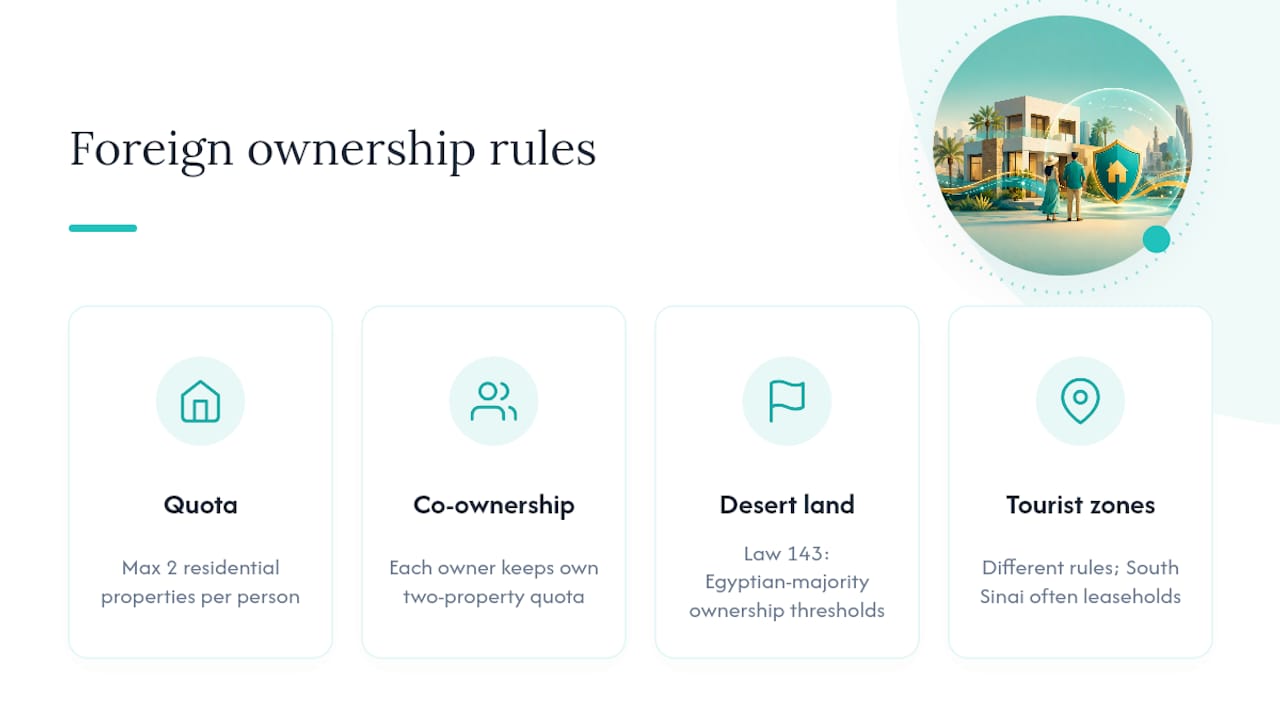
Tourist zones like the North Coast, the New Administrative Capital, and South Sinai often run on different rules. South Sinai frequently uses long leasehold arrangements rather than freehold title, a distinction that catches buyers off guard when they assume every resort purchase works the same way. Always verify current terms through GAFI and a licensed local lawyer before committing.
How to buy and register jointly owned property in Egypt
Buying with a co-owner adds a layer of coordination on top of Egypt's standard purchase process, but the core steps stay the same. Here's the sequence that protects you.
- Run independent due diligence. Hire your own lawyer, separate from the seller's or developer's, to verify title history, confirm the developer's permits, and check whether the unit qualifies for a registered green contract rather than a weaker notarized one.
- Gather your documents. You'll need passports for every co-owner, an Egyptian tax card, and, where relevant, birth or marriage certificates. Buyers purchasing remotely typically need a notarized power of attorney authorizing someone in Egypt to sign on their behalf.
- Transfer funds through formal banking channels. Foreign buyers must move purchase money into Egypt in foreign currency through the banking system rather than in cash, and keep every record. That paper trail is what preserves your right to repatriate funds later and supports the certificate you'll need for title registration.
- Register at the Real Estate Publicity Department (Shahr Aqari). This registry issues the strongest form of title in Egypt, and every co-owner must sign the transfer documents and submit valid identification. Registration timelines vary by governorate but commonly run several weeks to a few months once documents are complete.
- Budget for the full cost stack. Expect registration fees, stamp duty, and disposition tax on top of lawyer and notary charges. These add up, and none of them are optional if you want registered protection.
Pro Tip: Never pay large sums in cash, even to a seemingly trustworthy developer. Without a banked, traceable transfer, you may struggle to prove the source of funds when you eventually want to sell or move money out of Egypt.
The step-by-step buying process applies whether you're purchasing solo or splitting ownership with a partner. Joint buyers simply need every named owner present, in person or through power of attorney, at each signing stage.
Managing co-ownership and handling disputes between owners
A registered, written co-ownership agreement is the single best safeguard against future conflict. Partition disputes frequently escalate specifically because co-owners never formalized how the property would be managed, leaving verbal understandings to fall apart once money or scheduling gets involved. A solid agreement should spell out:
- Who manages the property day to day, and whether that manager is paid.
- How maintenance costs, taxes, and improvements get split and approved.
- Booking or usage rules if the property is a holiday home shared by multiple families.
- What happens if one owner wants to sell their share, including first-refusal rights for the others.
When co-owners can't agree, Egyptian law offers two exits. Consensual partition requires unanimous agreement and is faster, cheaper, and far less stressful. Judicial partition, known as farz wa tajnib, lets any single co-owner force the issue through the courts if consensus fails. Courts typically order an engineering expert to assess whether the property can be physically divided without losing value. If it can't, which is common with apartments and single villas, the court orders a public auction and splits the proceeds according to each owner's share. Expect this route to take months, sometimes longer, and to cost more than either party wants to spend.
Alternatives to direct joint title worth considering
Direct co-ownership isn't the only lawful structure available, and some buyers find these alternatives fit their situation better.
- Company ownership removes the individual two-property cap since the entity, not the individual, holds title, though Law No. 143 imposes Egyptian-majority ownership rules for certain land categories.
- Long leasehold agreements, often running 99 years, are common in South Sinai where freehold sales to foreigners face tighter restrictions.
- Fractional ownership platforms are gaining traction in Egypt's resort markets, but buyers should verify the same fundamentals that matter in any co-ownership deal: is the arrangement actually registered, who manages the asset, and what are the exit terms if you want out?
- Regulated pooled investment vehicles are also expanding. As Egypt's Financial Regulatory Authority eases requirements for REITs and similar funds, expect more diversified, professionally managed routes into Egyptian property that don't require direct co-ownership at all. Structures like these, explained well in this guide to REITs as an investment vehicle, suit buyers who want exposure to Egyptian real estate without the governance work joint title requires.
How Padsabroad supports buyers entering joint ownership
Padsabroad helps international buyers navigate joint purchases across Hurghada, El Gouna, Sahl Hasheesh, and the North Coast, starting with property discovery that matches your budget and share arrangement. The team connects buyers with independent Egyptian lawyers for title verification, something no co-owner should skip. For readers still mapping out the numbers, the ROI calculator and first-time buyer resources are useful starting points before you commit to a specific unit or co-owner arrangement.
What we've seen go wrong, and how to avoid it
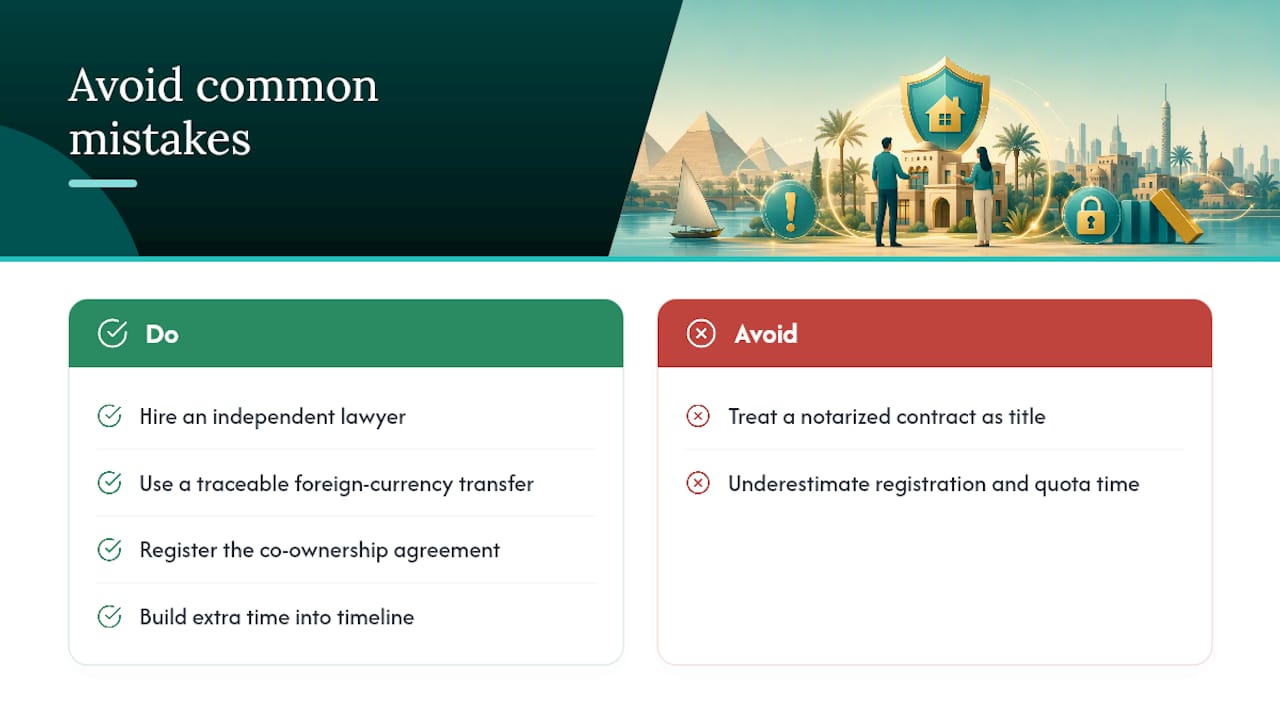
The costliest mistake we encounter is buyers accepting a notarized contract as if it were equivalent to registered title. It isn't, and it leaves co-owners exposed when disputes or resale come up years later. Second most common: underestimating how long registration and quota verification actually take, then getting frustrated mid-transaction.
Protect yourself with four habits: hire your own lawyer independent of the seller, insist on a traceable foreign-currency bank transfer, register your co-ownership agreement rather than leaving it verbal, and build extra time into your purchase timeline. None of these steps are complicated. Skipping them is what causes the real damage.
— PADSABROAD
Ready to explore a joint purchase in Egypt?
Padsabroad gives joint buyers something a standard listings site can't: local legal introductions and registration support built specifically around Egypt's shuyu framework, so you're not piecing together Law No. 230 compliance on your own. Whether you're splitting a unit with a partner, sibling, or investment group, our team helps verify title status, coordinate independent legal checks, and guide the banking steps that protect your repatriation rights.

Start by downloading the First-Time Buyer Guide to Egypt Red Sea Property Investment, which walks through documentation and registration timing in more detail than any single article can. If you already have a property in mind, reach out through Padsabroad's safe-buying service and we'll help you and your co-owner move through due diligence, registration, and long-term management without the guesswork.
Where to verify these rules yourself
- How to register property in Egypt (Bylawme) — registry procedures, including joint-property filings.
- Buying property in Egypt as a foreigner (GREM Capital) — step-by-step purchase and title guidance.
Sources
- Buy Property in Egypt 2026 | Guide - Lawyer Secretary
- Article on joint ownership (shuyu) and partition under Egyptian law
- How to buy property in Egypt as a foreigner — GREM Capital guide