
Yes, you can sell property in Egypt as a foreigner, and the process is well established. You need a valid title deed, payment of the 2.5% Real Estate Transaction Tax through the Egyptian Tax Authority portal, notarization of the sale contract, and registration at the Real Estate Publicity Department, known locally as Tabu. Foreign sellers also need proof of how the property was originally funded before money leaves the country. The rest of this guide walks through each step in order.
TL;DR:
- Paying the 2.5% Real Estate Transaction Tax through the ETA portal is mandatory and must be completed before notarization.
- Buyers should prepare a complete set of documents, including registered title deed, tax clearance, utility bills, and a transaction-specific Power of Attorney if abroad.
- Notarization requires presentation of verified documents and payment receipts, with registration at Tabu needed within 10 days to finalize ownership transfer.
- Undischarged liens, incomplete paperwork, or missing tax clearances are common causes of delays in the sale process.
- Foreign sellers must demonstrate how the property was funded using authorized banking records to comply with currency transfer rules.
Table of Contents
- How Does the Property Selling Process Work in Egypt?
- What Documents Do You Need Before You List?
- Taxes, Fees and What the Seller Should Expect to Pay
- Currency Rules Every Foreign Seller Needs to Know
- Should You Sell Through an Agent, Privately, or via EREP?
- How to Price and Prepare Your Property for Sale
- What Happens at the Notary and Tabu Registration?
- How Long Does a Sale Take and What Slows It Down?
- Your Seller Checklist and How Padsabroad Fits Each Step
- Can Foreigners Legally Own and Sell Property in Egypt?
- What Legislative Changes Affect Sellers Right Now?
- What Pitfalls and Legal Risks Should You Watch For?
- How Do You Handle Disputes or Claims on the Property?
- How Do You Verify the Title Deed Is Genuine?
- Do You Need a Building Condition Certificate?
- What Padsabroad Has Learned Selling Red Sea Properties
- How Padsabroad Supports Sellers From Valuation to Closing
- Where to Verify Official Rules Before You Sign Anything
- Sources
How Does the Property Selling Process Work in Egypt?
Selling property in Egypt follows a fairly linear path, but each stage has its own paperwork and its own point of failure. Understanding the sequence before you start saves weeks later.
- Get a valuation and pick your channel. Decide whether you'll work with a licensed agent, list through the government's EREP portal, which matches owners with verified agents and syndicates listings across Egypt's MLS, or handle the sale privately. Your choice shapes how fast you find a buyer and how much paperwork lands on your desk.
- Negotiate and take a deposit. Once a buyer is interested, most sales move through an offer, a reservation deposit, and a preliminary sale agreement (often called an "Orfy contract" locally) that locks in price and terms before the formal transfer.
- Settle the tax before notarization. The 2.5% RETT must be paid electronically through the ETA portal, and the payment receipt is a hard requirement before a notary will authenticate the final contract.
- Notarize the sale contract. A notary public verifies both parties' identities, confirms the tax receipt, and authenticates the transfer document.
- Hand over possession. Keys, utility account transfers, and any community or homeowners' association handovers happen once registration is confirmed.
Miss step 3 and you cannot legally get to step 4. That single dependency is where most delays start, especially for sellers trying to close from overseas.
What Documents Do You Need Before You List?
Egyptian notaries and Tabu officials will reject an incomplete file outright, so it pays to assemble everything before you put a property on the market rather than scrambling once you have a buyer.
- Original title deed or Green Contract, confirmed as registered at Tabu, not just held as a preliminary contract.
- Tax clearance certificate showing no outstanding property tax owed on the unit.
- Recent utility bills and receipts proving accounts are current and in the seller's name.
- Passport and ID copies for every named owner on the title, plus company registration documents if the property is held through an entity.
- Power of Attorney, if you're selling from abroad, drafted for this specific transaction rather than a general-purpose PoA.
That last point trips up more overseas sellers than anything else. A Power of Attorney drawn up for one deal must be transaction-specific, legalized or apostilled in your home country, and translated into Arabic by a certified translator. Generic or outdated PoAs are routinely rejected by Tabu, which can cost weeks if you discover the problem after a buyer is already lined up.
Pro Tip: Order your tax clearance certificate the same week you decide to sell, not after you accept an offer. It can take longer to obtain than most sellers expect, and a buyer's notary appointment will stall without it.
Taxes, Fees and What the Seller Should Expect to Pay
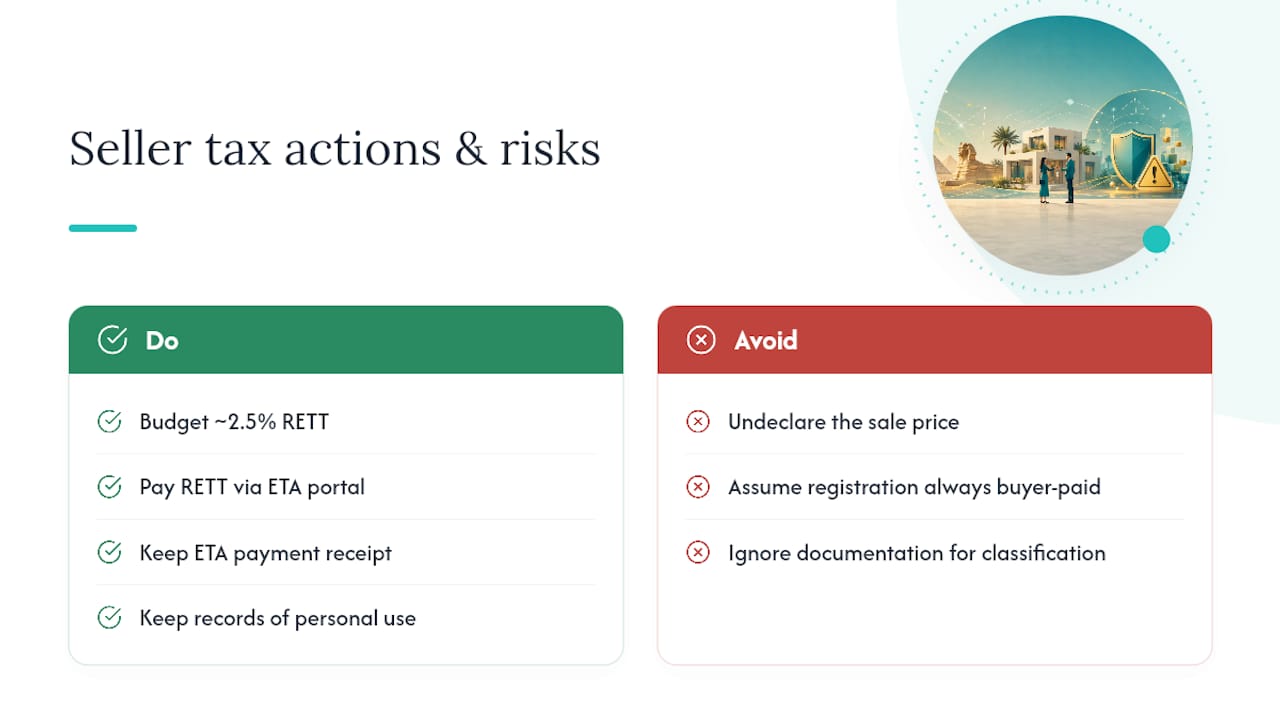
The headline number for sellers is the Real Estate Transaction Tax: a one-time 2.5% charge calculated on whichever is higher, the actual sale price or the property's official government valuation. The seller is legally responsible for this tax, and it must be paid electronically through the ETA portal, with the payment receipt required before a notary will proceed.
On a property selling for a high value, a seller should budget roughly 2.5% of the sale price for RETT alone, assuming the sale price exceeds the official valuation.
Beyond RETT, expect stamp duty and notary fees, along with registration costs that typically run 1% to 3% and are conventionally paid by the buyer, though this splits by negotiation in practice.
Two things catch sellers out. First, undeclaring the sale price to shrink the tax bill is a common temptation, but it creates a registration mismatch that can block the transfer entirely and invite penalties later. Second, a 2026 tax facilitation package now limits how easily the Tax Authority can reclassify an individual's personal property sale as professional trading activity, which matters if you're an expatriate selling a single second home rather than flipping units for a living. Keep records showing personal use, and you're better protected than sellers were a few years ago.
Currency Rules Every Foreign Seller Needs to Know
If you bought your property from abroad and are now selling it, Egyptian registration offices want to see how that original purchase was funded. This isn't a formality. Since 2024, offices have strictly enforced foreign-exchange documentation, and missing proof can stall or block registration when the buyer is also foreign.
- Keep your original SWIFT transfer trace or bank remittance advice from the purchase.
- Retain bank statements showing the funds arrived through an authorized channel, not cash or informal transfer.
- Request a bank letter confirming the original transfer if your paperwork from years ago has gone missing.
- Work with a lawyer to regularize the file if you genuinely cannot locate the original funding evidence.
- Plan repatriation of sale proceeds through the same authorized banking channels, coordinating with your bank ahead of closing rather than after.
The Central Bank of Egypt sets the framework banks follow for these transfers, so a bank familiar with foreign property transactions will move faster than a branch handling one for the first time.
Should You Sell Through an Agent, Privately, or via EREP?
A licensed agent brings local market reach and handles the paperwork trail that trips up sellers unfamiliar with Egyptian bureaucracy. Commission structures vary, but most agents work on a percentage of sale price rather than a flat fee, and a written mandate should spell out exactly what that percentage covers.
The government's own EREP platform offers a different route: submit your property details and get matched with verified agents across Egypt's MLS network, which reduces exposure to unlicensed operators. It's worth using alongside, not instead of, direct agent relationships, particularly for coastal properties where buyer pools are smaller than in Cairo.
Selling privately is possible but riskier for foreign owners specifically, since document scrutiny, Arabic-language contracts, and unfamiliar notary procedures all fall on your shoulders. If you go this route:
- Get everything in writing, including a signed mandate if any third party helps you.
- Verify any agent's license and ID before sharing property documents.
- Spell out commission and payment timing in the contract, not a verbal agreement.
Pro Tip: Ask any agent you're considering how many EREP-listed sales they've closed in the last year. It's a quick way to gauge whether they actually work the official channels or just rely on word of mouth.
How to Price and Prepare Your Property for Sale
Pricing an Egyptian property correctly means pulling from more than one source. Compare an agent's suggested price against portal listings for similar units and, for higher-value properties, a professional appraisal that lines up with the official Tabu valuation you'll need for tax purposes anyway.
Small fixes move the needle more than sellers expect. Fresh paint, a repaired air conditioning unit, and clean common areas in a shared building all shape a buyer's first impression, and coastal units especially benefit from decluttering to show sea views clearly.
Currency signals matter too. Coastal resort markets in places like Hurghada often list in USD or GBP because that's how international buyers think in value terms, while Cairo residential sales trade almost entirely in EGP. Matching your listing currency to your likely buyer pool avoids scaring off serious offers with an unfamiliar price format. If you're unsure which way to lean, a guide to USD pricing conventions in the Egyptian market is worth a read before you set a number.
- Pull at least three comparable sales from portals or agents before setting a price.
- Fix visible defects; skip cosmetic overhauls that won't return their cost.
- List coastal and resort units in the currency your target buyer thinks in.
- Use professional photography, since resort and second-home buyers shop remotely far more than local Cairo buyers do.
A structured pricing approach that weighs comparables against condition and timeline pressure tends to outperform a number picked purely on gut feeling, and the same discipline applies whether you're pricing a Cairo apartment or a Red Sea villa.
What Happens at the Notary and Tabu Registration?
The notary's job is verification, not negotiation. They confirm both parties' identities, check that the RETT payment receipt is genuine, and authenticate the sale contract as the official record of transfer.
- Present your documents. Title deed, tax clearance, RETT payment receipt, and ID for all parties go to the notary together.
- Notary authenticates the contract. This creates the legal record that Tabu will use to register the new owner.
- File at Tabu within 10 days. The Real Estate Publicity Department has a statutory window for lodging the authenticated contract after notarization.
- Tabu runs its checks. Registrars confirm there are no outstanding encumbrances, no unresolved mortgage, and no municipal debts attached to the unit before recording the transfer.
- Registration is confirmed. The buyer receives clean title, and you as seller should keep the registration slip as your own proof the sale closed properly.
Sellers who clear any existing mortgage and settle municipal fees before this stage move through Tabu far faster than those who try to resolve encumbrances mid-process. If your property has any lien history, get a lawyer to pull the encumbrance record early rather than finding out about it at the registrar's desk.
How Long Does a Sale Take and What Slows It Down?
Most straightforward sales, from listing to completed Tabu registration, run a few months once a buyer is committed, though the legal steps themselves (notarization to registration) move in a matter of weeks when documents are ready.
- Missing or expired tax clearance certificates are the single most common holdup.
- Untranslated or improperly legalized Power of Attorney documents for absent owners add real delay.
- Undischarged mortgages or liens discovered only at Tabu can stop a sale in its tracks.
- Inheritance disputes over title, common on older family-owned properties, can take months to resolve through the courts.
Pre-check your mortgage status, confirm tax receipts are current, and have any PoA translated well before you need it. If your title involves inheritance or a joint family holding, bring in a lawyer at the listing stage, not after you've already found a buyer.
Your Seller Checklist and How Padsabroad Fits Each Step
Here's the sequence condensed into one working list, with a note on where support actually saves you time.
- Valuation and pricing, comparing agent estimates, portal comparables, and official assessment.
- Document gathering, title deed, tax clearance, utility receipts, and PoA if you're abroad.
- Tax payment, RETT settled through the ETA portal, with receipt in hand before notarization.
- Channel selection, verified agent, EREP listing, or both.
- Notarization and Tabu registration, completed within the statutory 10-day window.
Padsabroad works with sellers across Hurghada, El Gouna, Sahl Hasheesh, and the North Coast specifically on the steps that trip up overseas owners: matching you with verified local agents, coordinating PoA drafting and legalization when you can't be in Egypt in person, and helping structure listings for EREP visibility.
Pro Tip: If you bought through Padsabroad originally, your purchase file already has the funding documentation a Tabu registrar will ask for when you sell, which can shave real time off the currency verification step.
Can Foreigners Legally Own and Sell Property in Egypt?
Foreign nationals can own and sell most freehold residential property in Egypt, subject to conditions tied to project location and property type. Ownership near certain border or military-sensitive zones carries restrictions, and some regulations cap total foreign ownership within specific developments or require holding periods before resale.
The Egyptian government has drafted amendments to the law regulating foreigners' real estate ownership, and these proposals are still moving through official channels. That matters practically: a rule that applied when you bought five years ago may not be the exact rule in force when you sell. Confirm current ownership status with a property lawyer or your agent before listing, particularly if your unit sits in a resort development with its own foreign-ownership quota built into the original sales contract.
Most Red Sea resort communities, including the areas Padsabroad works in, were structured from the outset to accommodate foreign freehold ownership. This is part of why they attract international buyers in the first place. That doesn't remove the need to check your specific title's conditions, especially if the development predates more recent regulatory clarifications.
What Legislative Changes Affect Sellers Right Now?
Egypt's property tax framework has shifted meaningfully with the 2026 tax facilitation package, specifically laws addressing how individual property sales get classified. Before this clarification, an owner selling even one investment property risked the Tax Authority treating the sale as professional trading activity, which carries a heavier tax burden than a standard personal disposal.
Under the current reading, personal-use property sales aren't automatically classified as trading unless the Tax Authority can actually demonstrate that pattern, shifting the burden of proof in the seller's favor. If you're an expatriate selling a single holiday home or investment unit rather than running a property business, this protection is worth understanding before you file.
Separately, the foreign ownership amendments mentioned above remain under discussion, and any final version could affect resale conditions, holding periods, or documentation requirements for specific developments. Sellers with properties in newer coastal projects should ask their agent or lawyer whether their specific development falls under any pending regulatory change before setting a closing timeline. Legislation in this space tends to move in the direction of more clarity for foreign owners rather than less, but "under discussion" is not the same as settled law.
What Pitfalls and Legal Risks Should You Watch For?
The most common risk isn't fraud. It's incomplete paperwork discovered at the worst possible moment, usually at the notary's desk with a buyer waiting.
Under-declaring the sale price to reduce RETT liability is a temptation worth resisting outright. Beyond the ethical issue, it creates a mismatch between the declared price and the actual funds transferred, which invites registration blocks and tax penalties later, sometimes well after the sale has closed and you've already left the country.
Other recurring risks include:
- Selling through an unlicensed intermediary who disappears once a deposit changes hands.
- Discovering an undischarged mortgage or lien only after a buyer's notary appointment is booked.
- Accepting a preliminary agreement with vague payment terms that a buyer later disputes.
- Relying on a general Power of Attorney that Tabu rejects as insufficiently specific to the transaction.
Verify any agent's license before handing over documents, insist on official receipts at every payment stage, and never let a preliminary agreement substitute for the full notarized contract. Transparency with the Tax Authority protects you far more than a lower declared price ever will.
How Do You Handle Disputes or Claims on the Property?
Title disputes in Egypt most often stem from inheritance situations, where multiple heirs hold claims on a property that was never formally divided at Tabu. If your property has any inherited component, resolve heir claims through a lawyer before listing, since a buyer's notary will not proceed with an unresolved ownership dispute on record.
Boundary disputes and unregistered informal sales from years past also surface occasionally, particularly on older properties that changed hands through preliminary contracts that were never fully registered at Tabu. If a previous owner sold informally without registration, the chain of title can be genuinely unclear.
Practical steps if a dispute surfaces:
- Engage a property lawyer immediately rather than trying to negotiate directly with a claimant.
- Pull the full Tabu registration history to establish a documented chain of ownership.
- Settle inheritance claims through formal partition or buyout before attempting to list.
- Avoid any cash settlement with a claimant that isn't documented and legally binding.
A dispute doesn't have to be a deal breaker, but it will add months to your timeline if it surfaces after you've already found a buyer rather than before you list.
How Do You Verify the Title Deed Is Genuine?
A title deed that looks official isn't necessarily registered. The single most important check is confirming your Green Contract or title deed actually appears in Tabu's registration records under your name, not just that you hold a signed document.
Request an official extract or search from the Real Estate Publicity Department showing the current registered owner and any recorded encumbrances. This search reveals mortgages, liens, or competing claims that wouldn't be visible from the deed document alone. If your property was purchased years ago and you've never confirmed registration status, do this before you list, not after a buyer's lawyer flags it.
For properties bought through a developer, cross-check that the developer actually transferred registration to your name at the time of purchase, since some older resort developments left units registered under a master developer title for extended periods. A lawyer or a verified agent can run this check quickly, and it's one of the cheapest due-diligence steps available relative to the delay it can prevent later.
Do You Need a Building Condition Certificate?
For most standard apartment and villa sales in Egypt, a building condition certificate isn't a universal legal requirement the way tax clearance is. However, certain situations call for one: older buildings with visible structural concerns, properties in developments with active homeowners' association disputes over maintenance, or sales where the buyer's financing institution requires an independent structural assessment before releasing funds.
If your buyer requests one, or if your property sits in an older building where structural condition is a reasonable concern, a licensed engineer's report documenting the building's condition can prevent disputes after closing. This is particularly relevant for freestanding villas and older Red Sea coastal properties exposed to salt air and humidity, both of which accelerate certain kinds of structural wear compared to inland Cairo buildings. Getting ahead of a buyer's concern with your own documented assessment tends to smooth negotiation rather than leaving it as a point of friction late in the process.
What Padsabroad Has Learned Selling Red Sea Properties
Bilingual, local representation solves more problems than any checklist can. Foreign sellers most often stumble on document readiness, not market conditions. They wait to gather tax clearance or PoA paperwork until a buyer is already at the table, which turns a routine step into a bottleneck.
The sellers who close fastest do three things early: verify their agent's license before sharing documents, prepare PoA and Arabic translations before listing rather than after, and set clear written escrow instructions so funds move only against confirmed milestones.
Private sale can work for a straightforward, mortgage-free property with a local seller. For overseas owners, especially with currency documentation involved, professional representation earns its cost back in avoided delays.
— PADSABROAD
How Padsabroad Supports Sellers From Valuation to Closing
Padsabroad works directly with property owners across Hurghada, El Gouna, Sahl Hasheesh, Soma Bay, Marsa Alam, Port Ghalib, and the North Coast, handling the parts of a sale that cause the most friction for overseas owners: matching you with verified local agents, coordinating Power of Attorney drafting and legalization when you're selling from abroad, structuring your listing for EREP and MLS visibility, vetting prospective buyers, and helping arrange proceeds repatriation through the correct banking channels.

If you're weighing whether to sell now or hold, start with a property valuation through Padsabroad's Red Sea property investment guide, where the team can walk through your specific development, title status, and realistic pricing before you commit to listing. For sellers still gathering documentation, the safe property transactions guide covers the same trust checks and legalization steps Padsabroad applies on the sell side. Get in touch to request a valuation on your unit and find out what your specific paperwork situation looks like before you go to market.
Where to Verify Official Rules Before You Sign Anything
Confirm every figure and procedure in this guide against the primary source before you rely on it. The Egyptian Tax Authority portal handles RETT payment and issues the receipt your notary will require. The EREP platform is the official channel for listing with verified agents. The Real Estate Registration Authority governs Tabu registration and encumbrance checks, and the Central Bank of Egypt sets the foreign-exchange documentation rules that apply to repatriating sale proceeds. Keep every payment receipt and registration slip; you'll need them if any step is ever questioned later.
This article is general information, not a substitute for advice from a qualified financial advisor. Consult a qualified financial professional about your own circumstances before acting on anything here.
Sources
- Sell Your Property in Egypt | The Official Egyptian Real Estate Platform
- Egyptian Tax Authority (ETA)
- Real Estate Taxation in Egypt