
Budget for property management fees of roughly 8% to 15% of collected rent for long-term lets in Egypt, or a higher percentage for full-service holiday-rental management, plus separate maintenance and service charges. Combined, most owners end up spending 20% to 35% of gross rent on total holding costs for long-term rentals, and 35% to 55% for short-term listings once cleaning, guest turnover, and higher-touch management get added in.
Two numbers matter most when you're setting a budget. First, monthly management fees on a typical Red Sea apartment usually fall in the range of 8% to 12% of rent, according to figures used by local property management business planners. Second, maintenance and building service charges in resort communities often land somewhere between EGP 80 and 200 per square meter each year, though the figure swings widely depending on amenities, generator backup, and how new the compound is. Inflation and property type will move your net yield more than any single fee line, so treat these ranges as a starting point, not a guarantee.
- Long-term management fees: 8% to 15% of monthly rent
- Holiday-rental management fees: 10% to 25% of booking revenue, depending on service level
- Coastal maintenance/service charges: roughly EGP 80 to 200 per sqm, per year
- Gated-community compound fees: can run into the thousands of EGP per month on higher-end units
- Typical monthly holding cost (long-term let): commonly EGP 4,000 to 20,000, depending on building class and management scope
Cairo gross rental yields sit around 6% to 9%, but net yields after management, maintenance, and service charges often fall to just 3.5% to 6% — a gap of roughly half your headline return, according to Sands of Wealth's 2026 market data. That gap is exactly why the rest of this guide focuses on real, itemized costs rather than the gross yield figures most listings advertise.
Key Takeaways
Budgeting for property management in Egypt requires combining a realistic fee range, itemized maintenance costs, and an NOI-first calculation rather than relying on advertised gross yield figures.
| Point | Details |
|---|---|
| Fee bands to budget for | Expect 8% to 15% of rent for long-term management, 10% to 25% for full-service holiday letting. |
| Monthly holding costs | Total holding costs commonly run EGP 4,000 to 20,000 per month depending on building class and services. |
| Reserve sizing | Set aside a fixed percentage of rental income specifically for large, infrequent capital repairs. |
| Hiring checklist priority | Require invoice-backed billing and a written markup cap before signing any management contract. |
| Recommended next step | Remote owners should prioritize a full-service manager like Padsabroad that offers PoA support and transparent invoicing. |
Table of Contents
- Property Management Costs in Egypt: What Services You Actually Get
- How Property Management Fees Are Calculated in Egypt
- What Maintenance and Service Charges Actually Cost Per Square Meter
- How to Budget Properly: Calculate NOI and Plan for Inflation
- What Drives Property Management and Maintenance Costs Higher or Lower in Egypt
- Self-Managing vs Professional Management: The Real Cost Tradeoffs
- What to Ask Prospective Property Managers Before You Sign
- A Worked Example: Budgeting a 100 Sqm Apartment in a Red Sea Resort
- Final Recommendations for Egypt-Based and Overseas Owners
- An Author's Note on Budgeting for Red Sea Investors
- How Padsabroad Supports Overseas Owners With Management and Costs
- Sources
Property Management Costs in Egypt: What Services You Actually Get
A management fee only means something once you know what it buys. Contracts vary enormously between agencies, and the biggest source of owner frustration is discovering, after signing, that "management" meant far less than expected.
Standard long-term rental management in Egypt typically includes:
- Tenant finding and marketing, including listing photos and local advertising
- Tenant screening and reference checks before signing a lease
- Lease signing and renewal, often handled under a Power of Attorney for overseas owners
- Monthly rent collection and follow-up on arrears
- Coordination of routine repairs with vetted contractors
- Common-area and building-system oversight (elevators, generators, water pumps)
- Monthly financial reporting and basic accounting
Some services usually cost extra, even when they sound like they should be included. Emergency call-outs outside business hours, utility bill payments on the owner's behalf, annual condition inspections, and furnishing or restocking between tenants are the most common add-ons. Ask for these in writing before you sign anything.
Holiday-rental and short-term management, common in Hurghada, El Gouna, and Sahl Hasheesh, adds a distinct layer of service: listing optimization across booking platforms, guest messaging and check-in coordination, professional cleaning between stays, and linen or amenity restocking. Owners moving from long-term to holiday letting shouldn't be surprised that management fees roughly double. Local property advisors note that professional management tends to pay for itself by reducing vacancy and catching small repair issues before they become expensive ones, but that value only shows up if the service list actually matches what you're paying for.
How Property Management Fees Are Calculated in Egypt
Three pricing models dominate the Egyptian market, and each suits a different type of owner.
Percentage of collected rent is the most common structure for long-term lets. This aligns incentives reasonably well: a manager earning nothing on an empty unit has a reason to fill it quickly. Flat monthly or annual fees show up more often with smaller boutique operators or self-managed compounds, where the fee stays fixed regardless of rent collected. This model gives you cost certainty but removes the manager's incentive to chase occupancy hard. Tenant-placement or onboarding fees are one-off charges, often equal to a half or full month's rent, paid when a new tenant signs. Some agencies charge this on top of a lower ongoing percentage; others fold it into a single, higher rate.
Short-term and holiday letting almost always commands a higher percentage than long-term management, since it involves far more hands-on work: guest turnover, cleaning coordination, and platform management all take real staff time.
Watch for extras layered on top of the headline percentage. Maintenance markups are the most common, where an agency adds a margin to every repair invoice unless your contract specifically bans it. Vendor administration fees, emergency call-out premiums, onboarding inspection charges, and marketing fees for new listings can each add a percentage point or two to your effective cost.
| Fee model | Typical range | Most common for |
|---|---|---|
| Percentage of collected rent | 8% to 15% | Long-term residential lets |
| Flat monthly/annual fee | Varies by agency, fixed regardless of rent | Smaller operators, boutique buildings |
| Tenant-placement fee (one-off) | Roughly half to one month's rent | New tenant sign-ups, either alone or added to a lower ongoing rate |
| Full-service holiday-rental fee | 10% to 25% of booking revenue | Short-term coastal rentals (Hurghada, El Gouna) |
What Maintenance and Service Charges Actually Cost Per Square Meter
Maintenance costs vary more by building type and location than management fees do, because they're tied to physical infrastructure rather than a negotiated percentage.
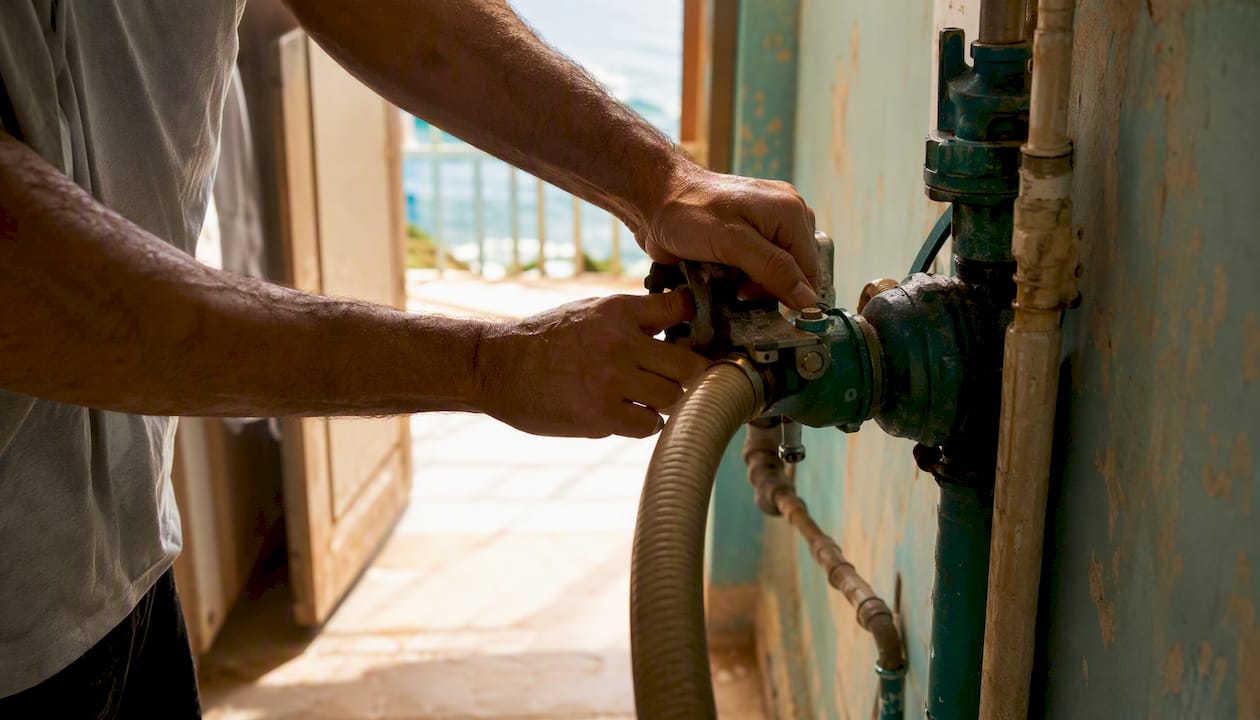
| Property type | Typical annual cost basis | Major line items included |
|---|---|---|
| Standard older apartment (non-gated) | Lower per-sqm cost, fewer shared amenities | Basic building upkeep, minimal shared security |
| Gated-community apartment (New Cairo/Sheikh Zayed style) | Monthly compound fee often the largest single cost | Security, landscaping, generator backup, shared facilities |
| Coastal resort apartment (Hurghada/Red Sea) | Roughly EGP 80 to 200 per sqm, per year | Security, landscaping, generator/water backup, pool maintenance |
| Short-term furnished holiday unit | Higher effective cost due to turnover | Cleaning between stays, linen replacement, higher wear-and-tear on furnishings |
Gated communities and newer high-service coastal compounds often carry the steepest monthly compound fees of any property type, sometimes becoming the single largest line item an owner pays before management fees or repairs even enter the picture. That's the tradeoff for the security, landscaping, and generator backup that make these developments attractive to renters in the first place.
Coastal resort maintenance and service charges commonly cluster around EGP 80 to 200 per square meter per year, a range widely cited in local property-management planning documents. On a 100 sqm apartment, that alone works out to a meaningful annual cost before you've paid a single management fee, which is why owners who only budget for the percentage-of-rent fee are routinely surprised by their actual holding costs.
How to Budget Properly: Calculate NOI and Plan for Inflation
Prioritize Net Operating Income (NOI) over gross yield when budgeting for a property in Egypt. NOI tells you what actually lands in your pocket, while gross yield only tells you what a property advertises before real costs get subtracted.
The formula is simple: NOI = Gross Rental Income − Operating Expenses (excluding mortgage payments). Operating expenses include management fees, maintenance and service charges, insurance, and a vacancy allowance.
Here's how that plays out in practice:
- Start with gross annual rent your unit realistically commands.
- Subtract the management fee (8% to 15% for long-term, more for holiday lets).
- Subtract service charges and building fees, calculated per sqm or as a flat compound fee.
- Subtract a maintenance reserve for larger, less frequent repairs.
- Subtract a vacancy allowance, since almost no property rents 100% of the year.
- What remains is your NOI, the number that actually reflects your return.
Inflation changes this calculation year over year, and Egypt's inflation environment has been volatile enough that a maintenance budget set two years ago can be badly out of date today. Costs for imported parts, generator fuel, and specialized contractor labor tend to move faster than rent itself, which quietly compresses your margin if you don't revisit your numbers annually.
- Review your service-charge and maintenance line items at least once a year against actual invoices.
- Build a vacancy allowance into every projection, even if your unit has never sat empty.
- Treat your management fee as a floor, not a ceiling, since markups on repairs can push the effective cost higher.
Pro Tip: Set aside a dedicated maintenance reserve fund equal to a fixed percentage of rental income, separate from your regular operating budget, specifically earmarked for big-ticket items like AC replacement, elevator work, or facade repairs. Owners who skip this step are the ones hit hardest by sudden, unplanned repair bills.
Understanding your real return on investment means running this calculation before you buy, not after, so the numbers reflect the actual property class you're considering rather than a generic market average.
What Drives Property Management and Maintenance Costs Higher or Lower in Egypt
Some cost drivers are within your control. Others simply come with the property.
Location sets the baseline. Coastal resort communities in Hurghada, El Gouna, and Sahl Hasheesh typically carry higher service charges than older Cairo apartments, because they offer amenities like pools, landscaped grounds, and 24-hour security that Cairo buildings often lack. Property type matters just as much: a studio costs less to maintain than a three-bedroom villa with a private garden and pool, and gated-community amenities add ongoing costs that a standalone apartment building simply doesn't carry.
Building age and systems play a bigger role than most first-time owners expect. Older elevators, aging generators, and outdated plumbing all mean more frequent repair calls, and factors affecting rental income in Egypt often trace back to exactly these physical infrastructure issues rather than market demand.
- Short-term versus long-term use, since holiday rentals carry higher turnover and cleaning costs
- Furnishing level, as furnished units command a rent premium of roughly 20% to 35% but also require a bigger replacement budget
- Occupancy rates, since a manager working harder to fill vacancies may justify a higher fee
- Owner proximity, as remote owners typically need more services bundled in
Vendor markets add another layer of unpredictability. Spare parts for generators, AC units, and elevators are often imported, so currency fluctuations and supply-chain disruptions can push repair costs up faster than general inflation. Tenant profile matters too: expat tenants on corporate leases tend to report issues promptly and expect a faster response, which can mean more frequent, smaller maintenance costs rather than large deferred repairs.
Self-Managing vs Professional Management: The Real Cost Tradeoffs
Self-managing your property can look cheaper on paper, since you skip the management fee entirely. In practice, it often costs more in the long run through higher vacancy, delayed repairs, and the compounding wear that comes from inconsistent oversight.

| Factor | DIY / local caretaker (bawab) | Basic local agency | Full-service corporate manager |
|---|---|---|---|
| Direct cost | Lowest, often just tips or a small monthly stipend | Moderate, roughly 8% to 12% of rent | Higher, 10% to 25% depending on service scope |
| Time commitment from owner | High, especially for remote owners | Moderate | Low |
| Risk to asset value | Higher, due to inconsistent oversight | Moderate | Lowest, with structured inspections |
| Suitability for remote owners | Poor without a trusted local contact | Fair | Best fit |
| Scalability across multiple units | Poor | Moderate | Strong |
A local caretaker arrangement costs little upfront but relies entirely on one person's reliability, with no formal reporting and no backup if that person becomes unavailable. Basic local agencies sit in the middle: lower fees than a corporate operator, but often less structured reporting and a smaller vendor network to draw on. Full-service corporate managers charge the most but bring standardized inspections, documented maintenance schedules, and dedicated staff for emergencies, which matters most for owners who can't personally check on a property.
The market has been shifting away from informal caretaker arrangements toward structured corporate management, largely because international investors want consistent income and documented maintenance rather than an informal handshake deal. For remote landlords specifically, a Power of Attorney is usually necessary to let a manager sign leases and handle utilities on your behalf, which is one more reason full-service arrangements tend to work better than informal ones when you're not physically in Egypt.
Pro Tip: If you're weighing a caretaker against an agency purely on fee percentage, factor in the cost of even one missed repair or one extended vacancy. A single month of lost rent often costs more than a full year of the fee difference between the two options.
What to Ask Prospective Property Managers Before You Sign
The interview stage is where owners catch, or miss, the difference between a transparent operator and one that layers in hidden costs.
Ask every prospective manager these questions directly:
- What is your exact fee, and does it apply to gross rent collected or gross rent billed?
- Do you mark up repair invoices, and if so, by how much?
- Can you provide a sample monthly report from an existing client?
- What is your typical response time for tenant maintenance requests?
- How do you select and vet contractors and vendors?
- Will you provide original invoices for every repair, not just a summary total?
- Do you require a Power of Attorney, and how do you handle it for overseas owners?
- What onboarding or setup fees apply before the first tenant moves in?
- Is any insurance coverage included, or is that the owner's separate responsibility?
Certain answers, or non-answers, should raise concern immediately. Vague contract language that doesn't specify what's included, a refusal to show a sample report, resistance to sharing vendor invoices, and an unusually low headline commission paired with a long list of extra fees are all signs worth walking away from. A manager with no visible local office or an unclear process for remitting rental income to an overseas account deserves extra scrutiny before you commit.
Pro Tip: Insist on invoice-backed billing for every repair, and negotiate a cap on emergency call-out markups before you sign. This single clause prevents the most common source of quiet fee creep in Egyptian property management contracts.
A Worked Example: Budgeting a 100 Sqm Apartment in a Red Sea Resort
Here's how that breakdown works.
- Start with gross annual rent for a well-located 100 sqm resort unit.
- Subtract a management fee of 10% to 15% for full-service long-term management.
- Subtract service charges calculated at EGP 80 to 200 per sqm annually, meaning roughly EGP 8,000 to 20,000 per year on this size unit.
- Subtract a maintenance reserve, ideally a fixed percentage set aside specifically for larger capital items.
- Subtract a vacancy allowance, since even well-managed units rarely stay occupied 100% of the year.
- What remains after all four deductions is your realistic NOI, not the number on the original listing.
- If you self-manage instead of hiring full-service, you skip the management fee but take on the vacancy and repair risk yourself.
- If you switch to holiday letting, gross rent potential rises, but so does the effective fee percentage and the turnover-related maintenance cost.
- Furnished units can add a rent premium, but that premium needs to be weighed against faster wear on furniture and appliances.
The gap between the advertised gross yield and your actual NOI is exactly where most first-time owners get their budgeting wrong. Numbers like these are illustrative ranges, not guarantees, since actual figures shift with building class, compound fees, and how aggressively a manager marks up repairs.
Final Recommendations for Egypt-Based and Overseas Owners
Build your budget around NOI, not gross yield, keep a dedicated maintenance reserve, and if you're managing remotely, choose a full-service manager who commits to invoice-backed billing in writing.
Before you sign anything, take these steps:
- Run a full NOI calculation using realistic, not aspirational, rent figures for your specific property type and location.
- Request proposals from at least three managers, and insist each one includes a sample monthly report.
- Require invoice-backed maintenance billing as a contract condition, not an informal promise.
- Set a maintenance reserve policy before your first tenant moves in, not after the first major repair bill arrives.
Owners who follow this order, budget first, then vet managers against that budget, consistently end up with fewer surprises than those who pick a manager first and hope the numbers work out. If you're still assembling your purchase and ownership plan, working through an investment checklist before you commit to a property can save significant budgeting headaches later.
An Author's Note on Budgeting for Red Sea Investors
Working across the Red Sea coast, from Hurghada to El Gouna to Sahl Hasheesh, makes one pattern obvious: owners who budget using NOI from day one make calmer, better decisions than owners who chase gross yield and get blindsided by their first big repair bill.
The maintenance reserve conversation is the one most owners skip, and it's the one that matters most in a coastal market. Sea air is hard on building systems, generators run more, and AC units work overtime for most of the year. A reserve fund sized for a Cairo apartment is often inadequate for a coastal one, which is exactly why treating maintenance as a line item rather than an afterthought protects your return far more reliably than chasing a slightly lower management fee.
Local vendor relationships and fast emergency response matter enormously for owners who aren't in the country day to day, and that's precisely where a locally embedded management approach earns its fee. Holiday-rental experience adds another layer: knowing which units command a premium in Hurghada versus Sahl Hasheesh, and pricing accordingly, comes from watching those markets move over time, not from a spreadsheet.
How Padsabroad Supports Overseas Owners With Management and Costs
Padsabroad handles full-service property management and holiday-rental support for overseas owners across the Red Sea coast, with transparent, invoice-backed billing built into how it operates rather than added as an afterthought.

For owners who don't want to chase down vendor invoices from another country or wonder whether a repair bill was marked up, that transparency is the practical difference between a manager you have to double-check and one you don't. Services include tenant placement, holiday-rental management for coastal properties, maintenance coordination with vetted local contractors, and Power of Attorney support so remote owners can sign leases and handle utilities without flying back to Egypt. This setup works best for owners who bought a Red Sea property as an investment or second home and need someone locally accountable, not just responsive by email.
If you're weighing whether to buy in Hurghada, El Gouna, or Sahl Hasheesh and want to understand both the purchase process and what ongoing costs will look like, start with the first-time buyer guide to Red Sea property investment to see how buying and management support fit together from day one.
Sources
- Buying and Renting Out in Egypt (2026) – Sands Of Wealth
- Business Property Management Services Business in Egypt
- Property Management Secrets: Maximize Rental Income and Minimize Stress