
Egypt taxes built real estate at 10% of the net annual rental value after statutory deductions of 30% for residential units and 32% for non-residential ones. Owners whose primary residence has an annual rental value below the official exemption threshold pay no real estate tax under the Real Estate Taxation Authority (RTA) rules. For everyone else, the bill lands in two installments each year, one by mid-year and one by year end.
TL;DR:
- Exemption applies only to a single primary residence with rental value below the official threshold, and owners must file Form 6 to claim it.
- Property tax is calculated on the rental value, which is roughly 7% of the property's annual rental income after deductions.
- The tax is due in two installments per year, with a 5% discount available for prepayments or voluntary filings.
- Property valuation updates occur every five years, with a 60-day appeal window and a refundable deposit fee for disputes.
- Foreign owners must confirm registration and file the proper declaration, but most issues arise from incomplete paperwork rather than the tax rate itself.
Table of Contents
- Understanding property tax in Egypt: the legal basis
- How to calculate property tax in Egypt
- Who qualifies for property tax exemptions in Egypt?
- When and how do you pay real estate tax in Egypt?
- How property values get assessed, and how to appeal
- Penalties, discounts, and relief options
- Real estate tax vs. wealth tax vs. transaction tax
- A compliance checklist for foreign buyers
- Why most guidance on this topic misses the point
- Sources
Understanding property tax in Egypt: the legal basis
Egypt's annual real estate tax is not a local custom or a developer add-on. It runs on a specific statute, Law No. 196 of 2008 Concerning the Issuance of the Law on Property Tax on Built Real Estate, administered day to day by the Real Estate Taxation Authority. The RTA collects the tax, runs the valuation committees, and processes appeals.
The tax attaches to the building itself, not to whoever holds the registered title on paper. That distinction matters for foreign buyers who complete a purchase through a preliminary contract before full registration; the taxable unit exists whether or not the deed has caught up.
Property types typically subject to the tax include:
- Residential apartments and villas, whether occupied or vacant
- Commercial units, offices, and retail space
- Industrial buildings and warehouses
- Hotel and tourism-sector buildings, including resort units common along the Red Sea coast
Land without construction, agricultural buildings, and certain government and religious properties generally fall outside this tax. Vacant land held purely as an investment is not "built real estate" under the law, so it sits outside this particular levy, though other charges can still apply at the point of sale.
How to calculate property tax in Egypt
The RTA calculation follows a fixed sequence, and once you have the numbers, the math is straightforward.
- Start with the property's capital value, based on location, finish quality, and services.
- Apply the RTA's guidance rate, roughly 3% of capital value, to estimate the annual rental value.
- Deduct the statutory maintenance allowance: 30% for residential units, 32% for non-residential ones, per both the RTA and PwC's summary of Egyptian tax rules.
- Subtract the exemption threshold if the unit qualifies as a primary residence.
- Apply the 10% rate to what remains.
Pro Tip: Run the numbers on rental value first, not sale price. A unit that sold for a high price can still carry a modest rental value if the local market rents are low, which keeps the tax bill smaller than buyers often expect.
Take a residential apartment with an estimated annual rental value of 150,000 EGP. Apply 10%, and the annual tax comes to 10,500 EGP, split into two payments.
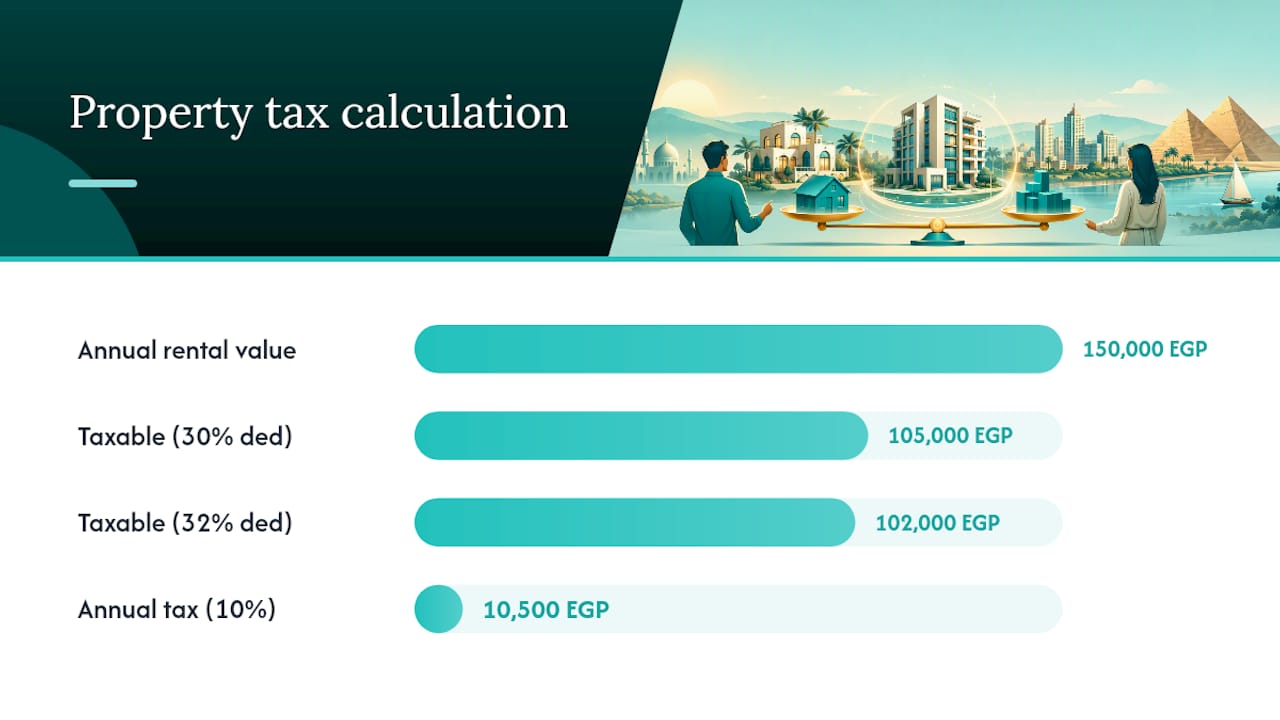
Because of the 30% to 32% deduction built into every calculation, the effective rate rarely reaches the full 10% headline figure. On a residential unit, the real burden works out closer to 7% of the estimated annual rental value once deductions are applied.
Who qualifies for property tax exemptions in Egypt?
The most valuable exemption applies to a single primary residence, with an official exemption threshold set for annual rental value under which no tax is levied. That threshold covers one unit per family, defined as spouse and minor children together, so a second property in your name (a vacation unit, a rental apartment) doesn't ride along on the same exemption.
Beyond the primary-residence rule, several categories carry their own exemptions or reduced treatment:
- Government-owned buildings and public facilities
- Buildings used for religious worship
- Educational and charitable institution property below set value thresholds
- Some agricultural-support buildings tied to farming operations
To claim the primary-residence exemption, owners file Form 6 or submit the equivalent declaration through the RTA's electronic services. You need to state the exemption yourself. The RTA doesn't automatically apply it just because a unit qualifies on paper.
When and how do you pay real estate tax in Egypt?
Filing and payment follow a predictable rhythm once you know the calendar.
- Initial declaration: submit a property declaration when you acquire a unit or when it changes in a way that affects value (new construction, major renovation, change of use).
- Five-year survey window: the RTA re-surveys properties on a five-year cycle, but you must report material changes as they happen rather than waiting for the survey.
- Two installments: pay the first half by the end of June, the second by the end of December, or settle the full annual amount in one payment if you prefer.
- Electronic filing: the RTA's push toward electronic declarations lets owners with properties in more than one governorate file under a single declaration mechanism, instead of separate paperwork per location.
For overseas investors juggling a Hurghada apartment and a unit elsewhere, that single-declaration option removes a genuine administrative headache.
How property values get assessed, and how to appeal
Survey and estimation committees set the taxable value using location, construction quality, services available, and comparable rental rates in the area. Their findings feed directly into your annual bill.
Key points to know about the assessment cycle:
- Valuations are refreshed roughly every five years, not annually
- Law No. 196/2008 caps how much an assessment can jump between cycles, which limits shock increases even in fast-appreciating markets
- Owners who disagree with a new valuation have 60 days from notification to file a formal appeal
- Filing an appeal requires a deposit of L.E.50, refundable depending on the outcome, per RTA guidance
- Appeals go to the RTA's local office covering the property's location, and the authority sets a review timeline once the file is complete
If a five-year re-evaluation pushes your unit's rental value estimate up sharply, the statutory cap is your main protection, and the appeal window is your recourse if the committee's figure still looks wrong.
Penalties, discounts, and relief options
Missing payment deadlines triggers late-payment penalties, though recent RTA amendments set statutory limits on how much those penalties can compound, protecting owners from open-ended fines.
On the upside, the RTA rewards proactive compliance:
- A 25% discount for residential owners who file and pay voluntarily
- A 10% discount for non-residential unit owners doing the same
- An additional 5% prepayment incentive for settling the full year in one go
Settlement programs and penalty relief have also appeared during broader economic relief periods, giving owners with overdue balances a path to clear arrears without the full penalty load. Prepaying isn't just tidy bookkeeping. It's the cheapest legal way to shave real money off your bill.
Real estate tax vs. wealth tax vs. transaction tax
Egypt runs three separate property-related levies, and investors who conflate them tend to miss a filing somewhere. Andersen in Egypt's guide lays out the distinction clearly:
- Annual real estate tax: triggered by ownership or the right to use a built property, paid by the owner or usufruct holder, billed twice yearly
- Real estate wealth tax: tied to the overall value of real estate holdings above certain thresholds, assessed on the owner
- Transaction tax: triggered at the point of sale, typically calculated on the sale price and settled around the transfer of title
If you own a Red Sea unit, rent it out, and later sell it, you're potentially dealing with all three at different points, plus rental income tax on top. Keeping the three straight in your own records saves a scramble when one of them comes due.
A compliance checklist for foreign buyers
Foreign ownership doesn't exempt anyone from Egyptian property tax rules, but a short checklist keeps you ahead of it.
- Confirm your unit's registration status and who holds the right of use, since that determines who the RTA treats as the taxpayer.
- Estimate your annual rental value using the 3% capital-value guidance, then apply the correct deduction for residential or non-residential use.
- Check whether your unit qualifies for the primary-residence exemption, and file Form 6 if it does.
- Mark both installment deadlines on your calendar, or set up prepayment to capture the 5% discount.
- If you lease the property, put the tax liability in writing in the lease itself.
Pro Tip: A lease that stays silent on who covers property tax almost always defaults to the owner in practice, even when a tenant assumed otherwise. Spell it out in the contract, not in a side conversation.
Padsabroad works with overseas buyers across Hurghada, El Gouna, Sahl Hasheesh, and the North Coast on exactly these gaps: confirming registration before purchase, estimating likely rental value for tax planning, and connecting owners with the declaration process so nothing slips between a signed contract and an RTA filing.

Where to verify the rules yourself
For primary sources, start with the RTA's real estate tax overview and the full text of Law No. 196/2008 for exact statutory wording. PwC's Egypt tax summary and Andersen in Egypt's guide offer useful professional interpretation alongside the raw legal text.
Why most guidance on this topic misses the point
That's the least useful number in the whole system, because almost nobody pays it. The deductions, the exemption threshold, and the prepayment discounts do the real work, and an owner who ignores them is planning around a figure that rarely applies to their actual bill.
The bigger risk for foreign buyers isn't the tax rate at all. It's the paperwork gap between buying a unit and getting it properly declared, especially when a purchase closes through a preliminary contract before formal registration catches up. That gap is where penalties and confused lease clauses come from, not from the tax formula itself.
If you take one thing from this, prioritize the declaration and the exemption check before you worry about optimizing anything else. Confirm your unit's status, file Form 6 if it qualifies, and put tax liability in writing in any lease. Everything else, the discounts, the appeal process, the five-year cycle, matters far less if that first step never happens.
— PADSABROAD
Sources
- Real Estate Tax | RTA
- Real Estate Tax Guide for Egypt: Real Estate, Wealth, Transaction | Andersen in Egypt
- Egypt - Individual - Other taxes | PwC
- Law No. 196 of 2008 Concerning the Issuance of the Law on Property Tax on Built Real Estate | RTA (PDF)