Egyptian Red Sea markets — Hurghada, El Gouna, Sahl Hasheesh, Soma Bay, Marsa Alam, and Port Ghalib — are the stronger choice for investors who need near-term rental income and resale liquidity. Saudi megaprojects like Red Sea Global and Amaala offer long-horizon capital appreciation, but material returns are still years away. For most US investors comparing Red Sea real estate investment returns today, Egypt delivers faster cashflow with lower execution risk.
- Primary return type: Egypt = rental yield (gross 8–11% annually in prime Hurghada locations); Saudi = capital appreciation, contingent on phased project delivery
- Timeline to material upside: Egypt = 12–24 months from purchase; Saudi = 2028–2035+ depending on project phase
- First action: Run a net-yield model using conservative occupancy, then verify title and developer track record before committing capital
Pro Tip: Start your due diligence with a Red Sea property ownership checklist before you speak to any developer or agent. It frames every conversation that follows.
Table of Contents
- Why Egyptian Red Sea markets generate returns sooner
- How do you actually measure Red Sea property returns?
- Saudi megaprojects vs. Egyptian resort markets: a side-by-side view
- What are the biggest risks to your Red Sea returns?
- Your due-diligence checklist before buying Red Sea property
- Three investor profiles and how their returns play out
- Key Takeaways
- Padsabroad's perspective on where US investors should focus
- Ready to find the right Red Sea property for your goals?
- Primary sources and further reading
Why Egyptian Red Sea markets generate returns sooner
Egypt's Red Sea resort economy is already operating. Tourism arrivals to the Red Sea governorate rose significantly in 2025 compared to pre-pandemic levels, and average property prices in Hurghada increased notably between 2024 and 2025. Short-term rental returns in prime Hurghada locations are attractive for investors, reflecting solid gross yields.
The demand picture across key submarkets:
- Sahl Hasheesh and Soma Bay: Branded-residence hubs where yields typically run 7–9% in integrated resort settings
- Marassi Red Sea: A mega-project with a reported investment scale of around EGP 900 billion (~$18.5 billion), which acts as a capital-appreciation catalyst for surrounding submarkets
The Red Sea price index rose 13.25% year-on-year as of late 2025, with some North Coast pockets like Ras El Hekma recording notable appreciation in the same period. Padsabroad covers all of these markets directly and maintains current listings and buyer guides for each location at padsabroad.info.
How do you actually measure Red Sea property returns?
Gross rental yield is the starting point, but net yield is what you deposit. The gap between the two is where most investors get surprised.
| Metric | Definition | What shifts it |
|---|---|---|
| Gross rental yield | Annual rent ÷ purchase price | Occupancy rate, nightly rate, seasonality |
| Net yield | Gross yield minus all costs | Management fees, HOA, maintenance, taxes |
| Capital appreciation | Price growth over holding period | Location, project phase, demand drivers |
| IRR | Total return accounting for timing of cashflows | Entry price, hold period, exit price |
| Payback period | Years to recover purchase price from net income | Net yield level |
A simple example for a Hurghada apartment:
- Purchase price: $80,000
- Gross annual rent at 65% occupancy: $7,200 (9% gross yield)
- Management fee (20% of rent): $1,440
- HOA and maintenance: $800
- Net annual income: $4,960 (6.2% net yield)
- Payback period at net yield: approximately 16 years
The assumptions that change this calculation most are occupancy rate, management fee percentage, and whether the property sits in a branded resort with higher HOA costs. Currency conversion also matters for US investors: Egyptian pound depreciation has historically benefited dollar-denominated buyers on entry price, but repatriation of rental income requires planning. Always model the conservative scenario first.
Saudi megaprojects vs. Egyptian resort markets: a side-by-side view
| Axis | PIF-backed megaprojects (Saudi) | Established resort hubs (Egypt) |
|---|---|---|
| Development stage | Early-to-mid construction; Phase One openings from 2026 | Fully operational; active resale market |
| Primary return type | Capital appreciation | Rental income + moderate appreciation |
| Timeline to material upside | 2028–2035+ | 12–24 months from purchase |
| Liquidity / resale depth | Limited; thin secondary market | Active; established agent network |
| Regulatory clarity | High (SRSA-governed); foreign ownership rules still evolving | Moderate; freehold available in designated zones |
| Environmental constraints | Strict visitor caps and conservation targets built into project design | Less formal; varies by submarket |
| Typical entry costs | High; luxury-tier pricing | Accessible; — |
| Investor access | Restricted for direct foreign ownership currently | Open to foreign buyers in freehold zones |
| Suggested holding period | 7–15 years | 3–7 years |
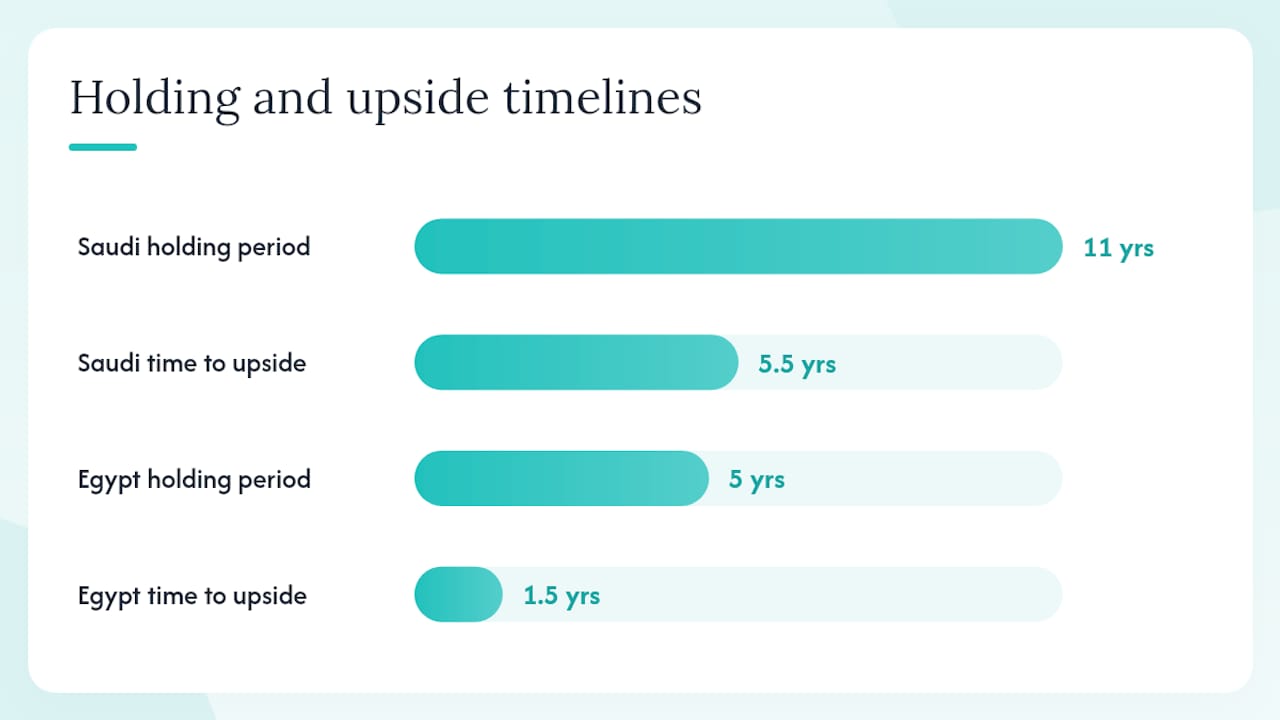
The table tells a clear story for most US investors: Egypt offers a shorter path to cashflow, a functioning exit market, and lower capital commitment. Saudi offers a higher-upside long-term play, but only for investors who can tolerate a long hold, limited liquidity, and evolving ownership rules.
What are the biggest risks to your Red Sea returns?
- Regulatory and delivery risk (Saudi): Project timelines can extend; foreign ownership rules may tighten or remain restrictive
- Environmental enforcement (Saudi): Visitor caps could limit occupancy upside if enforced strictly
- Currency and repatriation (Egypt): Egyptian pound movements affect dollar-denominated returns; confirm repatriation pathways before purchase
- Developer solvency (both markets): Off-plan purchases carry completion risk; check developer track record and escrow arrangements
- Liquidity at exit (Saudi): Thin secondary market means exit timing is uncertain
- HOA and fee surprises (Egypt): Branded resort fees can reduce net yield by 2–4 percentage points versus headline gross
Practical mitigations:
- Verify land title and freehold status with a licensed local attorney before signing anything
- Use escrow or staged payment plans tied to construction milestones, not calendar dates
- Request a performance bond or developer guarantee where available
- Engage a vetted local property manager before purchase, not after
- Consult a US-based tax advisor on FBAR reporting, PFIC rules, and foreign income treatment
This article is general information, not legal or financial advice. Confirm current rules with a qualified attorney and tax professional before committing capital.
Your due-diligence checklist before buying Red Sea property
- Verify land title: confirm freehold or usufruct status and check for encumbrances
- Confirm SRSA licensing (Saudi) or local permitting and zoning compliance (Egypt)
- Review developer track record: completed projects, delivery timelines, and buyer reviews
- Examine HOA and maintenance fee structures in detail, not just headline figures
- Model net yield at 60% occupancy before accepting any developer projection
- Confirm exit pathways: ask for recent comparable resale transactions in the same development
- Check legal ownership requirements for foreign buyers in your target submarket
Questions to ask your agent or developer:
- What is the average occupancy rate in this development over the past 12 months?
- What are the total annual HOA and maintenance costs per unit?
- How many units in this development have resold in the past two years, and at what price?
- Is the title freehold, and can a foreign national hold it directly?
Pro Tip: In Egypt, payment plans from reputable developers can stretch 5–7 years with zero interest. Structuring your purchase this way improves IRR significantly compared with a cash purchase, because you deploy capital in tranches while the asset appreciates. Padsabroad can identify which developers currently offer the strongest plan terms.
Three investor profiles and how their returns play out
-
Income-focused buyer (Egyptian Red Sea apartment, $80,000–$120,000): Targets Hurghada or Sahl Hasheesh; expects 8–11% gross yield, 5–7% net after fees; cashflow-positive within 12–18 months; exit via resale in 3–5 years with moderate appreciation upside. This profile suits investors who want predictable income and a clear exit path.
-
Long-horizon appreciation buyer (Saudi megaproject-linked opportunity): Accepts a 5–10 year wait before material capital gains; entry price is high; liquidity is limited until the secondary market matures post-2028. Suitable only for investors with patient capital and no near-term income requirement from this asset.
-
Hybrid short-term rental operator (branded residence, Soma Bay or Marassi): Targets beachfront or resort-integrated units that command premium nightly rates; blended IRR of 8–12% is achievable with a professional management partner; operational complexity is higher, and seasonality modeling is critical. The short-term rental income potential in Egypt is strongest in Q4 through Q1, when European demand peaks.
Key Takeaways
Egyptian Red Sea markets deliver near-term rental yields of 8–11% gross with active resale liquidity, while Saudi megaprojects offer long-horizon appreciation but require a 7–15 year hold and carry higher delivery risk.
| Point | Details |
|---|---|
| Egypt wins on near-term income | Gross yields of 8–11% in prime Hurghada locations; cashflow-positive within 12–24 months. |
| Saudi suits patient capital only | Material upside from Red Sea Global and Amaala likely requires a 2028–2035+ horizon. |
| Net yield is what matters | Management fees, HOA costs, and currency movements can reduce gross yield by 3–5 percentage points. |
| Due diligence is non-negotiable | Verify freehold title, developer track record, and HOA fees before any commitment. |
| Padsabroad covers Egypt's key markets | Padsabroad supports US buyers across Hurghada, El Gouna, Soma Bay, Marsa Alam, and Port Ghalib with listings, legal guidance, and management connections. |
Padsabroad's perspective on where US investors should focus
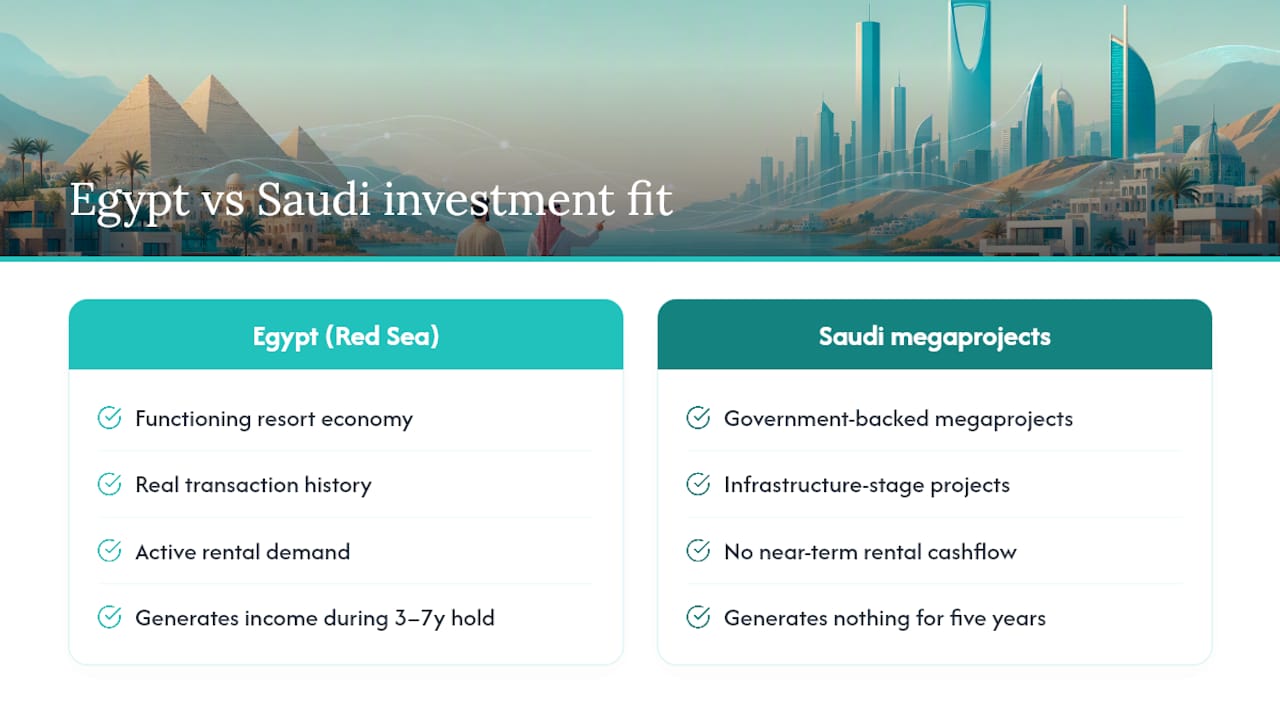
The framing of "Saudi vs. Egypt" can mislead investors into treating these as equivalent alternatives. They are not. Saudi megaprojects are infrastructure bets on a government-backed tourism vision. Egyptian Red Sea markets are functioning resort economies with real transaction history, active rental demand, and buyers who have already exited profitably.
For a US investor with a 3–7 year horizon and a need for income during the hold period, Egypt is the only realistic choice right now. The yield data supports it, the resale market supports it, and the entry costs are accessible without institutional-scale capital.
The Saudi opportunity is real, but it belongs in a different part of a portfolio: long-duration, illiquid, and speculative in the best sense of that word. Investors who conflate the two risk buying into a Saudi project expecting Egyptian-style cashflow, then holding an asset that generates nothing for five years while construction continues around them.
What Padsabroad recommends for US buyers: start with a shortlist of income-generating Egyptian Red Sea properties, model the net yield conservatively, verify title through a licensed attorney, and secure a vetted local property manager before you close. That sequence protects capital and sets realistic expectations from day one.
Ready to find the right Red Sea property for your goals?
Padsabroad works directly with US and international buyers across Egypt's Red Sea coast, covering Hurghada, El Gouna, Sahl Hasheesh, Soma Bay, Marsa Alam, and Port Ghalib. The focus is practical: property discovery matched to your yield targets, introductions to vetted legal professionals for title and ownership verification, and connections to proven local management companies for rental operations.
You can start with the First-Time Buyer Guide to Egypt Red Sea Property Investment for a step-by-step walkthrough of the purchase process, or go straight to browsing current listings across all key submarkets. For investors who want to buy property in Egypt safely with full legal protection, Padsabroad's team can walk you through the process from first search to keys in hand.
Primary sources and further reading
- Saudi Arabia’s Red Sea: Regulation is turning a coastline into an asset class | ZAWYA
- Hurghada, North Coast, and Red Sea: Coastal Real Estate Trends & Investment Returns 2026 | Egypt Real Estate
- The Economic Impact of the Marassi Red Sea Mega-Project on Egypt’s Real Estate Market | Egypt Real Estate
- Red Sea Property Investment: A 2026 Guide to High-Yield Coastal...
- PADSABROAD