
Beachfront property is defined by its direct, unobstructed access to the shoreline, and that single characteristic is the primary reason why beachfront property rents higher than any other coastal category. Investors who understand this distinction gain a real edge. The premium is not just about the view. It comes from a combination of geographic scarcity, strong guest demand, and the psychological value guests place on stepping directly onto the sand. This guide breaks down every major factor driving coastal property rental prices, so you can evaluate whether a beachfront investment fits your goals.
Why beachfront property rents higher: the core economic drivers
Beachfront land is finite. You cannot build more of it. That geographic limitation creates a supply ceiling that keeps pricing power firmly in the landlord's favor, regardless of broader market conditions.
The "first-row premium" is the industry term for the sharp price advantage that direct beach access commands over every other property type. Direct beach access commands 30%–50% more per night than comparable non-beachfront properties. That gap exists because guests lose the core experience the moment they must cross a road or walk through a public access point to reach the sand.

Discretionary travel budgets also play a major role. Guests booking a beach vacation are spending leisure money, not necessity money. That mindset makes them far more willing to pay a premium for the best available option. Coastal rental rates can adjust upward by 15%–20% or more during peak holidays because demand spikes while supply stays fixed.
The psychological benefits of beachfront living reinforce this pricing power further. Privacy, convenience, and the lifestyle experience of waking up to the ocean all contribute to what guests are actually buying. They are not renting square footage. They are renting an experience.
Pro Tip: When evaluating a beachfront property, confirm that the listing qualifies as true first-row access. Properties described as "beachfront" that require crossing a public road lose a significant portion of their pricing leverage.
How does seasonality impact beachfront rental income?
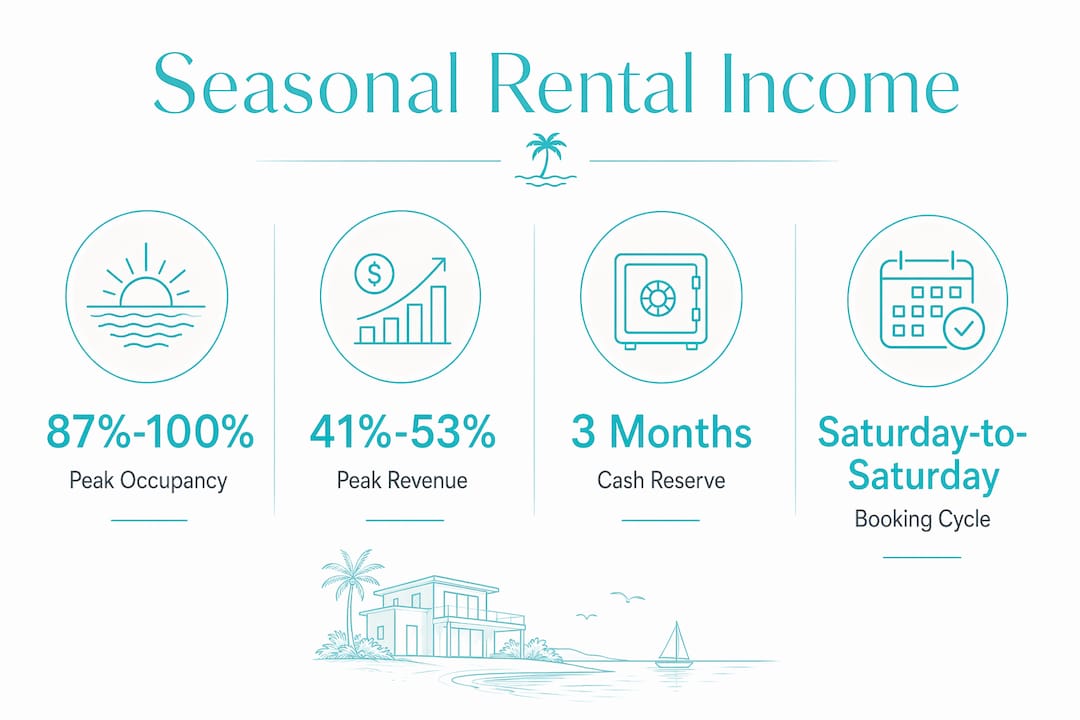
Seasonality is the defining financial characteristic of beachfront rental investments. Annual revenue concentrates heavily, with 41%–53% of total income earned within a single 90-day peak season. That concentration creates strong cash flow for a short window and near silence for the rest of the year.
Markets like Cape Cod and the Outer Banks illustrate this pattern clearly. In Cape Cod's top sub-markets, summer occupancy rates reach 87%–100% in areas like North Chatham and Harwich. Winter occupancy in those same markets drops to 20%–40%. The income swing is dramatic, and investors who ignore it face serious cash flow problems.
Weekly booking cycles reduce the damage. The Outer Banks operates on a Saturday-to-Saturday rental model that minimizes turnover costs and maximizes revenue per booking. Geographic constraints like limited bridge access also restrict supply, which keeps pricing power intact throughout the peak window.
| Season | Typical Occupancy | Revenue Share |
|---|---|---|
| Peak summer (June–August) | 87%–100% | 41%–53% of annual total |
| Shoulder season (spring/fall) | 40%–65% | 30%–40% of annual total |
| Off-season (winter) | 20%–40% | 10%–20% of annual total |
Pro Tip: Build a cash reserve equal to at least three months of operating costs before your first winter. Shoulder-season marketing to remote workers and couples can meaningfully reduce the income gap between summer and winter.
What are the costs and risks of beachfront rental investments?
Higher gross income does not automatically mean higher net returns. Beachfront properties carry a specific set of costs that inland rentals do not face, and investors need to account for all of them before modeling returns.
The major cost categories include:
- Insurance: Coastal properties face higher premiums due to storm, flood, and wind exposure. In hurricane-prone markets, this cost can be substantial.
- Maintenance: Salt air accelerates wear on exterior finishes, HVAC systems, and outdoor furniture. Replacement cycles are shorter than for inland properties.
- Taxes: Cape Cod combined STR tax rates can reach up to 17.45%, with rules varying by town. Tax compliance alone requires dedicated attention.
- Regulatory complexity: Coastal towns frequently impose short-term rental licensing requirements, occupancy limits, and noise ordinances that change regularly.
- Seasonal vacancies: Without active shoulder-season marketing, the off-season income gap can erode annual returns significantly.
The tax burden deserves particular attention. A combined lodging and occupancy tax rate approaching 17.45% in Massachusetts coastal markets means that a meaningful share of gross rental income flows directly to local and state governments. Investors must model net income after taxes, not gross revenue, to get an accurate picture of returns.
How do beachfront and ocean-view properties compare for investors?
Beachfront is not always the superior investment when measured by net cash flow. Ocean-view properties can outperform average beachfront investments due to lower acquisition costs and lower HOA fees, even though their nightly rates are lower.
The price-to-rent ratio often favors ocean-view properties. A beachfront unit might cost 40% more to acquire than a comparable ocean-view unit in the same resort, but the nightly rate premium rarely reaches 40%. That gap compresses the yield on beachfront acquisitions, particularly in markets with high entry prices.
Guest behavior adds another layer of nuance. First-time visitors often book ocean-view properties because the view satisfies their expectations at a lower price point. Repeat visitors who have experienced both categories tend to prioritize direct beach access because they understand the lifestyle difference. That repeat-visitor dynamic supports long-term occupancy for true beachfront properties, but it takes time to build.
HOA fees in beachfront resort developments can also be significantly higher than in ocean-view buildings. Those fees cover beach maintenance, private access infrastructure, and security, all of which add to the annual operating cost. Smart investors evaluate the full cost stack, not just the purchase price and projected nightly rate.
Experienced investors avoid what analysts call "category traps." They evaluate price-to-rent ratios and total operational costs rather than assuming beachfront always outperforms. A well-located sea-view studio in a high-demand coastal market can generate stronger net yields than a poorly priced beachfront unit with high carrying costs.
What steps can investors take to maximize beachfront rental income?
Strong gross revenue potential means nothing without a deliberate management strategy. These six steps give beachfront investors the best chance of converting location advantage into real returns.
- Apply dynamic pricing. Adjust nightly rates weekly based on local demand signals, competing inventory, and upcoming holidays. Median nightly rates in coastal markets can jump by up to 17% within a single week when transitioning into peak summer pricing.
- Add beach-specific amenities. Outdoor showers, kayaks, paddleboards, and beach chairs create an experience that guests pay a premium for. Beachfront-specific amenities generate income streams and guest loyalty that standard rentals cannot replicate.
- Shift to weekly booking cycles. Weekly bookings reduce cleaning costs, lower turnover risk, and increase total yield per reservation. This model works particularly well in markets with strong family vacation demand.
- Market actively in shoulder seasons. Target remote workers, couples, and retirees during spring and fall. These groups are less price-sensitive than summer families and can fill gaps that would otherwise sit empty.
- Build a maintenance reserve. Coastal wear is real. Set aside a fixed percentage of gross income each month to cover exterior repainting, HVAC servicing, and furniture replacement on a predictable schedule.
- Use local market data. Sub-market performance varies widely even within the same coastal town. Identify the specific neighborhoods and property types with the strongest occupancy rates before committing to a purchase.
Padsabroad's perspective on beachfront investment realities
The biggest mistake investors make is treating "beachfront" as a guarantee rather than a starting point. The location label creates pricing power, but it does not manage the property, handle the taxes, or fill the calendar in January.
Seasonality is the variable that catches most first-time coastal investors off guard. The numbers look extraordinary in July. They look very different in November. Investors who model their returns using peak-season occupancy rates across twelve months are setting themselves up for a cash flow problem. The correct approach is to model conservatively, assume winter occupancy at the low end, and treat any shoulder-season income as upside.
The "first-row premium" is real, but it requires verification. Padsabroad has seen properties marketed as beachfront that require guests to cross a public road or share a narrow access path with a neighboring development. That is not the same product. The pricing power of true direct access does not transfer to a property that merely faces the sea from a distance.
The Red Sea coast, particularly in areas like Sahl Hasheesh and Soma Bay, offers a genuinely different risk profile from North American coastal markets. Lower acquisition costs, year-round warm weather, and growing international tourism demand reduce the seasonal volatility that makes Cape Cod-style investments so challenging to manage. That does not mean the risks disappear. It means the risk profile is different, and investors should understand that difference before comparing yields across markets.
The best beachfront investments combine true first-row access, realistic seasonal cash flow modeling, and a clear plan for the off-season months. Location is the foundation. Management is what builds the return on top of it.
— Padsabroad
Beachfront investment opportunities on Egypt's Red Sea coast
Egypt's Red Sea coastline offers beachfront and ocean-view investment properties at price points that are difficult to find in European or North American coastal markets.

Padsabroad specializes in helping international buyers find and purchase coastal properties in Hurghada, El Gouna, Sahl Hasheesh, Soma Bay, and Marsa Alam. The Red Sea's year-round sunshine reduces the seasonal income gap that makes many beachfront investments difficult to manage. If you are evaluating your first coastal investment, the first-time buyer guide covers the full purchase process, tax considerations, and return expectations for Egypt's coastal market. You can also browse current beachfront and sea-view listings to compare property types and price points across the Red Sea region.
FAQ
Why does beachfront property rent higher than ocean-view?
Direct beach access eliminates the need to cross roads or shared paths, which guests value highly. The "first-row premium" commands 30%–50% more per night than comparable non-beachfront properties.
How much of beachfront rental income comes from peak season?
Between 41% and 53% of annual beachfront rental revenue concentrates within a single 90-day peak season. Investors must plan cash reserves carefully to cover the off-season months.
Are beachfront rentals always a better investment than ocean-view?
Not always. Ocean-view properties often carry lower acquisition costs and HOA fees, which can produce stronger net yields despite lower nightly rates. Evaluating the price-to-rent ratio is the correct approach.
What taxes apply to beachfront short-term rentals?
Tax rates vary significantly by location. In Massachusetts coastal markets, combined short-term rental tax rates can reach up to 17.45%. Investors should model net income after all local and state taxes before projecting returns.
What amenities increase beachfront rental income the most?
Beach-specific amenities like kayaks, paddleboards, outdoor showers, and beach chairs generate guest loyalty and justify premium pricing. These additions create an experience that guests cannot replicate in standard rental properties.
Key takeaways
Beachfront property rents higher because geographic scarcity, direct beach access, and strong seasonal demand create pricing power that no other property category can match at the same level.
| Point | Details |
|---|---|
| First-row premium | Direct beach access commands 30%–50% more per night than comparable non-beachfront properties. |
| Seasonal income concentration | 41%–53% of annual revenue earns within a single 90-day peak season; winter occupancy drops to 20%–40%. |
| Tax and cost burden | Combined STR tax rates can reach 17.45% in coastal markets; model net income, not gross revenue. |
| Ocean-view can outperform | Lower acquisition costs and HOA fees mean ocean-view properties sometimes generate stronger net yields. |
| Management drives returns | Dynamic pricing, weekly booking cycles, and shoulder-season marketing convert location advantage into real income. |