
A local solicitor is the single most important professional you will hire when buying property abroad. Not the agent. Not the developer's recommended lawyer. An independent, licensed attorney who works exclusively for you, knows the local legal system, and has no financial relationship with the seller or any other party in the transaction.
The term "local solicitor" in international property buying refers to a licensed attorney practicing in the country where the property sits. He or she performs conveyancing, legal due diligence, and contract review under that country's laws. Your home-country lawyer, no matter how experienced, cannot legally conduct those tasks in a foreign jurisdiction.
Why a local solicitor is indispensable in any overseas purchase
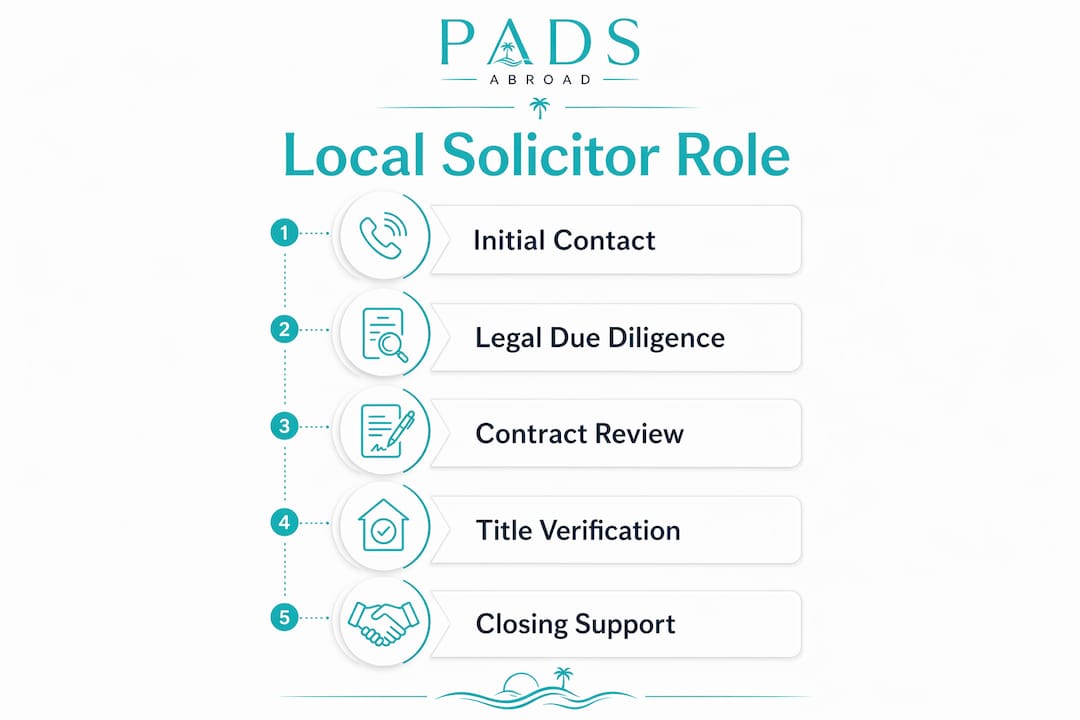
The role of a local solicitor in an overseas purchase goes far beyond paperwork. These professionals carry out the legal work that protects your ownership rights before you transfer a single dollar.
Here is what a qualified local solicitor does for you:
- Verifies the seller's legal title and confirms the property is genuinely theirs to sell, using local registries and official records
- Checks for liens, encumbrances, and outstanding mortgages that could transfer to you upon purchase, per legal due diligence standards in foreign jurisdictions
- Confirms property boundaries against cadastral maps and identifies any pending boundary disputes or enforcement actions
- Reviews planning permissions and verifies that any construction on the land complies with local building regulations
- Flags foreign ownership restrictions, which in some countries include limits on property type, geographic zone, or the legal structure through which you may hold title
- Negotiates contract terms on your behalf, including deposit conditions, completion timelines, and quality warranties
- Coordinates with notaries, tax advisors, and local authorities to cover every aspect of the transaction
One point buyers often miss: in many civil-law countries, a notary oversees the transaction and registers the deed, but they remain a neutral public official. Notaries do not advocate for buyers. They authenticate and register. Your solicitor is the only professional in the room whose legal duty runs entirely to you.
Failure to engage independent legal counsel risks capital loss, ownership disputes, or even property confiscation in jurisdictions where foreign ownership violations carry severe penalties.

How to select the right local solicitor for your overseas property purchase
Choosing the right attorney takes more than a quick internet search. The quality of your legal representation directly affects the safety of your investment.
Start with credible referral sources:
- U.S. embassies and consulates maintain lists of local attorneys willing to assist American buyers, though U.S. government personnel cannot recommend any specific lawyer or act on your behalf in private legal matters
- International property organizations such as the Association of International Property Professionals (AIPP) include vetted law firms among their members
- Consulates in the destination country often maintain separate attorney lists worth requesting
Verify credentials before committing:
- Confirm active membership in the local bar association
- Check for professional indemnity insurance, which protects you if the solicitor makes an error
- Ask whether they hold any dual qualification, particularly relevant if you want a lawyer registered with the Law Society in the UK who also practices in the destination country
Confirm independence above all else. Agents and developers frequently recommend their own preferred lawyers to maintain control over the transaction. Buyers need truly independent solicitors to avoid conflicts of interest. If the agent seems surprised or resistant when you insist on your own counsel, treat that as a warning sign rather than a cultural quirk.
Prioritize language and cross-border experience:
- Your solicitor should be fluent in your language or provide certified translation of all documents
- Experience with international buyers means they understand cross-border tax implications, not just local conveyancing
- Ask specifically about their experience with buyers from your home country
Get fee clarity in writing upfront. Overseas legal fees for property purchases typically represent a small percentage of the purchase price, with variations depending on the market and firm. Request an itemized estimate covering all stages, including any specialists or translators the solicitor may need to engage.
Pro Tip: Ask every candidate solicitor for a written legal opinion on whether foreign ownership of the specific property is permissible under local law. A licensed attorney who hesitates to provide this in writing is not the right choice for your transaction.
For buyers exploring Spain specifically, understanding how to buy a house in Spain as a foreigner illustrates exactly why local legal expertise is non-negotiable in civil-law markets.
Why a local solicitor outperforms relying on your home-country lawyer
Many buyers assume their trusted attorney back home can handle an overseas purchase with a bit of research. That assumption creates real legal exposure.
Attorneys licensed in the United States are not admitted to practice before foreign courts and cannot legally represent you in overseas property transactions. The U.S. State Department confirms that American attorneys may not represent clients in foreign courts unless they are separately admitted to practice there. A U.S. attorney with international law experience can help you understand the process and may recommend a foreign attorney, but they cannot substitute for one.
Local solicitors bring advantages that no remote lawyer can replicate:
- Direct registry access. Local attorneys access property registries, cadastral databases, and planning records in real time. Remote lawyers depend on secondhand information or local agents to gather the same data.
- Established relationships with local authorities. When an issue arises mid-transaction, a local solicitor can resolve it quickly through direct communication with the relevant office. A foreign lawyer cannot.
- Jurisdiction-specific contract knowledge. Every country has its own standard contract clauses, buyer protection mechanisms, and procedural requirements. A solicitor who practices locally every day knows which clauses are negotiable and which are legally mandated.
- Procedural compliance. Missing a local registration deadline or failing to obtain a required government approval can void a transaction or trigger penalties. Local solicitors track these requirements as a matter of routine practice.
For a broader look at how overseas property ownership works across different legal systems, the structural differences between common-law and civil-law jurisdictions become clear quickly.
Common legal pitfalls in overseas purchases and how solicitors prevent them
International buyers face a specific set of legal risks that rarely appear in domestic transactions. Most of them are preventable with proper legal representation.
Undisclosed liens and encumbrances. A property may carry outstanding mortgages, unpaid utility debts, or third-party rights that the seller does not volunteer. Without a thorough title search through local registries, these transfer to the buyer. A local solicitor conducts that search as a standard step, not an optional add-on.
Incomplete or one-sided contracts. Purchase contracts drafted by sellers or developers often lack buyer protections. They may omit dispute resolution clauses, fail to define completion timelines, or include penalties that apply only to the buyer. Your solicitor reviews every clause, negotiates amendments, and ensures the contract reflects what you actually agreed to.
Foreign ownership restriction violations. Some countries restrict non-nationals from holding freehold title, require government approval for certain purchases, or mandate that foreign buyers hold property through a local corporate entity. Violating these rules can result in forced sale or confiscation. Confirming foreign ownership permissibility requires a written legal opinion from a licensed local attorney, not a verbal assurance from an agent.
Document fraud and authentication gaps. In markets with less centralized property registries, deeds and ownership certificates can be forged or carry notarization irregularities. A local attorney verifies document authenticity and confirms the seller's legal capacity to convey the property.
Boundary and planning disputes. A property may encroach on neighboring land or include structures built without planning permission. These issues surface during a proper title search and site review. Buyers who skip independent legal checks often discover these problems only after completion, when remedies are far more expensive.
For a detailed look at the full range of risks, Padsabroad's guide to common pitfalls buying overseas property covers the most frequent mistakes international buyers make and how to avoid them.
Expert insights and best practices for working with local solicitors
The most experienced international buyers treat their local solicitor as the coordinator of the entire professional team, not just one advisor among several.
Build a coordinated legal and tax team. Legal compliance and tax compliance are separate disciplines. Local solicitors ensure legal compliance; tax advisors manage cross-border tax liabilities and reporting obligations in both the destination country and your home country. You need both, and they should communicate with each other throughout the transaction.
Verify ethical independence, not just credentials. Bar membership and indemnity insurance confirm competence. They do not confirm that the solicitor has no financial relationship with the developer or agent. Ask directly whether the solicitor has received referral fees or has any ongoing relationship with the other parties in your transaction.
Request written opinions, not verbal assurances. A written legal opinion on foreign ownership permissibility is standard practice and protects you if a dispute arises later. Any solicitor unwilling to put their assessment in writing is not providing the level of service an international buyer requires.
Engage your solicitor before signing anything. Many buyers sign a reservation agreement or preliminary contract before their solicitor has reviewed it, assuming these documents are non-binding. In many jurisdictions they are not. Your solicitor should review every document, including the earliest reservation forms, before you sign.
Understand what the notary does and does not do. In France, Spain, Germany, Italy, and many other civil-law countries, a notaire or notario oversees and registers the sale. They are impartial public officers who authenticate identity and register deeds. They are not your advocate. Independent solicitors act as buyers' legal guardians in a way that notaries, by design, cannot.
Pro Tip: Ask your solicitor to confirm in writing that they have no referral arrangement with the agent or developer before you formally engage them. This single step eliminates the most common conflict-of-interest scenario in overseas transactions.
For buyers who want qualified legal guidance specific to their destination market, working with specialists who understand both local law and international buyer requirements makes a measurable difference in transaction outcomes.
Key Takeaways
A local solicitor is the only professional in an overseas property transaction whose legal duty runs entirely to the buyer, making independent legal representation the single most important decision an international buyer makes.
| Point | Details |
|---|---|
| Independent solicitor is essential | Only a licensed local attorney can perform due diligence, verify title, and negotiate contracts on your behalf. |
| Notaries do not protect buyers | In civil-law countries, notaries register transactions impartially; they do not advocate for buyer interests. |
| Verify independence before engaging | Confirm no referral relationship exists between your solicitor and the agent or developer. |
| Coordinate legal and tax professionals | Legal compliance and cross-border tax obligations require separate qualified advisors working together. |
| Padsabroad connects buyers to vetted counsel | Padsabroad helps international buyers access independent, English-speaking solicitors for Egypt Red Sea property purchases. |
Why legal representation is the foundation of safe overseas investment
Buyers sometimes treat legal fees as a cost to minimize. That framing gets the math exactly backward. A solicitor who charges 1–1.5% of the purchase price and prevents a title dispute, a fraudulent transfer, or a foreign ownership violation saves multiples of their fee on the first problem they catch.
The harder truth is that the overseas property market creates structural pressure against independent legal representation. Agents earn commissions. Developers want fast closings. Preferred lawyers keep transactions moving in directions that favor the parties who refer them. Buyers who accept recommended counsel without verifying independence are not saving money. They are accepting a conflict of interest at the most legally consequential moment of the transaction.
Local solicitors with genuine independence and language fluency are not interchangeable with any other professional in the process. They are the only party whose legal obligation runs exclusively to the buyer. Every other professional in an overseas transaction, including agents, developers, notaries, and currency brokers, serves their own interests first. Your solicitor is the exception, but only if you choose one who is truly independent.
The buyers who navigate overseas purchases successfully share one consistent habit: they engage their solicitor early, before any document is signed, and they treat that solicitor's written opinion as the final word on whether to proceed.
Buying safely in Egypt's Red Sea market with Padsabroad
Padsabroad specializes in guiding international buyers through property purchases along Egypt's Red Sea coast, covering markets like Hurghada, El Gouna, Sahl Hasheesh, Soma Bay, and Marsa Alam. The legal landscape for foreign buyers in Egypt has its own specific requirements, and navigating them without the right support creates unnecessary risk.

Padsabroad connects buyers to independent, English-speaking local solicitors who understand Egyptian property law, foreign ownership regulations, and the specific conveyancing procedures that apply to international buyers. The team supports every stage, from solicitor selection and contract review through to final registration, with legal, financial, and tax considerations addressed together rather than in isolation. For buyers starting out, the first-time buyer guide to Egypt Red Sea property covers the full process, and buyers who want to understand the due diligence framework in detail can start with the safe property buying guide before taking any further steps.