
Egyptian property can deliver predictable cash flow from urban long-term leases or seasonal high-yield returns from Red Sea coastal units — but the Egyptian Tax Authority (ETA) and the Ministry of Tourism and Antiquities (MoTA) both have a say in how that income is classified and taxed. Before committing to a purchase, model at least one 1-bedroom and one 2-bedroom unit's gross and net yield using real local comps, then confirm your tax position with both Egyptian and U.S. counsel. Padsabroad works with international buyers across Hurghada, El Gouna, and the North Coast and can help you build that model from actual market data.
Key flags to keep in mind from the start:
- Egyptian Tax Authority: classifies frequent short-term rentals as taxable commercial activity, not passive income
- Ministry of Tourism and Antiquities: requires a Holiday Home License under Decree No. 209/2025 for any unit offered for short-term occupancy
- Padsabroad: provides local sourcing, due diligence coordination, and management referrals for foreign buyers
Pro Tip: Run two separate models before you shortlist properties: one for a Cairo apartment using steady 70–80% occupancy and a moderate average daily rate, and one for a Red Sea unit using a seasonally weighted occupancy curve with higher peak-month rates. The difference between the two tells you which income profile fits your portfolio.
Table of Contents
- How Egypt's dual rental market shapes your income profile
- What actually drives rental income in Egypt
- How to calculate gross yield, net yield, and ROI
- Egyptian tax rules and legal traps for vacation rentals
- What it costs to buy and operate a rental unit in Egypt
- Which unit types and locations give you the best rental outcomes
- How to operate your rental: management options compared
- What affects resale speed and price when you want to exit
- Principal risks and red flags to address before you buy
- Your next practical steps as an international investor
- Key Takeaways
- Why conservative modeling matters more than headline yields
- How Padsabroad helps you move from model to purchase
- Useful sources and further reading
How Egypt's dual rental market shapes your income profile
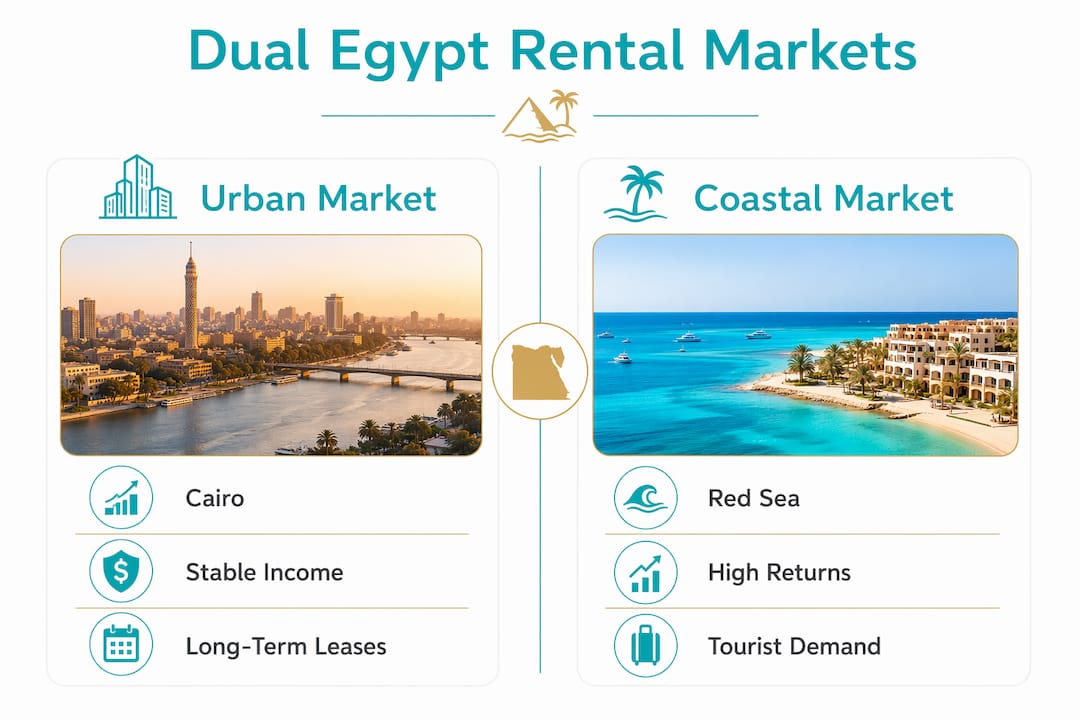
Egypt's rental market runs on two distinct engines, and understanding which one you are buying into changes everything about how you model returns.
Urban assets (Cairo, Alexandria) generate steady, lower-volatility income. Long-term leases to expatriates, business tenants, and domestic professionals produce consistent occupancy. Cairo's average gross rental yield was reported to be strong in 2025, with prime pockets like Zamalek and Mohandessin offering notably higher yields. Net yields after costs vary based on management and vacancy rates, generally showing a positive return for both long-term and short-term rentals in prime locations.

Coastal assets (Red Sea, North Coast) run on tourism demand. Average daily rates (ADR) are higher during peak season, but occupancy drops sharply in the off-season. Management intensity is also higher: you need a licensed operator, regular cleaning, and platform management.
A few practical differences between the two markets:
- Occupancy pattern: Urban assets run at relatively stable year-round occupancy; coastal assets spike October through April and slow in summer
- ADR: Coastal units command higher nightly rates during peak months; urban long-term rents are fixed by lease
- Management intensity: Short-term coastal lets require active management; urban long-term leases are largely passive once a tenant is in place
- Resale liquidity: Smaller urban apartments in established Cairo neighborhoods tend to sell faster than resort units
Pro Tip: For your first Egyptian investment, Padsabroad recommends 1-bedroom and 2-bedroom apartments in proven demand pockets. Smaller units offer deeper buyer and tenant pools, lower operating overhead, and easier remote management — all of which matter when you are managing from the U.S.
What actually drives rental income in Egypt
Tourism demand is the primary lever for coastal assets. Egypt recorded approximately 19 million tourist arrivals in 2025, a historic high, and Red Sea resort towns like Hurghada and Sharm El Sheikh absorbed a large share of that demand. Air connectivity, new resort development, and the growth of domestic staycation culture all support occupancy.
On the supply side, new-build inventory, finish quality, and hotel-grade amenities determine whether a unit competes at the top of the ADR range or gets lost in a crowded mid-market. Units with reliable air conditioning, backup power, and strong Wi-Fi consistently outperform on platforms like Airbnb and Booking.com.
Currency risk deserves a direct mention. The Egyptian pound (EGP) has experienced significant volatility, and rental income collected in EGP loses value in dollar terms when the pound weakens. Egypt has also maintained foreign exchange controls at various points, which can delay or complicate repatriation of rental proceeds. Budget for this in your net-return model and confirm current repatriation rules with a local bank or legal advisor before purchase.
How to calculate gross yield, net yield, and ROI
The core formulas are straightforward. Here is how to apply them, followed by a hypothetical worked example clearly labeled as illustrative.
Gross yield = (Annual rental income ÷ Purchase price) × 100
Net yield = ((Annual rental income − Annual operating costs) ÷ Purchase price) × 100
Simple cash ROI = Net annual income ÷ Total cash invested (including purchase costs)
Hypothetical worked example (illustrative only — not a guarantee)
The table below uses estimated figures to show how the math works for two unit types. Adjust inputs with real local comps before making any decision.
| Input | 1-Bed Red Sea (Coastal) | 2-Bed Cairo (Urban) |
|---|---|---|
| ADR (peak / off-season) | $70 / — | N/A (monthly lease) |
| Occupancy assumption | seasonally weighted occupancy | — |
A few notes on reading this table:
- The coastal gross yield looks attractive, but it assumes strong peak-season occupancy. A weaker season drops it materially.
- The Cairo net yield is lower but far more predictable. Management fees for remote foreign landlords typically run 8–12% of collected rent.
- Neither figure includes capital gains, currency movement, or the cost of furnishing and licensing.
For a deeper look at Egypt real estate ROI, Padsabroad's blog walks through additional scenario modeling.
Egyptian tax rules and legal traps for vacation rentals
This is the section most investors underestimate. The ETA does not simply tax rental income as passive income. When a unit is rented frequently, advertised on platforms, and managed in an organized way, the ETA treats it as a taxable commercial activity regardless of whether the owner is an individual or a company.
Key taxes to plan for:
- Personal income tax: Progressive brackets apply to net rental income (gross income minus a statutory 50% deduction for expenses). The top bracket reaches 27.5%.
- Corporate tax: If you operate through an Egyptian entity, corporate tax rates apply instead.
- VAT (14%): Once your short-term rental activity looks like organized tourism accommodation and turnover exceeds the registration threshold, VAT applies to the service revenue, not the property itself.
- Annual property tax: 10% of the assessed rental value (not market price), reassessed every five years.
If records are missing, tax examiners reconstruct income using advertised rates and assumed occupancy, which often produces assessments higher than actual income. Penalties for underreporting unpaid tax can be substantial, including fines and accrued interest.
For U.S. investors: foreign rental income must be reported on your U.S. federal return. Egyptian taxes paid may qualify as a foreign tax credit, but the two systems do not align perfectly. A U.S. CPA with international experience is not optional here.
Pro Tip: Keep a separate Egyptian bank account for rental income and expenses. Documented bookkeeping is your best protection against an ETA reconstruction assessment.
What it costs to buy and operate a rental unit in Egypt
One-time purchase costs typically include:
- Reservation deposit (varies by developer)
- Registration and notary fees (approximately 2–3% of property value)
- Lawyer fees (typically 1–2%)
- Developer handover charges and snagging costs
- Furnishing to holiday-home standard (budget separately)
Ongoing operating costs to model annually:
- Property management fees: 8–12% of collected rent for remote foreign owners
- Platform/OTA commissions: typically 15–20% of booking revenue
- Utilities, cleaning, and maintenance
- Holiday Home License renewal (annual, under MoTA Decree No. 209/2025)
- Accounting and tax compliance fees
- Municipal fees and building service charges
| Cost category | Typical range |
|---|---|
| Property management | 8–12% of rent |
| OTA commissions | 15–20% of revenue |
| Utilities and cleaning | 5–8% of revenue |
| Maintenance and repairs | 2–5% of revenue |
| Tax and accounting | 1–3% of revenue |
| Total operating costs | approximately 30% of gross revenue |
Pre-opening compliance checklist before your first booking:
- Obtain Holiday Home License from MoTA (proof of ownership, Civil Defence approvals, tax registration)
- Register with the Egyptian Tax Authority and obtain a tax number
- Open a dedicated Egyptian bank account for rental income
- Confirm VAT registration status with your accountant
- Arrange property insurance covering short-term occupancy
For a full purchase walkthrough, Padsabroad's guide on buying property in Egypt as a foreigner covers the legal steps in detail.
Which unit types and locations give you the best rental outcomes
Smaller units outperform for most foreign investors. One-bedroom and two-bedroom apartments offer deeper tenant pools, lower operating costs, and faster resale compared to large villas. A villa may command a higher nightly rate, but occupancy is harder to sustain and the carrying costs are proportionally larger.
Location rules of thumb:
- Red Sea resorts (Hurghada, El Gouna, Sahl Hasheesh, Soma Bay, Marsa Alam): Best for seasonal tourism yield; target units within resort compounds with managed amenities
- North Coast (Ras El Hekmah area): Strong domestic demand in summer; growing international interest
- Cairo (Zamalek, Garden City, New Cairo compounds): Best for steady expatriate and business tenant demand; lower management intensity
On the property itself, check building management quality, legal zoning, title clarity, and proximity to the airport or main attractions. For coastal units, hotel-grade finishes (reliable AC, backup power, quality fixtures) are the difference between a top-quartile listing and an average one.
Pro Tip: Furnished smaller units in Cairo's expat neighborhoods rent significantly faster than unfurnished equivalents. For coastal units, resort-compound properties with on-site management tend to hold resale value better than standalone buildings.
How to operate your rental: management options compared
| Factor | Short-term holiday let | Long-term lease |
|---|---|---|
| ADR / income potential | Higher (peak season) | Lower but fixed |
| Occupancy stability | Variable, seasonal | High and predictable |
| Management intensity | High (cleaning, guest comms, OTA) | Low once tenant is placed |
| Licensing requirement | MoTA Holiday Home License required | Standard lease registration |
| Best fit | Coastal resort units | Urban apartments |
Management options for remote foreign owners:
- Local professional manager: Handles bookings, guest check-in, cleaning, and maintenance. Best for coastal short-term lets. Commission typically 20–30% of revenue for full service.
- OTA-only / co-hosting: You manage listings; a local co-host handles on-the-ground tasks. Lower cost but requires more owner involvement.
- Hybrid model: Long-term lease in low season, short-term in peak months. Reduces vacancy risk but adds complexity.
Questions to ask any property manager before signing:
- Are you licensed under MoTA's current Holiday Homes framework?
- How do you vet guests and handle damage claims?
- What is your remittance schedule and currency?
- How do you report income for tax purposes?
- What is your average occupancy rate for comparable units?
Padsabroad can connect buyers with vetted property management services in Egypt as part of the purchase process.
What affects resale speed and price when you want to exit
Resale liquidity varies significantly by unit type, location, and documentation quality. Smaller furnished apartments in established resort compounds or Cairo expat neighborhoods sell faster than large villas or off-plan units in less-developed areas.
Factors that support a strong exit:
- Clear legal title and complete transfer documentation
- Reputable developer with a track record of completed projects
- Resort amenities and active compound management
- Proof of tax compliance and clean accounting records
- Regular maintenance log showing the unit has been well kept
Coastal seasonality affects timing. Listing a Red Sea unit during peak season (October through April) puts it in front of buyers who are visiting and can view in person. Off-season listings often sit longer and may attract lower offers.
Exit readiness checklist:
- Confirm title is clean and all transfer documents are in order
- Obtain a professional valuation before setting an asking price
- Compile maintenance records and tax compliance documentation
- Engage a local real estate lawyer to review the sale contract
- Confirm repatriation process for sale proceeds with your bank
Principal risks and red flags to address before you buy
Top risks and practical mitigations:
- Tax reclassification: Mitigate by registering correctly from day one and keeping documented accounts
- Missing Holiday Homes license: Obtain MoTA licensing before your first booking; engage local Tourism Directorate early
- Unclear title: Commission a full title search before exchange; use a qualified Egyptian property lawyer
- Developer delivery delays or inferior finishes: Require milestone-based payment schedules and written contractor warranties
- EGP currency volatility: Model returns in both USD and EGP; confirm repatriation process before purchase
- Seasonality risk (coastal): Stress-test your model at 40% annual occupancy, not just peak-season rates
Pro Tip: Ask your lawyer to confirm the property's zoning classification before purchase. A unit zoned for residential use may face additional hurdles to obtain a Holiday Home License under the 2025 MoTA decrees.
Your next practical steps as an international investor
- Build your financial model using the formulas and table in this guide. Run at least two comps: one coastal Red Sea unit and one Cairo apartment.
- Engage Egyptian tax counsel to confirm income tax bracket, VAT registration threshold, and property tax implications for your specific structure.
- Consult a U.S. tax advisor on foreign rental income reporting, foreign tax credit eligibility, and FBAR/FATCA obligations if holding a foreign bank account.
- Order a title search and legal due diligence on any shortlisted property. Confirm zoning, developer reputation, and Holiday Home licensing eligibility with MoTA.
- Clarify property management terms before committing: remittance schedule, commission structure, licensing compliance, and reporting cadence.
Additional resources to support each step:
- Padsabroad's Egypt real estate investment checklist for a structured due-diligence framework
- The Cairo vs. coastal Egypt comparison guide for a side-by-side market analysis
- Amereller's briefing on MoTA Decrees No. 209/2025 and No. 801/2025 for the full licensing framework
Key Takeaways
Egypt's rental income opportunity is real, but it rewards investors who model conservatively, register correctly, and choose the right unit type from the start.
| Point | Details |
|---|---|
| Dual-market reality | Cairo delivers steady net yields; Red Sea coastal units offer higher seasonal returns with more management complexity. |
| Tax and licensing risk | The ETA treats organized short-term rentals as commercial activity; MoTA's 2025 decrees require a Holiday Home License before your first booking. |
| Unit type recommendation | One-bedroom and two-bedroom apartments in proven demand pockets outperform larger units on occupancy, resale speed, and operating cost. |
| Model before you commit | Run gross yield, net yield, and cash ROI calculations using real local comps and a conservative occupancy assumption for coastal assets. |
| Padsabroad as your starting point | Padsabroad provides property sourcing, due diligence coordination, and management referrals for international buyers across the Red Sea coast and Cairo. |
Why conservative modeling matters more than headline yields
The Egyptian market has a habit of showing investors attractive gross yield numbers that shrink considerably once taxes, management fees, licensing costs, and currency movement are factored in. The gap between a 17% gross yield and a 10% net yield is not a rounding error — it is the difference between a property that works and one that quietly drains cash.
What gets overlooked most often is the tax characterization question. Many investors assume that because they own the property personally, rental income is simply passive. The ETA's approach is the opposite: it looks at how the unit is operated, not how it is owned. An investor who lists on Airbnb, sets dynamic pricing, and uses a cleaning service has, in the ETA's view, entered a commercial activity. Getting that classification right from day one, with proper registration and documented accounts, is not a bureaucratic formality. It is the foundation of a profitable, defensible investment.
The 2025 MoTA licensing decrees actually help here. They formalize a previously grey market, which means compliant operators face less retroactive enforcement risk than those who operated informally before the rules existed. Early engagement with the local Tourism Directorate speeds approvals and reduces the chance of problems later.
How Padsabroad helps you move from model to purchase
Padsabroad gives international buyers a concrete advantage over going it alone: direct access to vetted coastal and urban listings, coordination of legal and tax due diligence, and warm introductions to local accountants and property managers who understand the MoTA licensing framework.

For investors focused on Red Sea rental income, Padsabroad's First-Time Buyer Red Sea guide walks through the full purchase process, from shortlisting units in Hurghada and Sahl Hasheesh to understanding management handoffs and licensing requirements. If you want to start with a rental-income model built around real current listings, or browse available properties for sale on the Red Sea, Padsabroad's team can put that together for you. Reach out directly through the website to request a portfolio review or a tailored income projection for your target budget.
Useful sources and further reading
The following sources were used to build this guide. Primary legal and tax sources are listed first.
- Amereller: New Holiday Homes Regulation in Egypt (Decrees No. 209/2025 and No. 801/2025) — Primary source for MoTA licensing requirements, documentation, and corporate operator rules
- Andersen Egypt: Tax Treatment of Vacation Rental Units in Egypt — Primary source for ETA characterization of short-term rentals and the substance-over-form principle
- Middle East Briefing: Vacation Rentals in Egypt — Tax Insights for Foreign Investors — VAT analysis and service-based assessment framework
- Mondaq: Tax Treatment of Vacation Rental Units in Egypt — Income reconstruction methodology and documentation risk
- GateIn: Short-Term Rental Tax Guide for Egyptian Property Owners 2026 — Progressive tax brackets, VAT registration thresholds, and penalty ranges
- Realting: Egypt Real Estate Investment 2026 — Market-level yield data, tourism arrival figures, and price index context
- Sands of Wealth: Buying and Renting Out in Cairo (2026) — Cairo-specific yield ranges, management fee benchmarks, and occupancy data
- Sands of Wealth: Egypt Rental Yields (Investor Advice) — Unit-type recommendations and occupancy depth analysis for foreign buyers
- International Property Directory: Egypt Rental Properties Analysis — Dual-engine market framing and urban vs. coastal income behavior