
What U.S. investors owe on foreign real estate in 2026
U.S. citizens and resident aliens must report worldwide income to the IRS every year, and foreign property is no exception. Rental income, capital gains, and proceeds from overseas sales all fall under this obligation, regardless of where you live or where the property sits.
Here is a quick summary of what that means in practice:
- Report all rental income from foreign property on Schedule E of your federal return.
- Pay U.S. capital gains tax on profits from selling overseas real estate, calculated using your original purchase price, improvements, and selling costs.
- Claim the Foreign Tax Credit via IRS Form 1116 to offset taxes already paid to a foreign government and reduce double taxation.
- File FBAR (FinCEN Form 114) if your foreign financial accounts exceed $10,000 at any point during the year.
- Comply with FATCA (Form 8938) if your foreign financial assets cross the applicable reporting threshold.
- Understand FIRPTA if you are a foreign person selling U.S. real property, as buyers must withhold 15% of the gross sale price under current IRS rules.
- Factor in local taxes such as annual property taxes and transfer duties, which vary widely by country and directly affect your net returns.
How the IRS taxes income and gains from foreign property
Rental income from an overseas property is taxable in the U.S. the same year you receive it. You report it on Schedule E alongside your other passive income, and you can deduct legitimate expenses such as local property taxes, mortgage interest, repairs, and depreciation. One point many investors miss: foreign rental income is classified as passive income, which means it cannot be excluded under the Foreign Earned Income Exclusion.
Capital gains work similarly. When you sell a foreign property at a profit, the IRS calculates your gain using your original purchase price plus any capital improvements, minus selling costs like legal fees and agent commissions. The resulting gain is taxed at U.S. capital gains rates.

There is one useful exception. If the foreign property served as your primary residence, you may qualify for the Section 121 Exclusion, which lets you exclude up to $250,000 in gains ($500,000 for married couples filing jointly), provided you owned and lived in the property for at least two of the last five years. That exclusion can meaningfully reduce your U.S. tax bill on a profitable overseas sale.
How the Foreign Tax Credit reduces double taxation
The Foreign Tax Credit is the primary tool U.S. investors use to avoid paying tax twice on the same income. Filed on IRS Form 1116, it allows you to offset your U.S. tax liability by the amount of tax you already paid to a foreign government on the same income or gain.
- Taxes paid on foreign rental income generally qualify for the credit.
- Taxes paid on capital gains from a foreign property sale can also be credited.
- The credit cannot exceed your U.S. tax liability on that foreign income, so it reduces but may not eliminate your U.S. bill.
- Rental income cannot be claimed under the Foreign Earned Income Exclusion, making the Foreign Tax Credit the only available relief for that income category.
Bilateral tax treaties add another layer. The U.S. has tax treaties with dozens of countries, and each one handles property income and gains differently. Some treaties give the source country the primary right to tax, while others limit withholding rates or provide additional credits. Checking the specific treaty for your property's country before you file can prevent unexpected tax bills and help you claim every credit you are entitled to.
Pro Tip: Keep copies of all foreign tax receipts and official tax assessments. The IRS requires documentation to support your Form 1116 claim, and missing records can result in a denied credit.
What FIRPTA means for buyers and sellers of U.S. property
FIRPTA applies specifically to foreign persons selling U.S. real property interests. Under the PATH Act of 2015, the withholding rate increased from 10% to 15% of the gross sale price, and that rate remains in effect for 2026.
A few key points every investor should know:
- The buyer is responsible for withholding and remitting the tax to the IRS using Form 8288.
- Withholding is not the final tax. The foreign seller must file a U.S. tax return to report the actual gain, and any excess withheld can be refunded.
- Sellers can apply for a reduced withholding certificate using IRS Form 8288-B before the sale closes, which can significantly improve cash flow at closing.
- A U.S. Tax Identification Number (TIN) is required before the sale; applying early avoids delays.
- Some states impose their own withholding on top of the federal requirement, adding another layer of planning.
Misreading FIRPTA withholding as a final tax is one of the most common and costly mistakes foreign sellers make. The refund process exists precisely because withholding is a collection mechanism, not a tax assessment. Filing your U.S. return after the sale is how you reconcile the two.
How local foreign taxes affect your net investment returns
Beyond U.S. federal obligations, every country where you hold property has its own tax system. The IMF's 2024 guidance on property tax reform highlights how wide the variation is across jurisdictions, and investors who ignore local taxes often find their net yields are much lower than projected.
Common local taxes to account for:
- Annual property taxes assessed on the property's value, paid to local or national authorities each year.
- Transfer taxes or stamp duties charged when a property changes hands, sometimes levied on both buyer and seller.
- Wealth or inheritance taxes that some countries apply to real estate held by non-residents.
- Capital gains taxes at the local level, which may apply in addition to U.S. federal tax on the same gain.
Local tax rates and structures differ substantially from country to country. A property that looks attractive on gross yield can look very different after local taxes are factored in. Building these costs into your return projections from the start is the clearest way to avoid surprises.
Why global tax transparency is raising the stakes for compliance
Tax authorities worldwide are sharing more information than ever before. The OECD's 2024 report on international tax transparency specifically highlights real estate as an area where automatic information exchange is expanding, with governments working to close gaps in cross-border ownership reporting.
For U.S. investors, this means the risk of undisclosed foreign property income being detected has grown considerably. Tax administrations now use shared data to verify whether funds used to purchase foreign real estate were properly declared, whether rental income was reported, and whether capital gains were taxed on disposal.
Strict compliance with FBAR, FATCA, and any entity-level reporting forms is the only reliable protection. Owning foreign property through a foreign corporation or partnership triggers additional IRS filings, specifically Form 5471 or Form 8865, with serious penalties for non-compliance.
Common pitfalls U.S. investors face with foreign real estate
Most compliance problems come from a handful of recurring mistakes. Knowing them in advance is the most practical form of tax planning available.
- Not reporting rental income from foreign property is one of the most audited issues for U.S. expats and investors.
- Buying through a foreign entity without understanding the IRS reporting requirements adds cost and complexity that often outweighs any perceived benefit.
- Missing FBAR filings when foreign accounts hold rental proceeds or sale proceeds: penalties for innocent non-filing can reach $10,000 per violation.
- Treating FIRPTA withholding as a final tax rather than a prepayment, which leads to poor cash flow decisions and missed refund opportunities.
- Ignoring treaty provisions that could reduce withholding rates or provide additional credits on property income.
Pro Tip: Apply for your U.S. TIN well before any planned property sale abroad. Processing delays are common, and a missing TIN can hold up closing or trigger default withholding rates.
Reviewing your overseas property ownership structure before you buy, not after, is the single most effective way to avoid these pitfalls. See also the common mistakes guide for a broader look at what trips up foreign property buyers.
How to manage tax compliance for foreign property investments
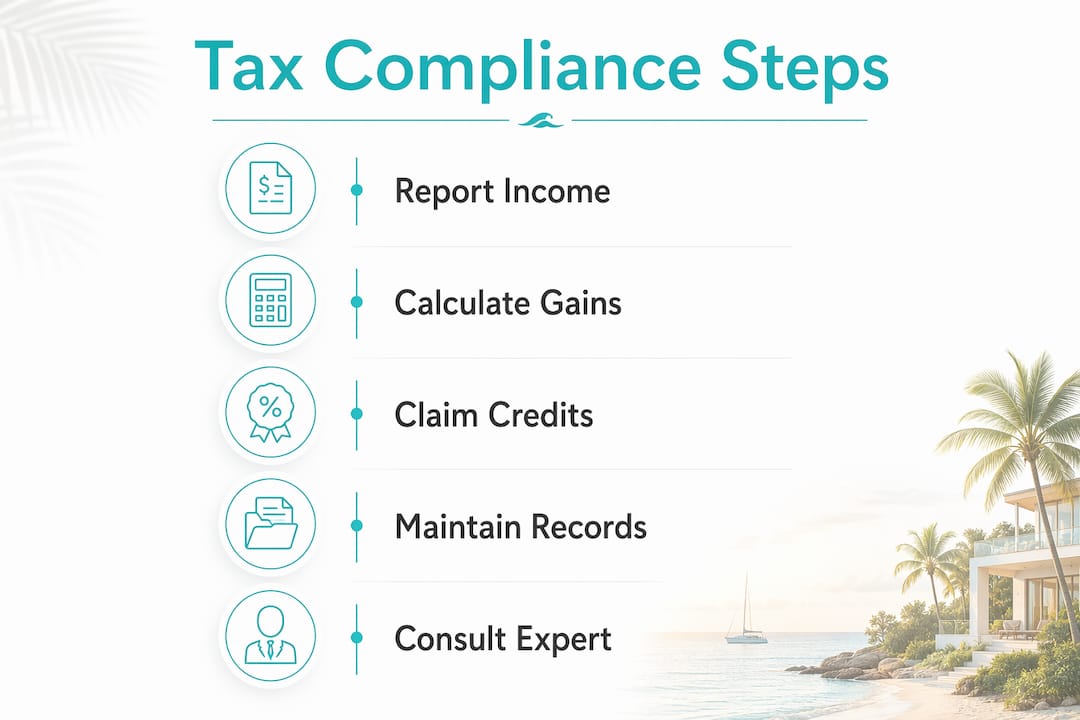
Good record-keeping is the foundation of everything else. From the day you purchase a foreign property, maintain detailed records of the purchase price, all capital improvements, operating expenses, and any foreign taxes paid. These records directly determine your taxable gain when you eventually sell.
Key filing responsibilities to track each year:
- Schedule E for foreign rental income and deductible expenses.
- Form 1116 for the Foreign Tax Credit on income or gains taxed abroad.
- FinCEN Form 114 (FBAR) if foreign account balances exceed $10,000 at any point.
- Form 8938 (FATCA) if foreign financial assets exceed the applicable threshold.
- Form 5471 or 8865 if you hold the property through a foreign corporation or partnership.
- Form 8288-B to request a reduced FIRPTA withholding certificate before a U.S. property sale.
Working with a tax professional who specializes in international real estate and expatriate tax law is not optional for most investors with foreign holdings. The rules change, treaties get updated, and the cost of a missed filing consistently exceeds the cost of professional advice. Reviewing IRS guidance annually and checking for treaty updates relevant to your property's country keeps your compliance current.
Thinking about investing in Egypt's Red Sea coast? Padsabroad works with international buyers across Hurghada, El Gouna, Sahl Hasheesh, and beyond, helping you understand the full picture before you commit.

Key takeaways
U.S. investors must report all foreign rental income and capital gains to the IRS, use the Foreign Tax Credit to reduce double taxation, and comply with FBAR, FATCA, and FIRPTA rules to avoid penalties.
| Point | Details |
|---|---|
| Worldwide income reporting | All U.S. citizens must report foreign rental income and capital gains on their federal return annually. |
| Foreign Tax Credit on Form 1116 | Offsets U.S. tax by the amount paid to a foreign government, reducing double taxation on the same income. |
| FIRPTA withholding at 15% | Buyers withhold 15% of the gross sale price from foreign sellers; sellers file a return to reconcile and claim any refund. |
| FBAR penalties up to $10,000 | Missing an FBAR filing when foreign accounts exceed $10,000 can trigger a civil penalty of up to $10,000 per violation. |
| Local taxes reduce net returns | Annual property taxes, transfer duties, and local capital gains taxes vary widely and must be built into return projections. |
Why proactive planning matters more than most investors realize
The conventional wisdom on foreign property investment tends to focus on gross yields and currency gains. What gets underestimated, consistently, is how much the tax layer compresses those returns when it is not planned for from the start.
The OECD's push for automatic information exchange on real estate ownership is not a future concern. It is already reshaping how tax authorities in the U.S. and abroad identify unreported income. Investors who assumed their overseas holdings were below the radar are finding that assumption increasingly wrong.
The Foreign Tax Credit is genuinely useful, but only when you have the documentation to support it. A foreign tax receipt that cannot be verified, or a treaty provision that was never checked, can turn a credit into a disallowed deduction. The difference between a well-planned foreign property investment and a costly one often comes down to whether the investor engaged a qualified international tax advisor before the first purchase, not after the first audit notice.
Padsabroad's focus on Egypt's Red Sea markets, including Hurghada, Sahl Hasheesh, and Marsa Alam, means the team works regularly with buyers who are navigating exactly these questions. Understanding the tax environment on both sides of the transaction is part of what makes an overseas investment genuinely rewarding rather than just geographically exciting.