
Property abroad tax implications are defined as the income, capital gains, and reporting obligations that arise when a U.S. citizen or resident owns real estate outside the United States. Ownership alone rarely triggers a U.S. tax bill. The liability kicks in when you earn rental income, sell the property, or hold foreign financial accounts connected to it. The IRS taxes worldwide income and gains from foreign real estate, and separate reporting rules under FBAR and FATCA add another layer of compliance. Understanding what are property abroad tax implications before you buy is the clearest way to avoid costly surprises later.
How does U.S. tax law treat income from foreign property?
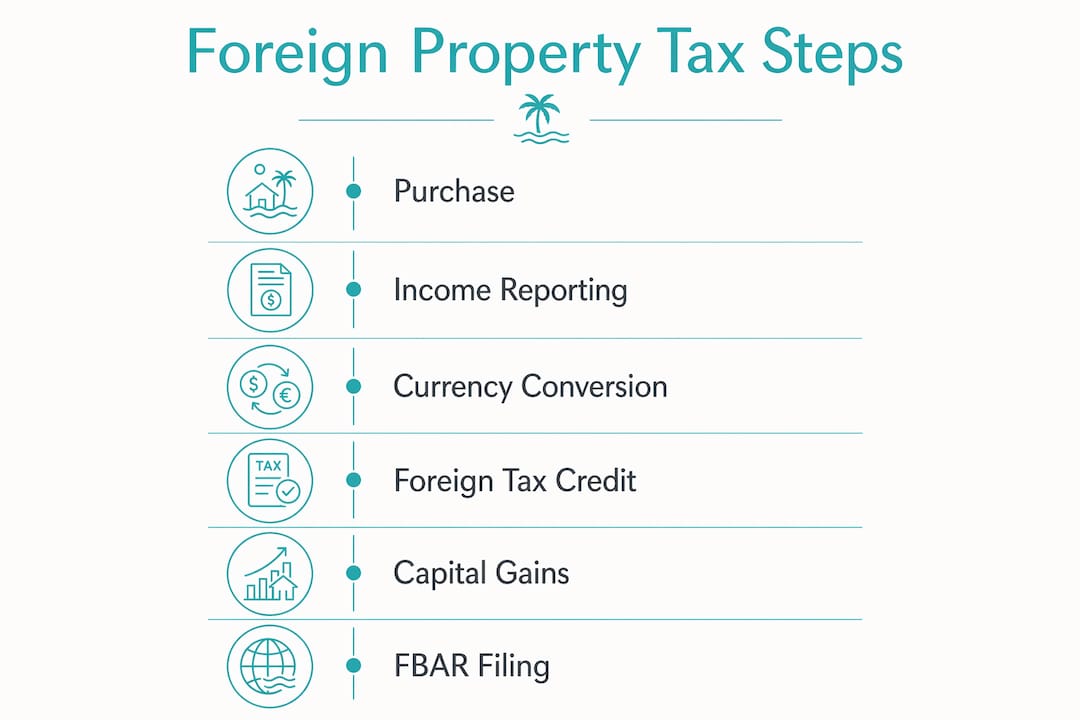
Rental income from foreign property must be reported on Schedule E of Form 1040, the same form used for domestic rentals. That means the IRS treats a beachfront apartment in Hurghada the same way it treats a rental unit in Houston. The good news is that the same deductions apply too.
You can deduct allowable expenses against your foreign rental income, including:
- Property management fees paid to local agents
- Maintenance and repairs directly related to the rental
- Depreciation calculated on the foreign building's value under U.S. rules
- Mortgage interest on loans up to $750,000 in debt, if the property qualifies as a main or second home
- Local property taxes assessed by the foreign government
Currency conversion is a hidden complication that catches many buyers off guard. All income and expenses must be converted into USD for U.S. tax reporting purposes. A strong dollar year can shrink your reported income; a weak dollar year can inflate it, even if the rent you collected in Egyptian pounds or euros never changed.
Double taxation is a real risk, but the IRS provides a direct remedy. The foreign tax credit offsets your U.S. tax liability dollar-for-dollar for foreign taxes already paid on the same income. Excess credits carry forward for up to 10 years, so they are rarely wasted entirely.

Pro Tip: Keep a monthly log of the exchange rate you used to convert each rental payment. The IRS accepts the official Treasury rate or a recognized financial institution rate, but consistency matters. Switching methods mid-year creates audit risk.
What are the capital gains tax implications when selling foreign property?
Capital gains from selling foreign real estate are fully taxable for U.S. citizens and residents, regardless of where the property sits. The tax rate depends on how long you held the property. Assets held longer than one year qualify for long-term capital gains rates, which are lower than ordinary income rates. Assets held one year or less are taxed as ordinary income.
Calculating your gain requires four steps:
- Start with the original purchase price converted to USD at the exchange rate on the date of purchase.
- Add the cost of capital improvements such as renovations or additions, also converted at the rate on the date each improvement was made.
- Subtract depreciation you claimed or were entitled to claim during any rental period.
- Subtract the adjusted basis from the sale price converted to USD at the exchange rate on the date of sale.
The timing of your sale relative to your U.S. tax residency status matters enormously. Selling before you establish U.S. tax residency generally avoids U.S. capital gains tax on pre-residency appreciation. Selling after you become a U.S. tax resident triggers full U.S. taxation on the entire gain, with no step-up in basis at the point you became a resident.
| Scenario | U.S. Capital Gains Tax? | Key Consideration |
|---|---|---|
| Sell before U.S. residency | Generally no | Pre-residency gain excluded |
| Sell after U.S. residency | Yes | Full gain taxable in USD |
| Hold longer than one year | Yes, lower rate | Long-term rates apply |
| Hold one year or less | Yes, higher rate | Ordinary income rates apply |
Currency fluctuations add a layer of complexity that most buyers miss. Exchange-rate gains can inflate taxable income even when the property's local value has not increased. If the Egyptian pound weakened against the dollar between your purchase and sale dates, your USD-denominated gain could be larger than your actual profit in local currency. This is not a theoretical risk. It is a documented pattern that affects buyers in emerging markets regularly. For a deeper look at how this plays out, the Padsabroad guide on currency and overseas returns covers the mechanics clearly.
Pro Tip: If you are approaching the one-year holding mark, consult a tax professional before listing the property. The difference between short-term and long-term capital gains rates can be significant, and a few weeks of patience can save thousands.
What foreign tax and reporting obligations apply to property owners abroad?
Foreign real estate tax responsibilities extend well beyond the U.S. tax return. Most countries impose their own taxes on property owners, and those obligations exist regardless of your U.S. filing status.
Common taxes you may face in the country where the property is located include:
- Annual property tax assessed by the local municipality
- Wealth tax applied to the total value of assets held in certain countries. France, for example, applies its wealth tax (IFI) to property exceeding €1.3 million for non-residents.
- Inheritance tax imposed by France, Spain, and Italy on foreign property held by non-residents, making estate planning a necessity rather than an option.
- Capital gains tax at source in the country of sale, often withheld before proceeds are released.
On the U.S. reporting side, two frameworks dominate: FBAR and FATCA.
| Reporting Obligation | Trigger | Form | Deadline |
|---|---|---|---|
| FBAR | Foreign accounts exceed $10,000 aggregate | FinCEN 114 | April 15, extended to October 15 |
| FATCA | Specified foreign assets exceed thresholds | Form 8938 | With annual tax return |
| Foreign corporation ownership | Ownership in a foreign corporation | Form 5471 | With annual tax return |
| Foreign trust | Ownership or transactions with a foreign trust | Form 3520 | With annual tax return |
FBAR filing is required whenever your aggregate foreign financial accounts exceed $10,000 at any point during the calendar year. That includes accounts used to receive rent or pay property expenses. Missing the deadline carries penalties that can exceed the account balance itself.
Owning property through a foreign corporation or trust triggers additional mandatory filings such as Form 5471 and Form 3520. Many buyers choose corporate structures for liability protection without realizing the compliance cost. Non-compliance with these forms is not treated leniently by the IRS. Penalties for non-compliance with foreign asset reporting can be severe, and the IRS has increased enforcement activity on foreign holdings in recent years. For a full breakdown of ownership structures and their legal implications, the Padsabroad overseas ownership guide is a practical starting point.
How to navigate common pitfalls in your foreign property tax strategy
Most tax problems with foreign property are avoidable. They stem from poor record-keeping, late filings, and decisions made without understanding the cross-border rules first.
Before you buy, map the full tax picture:
- Research the local tax regime in the target country, including annual property taxes, wealth taxes, and any transfer taxes due at purchase.
- Confirm your U.S. residency status and how it affects your reporting obligations. U.S. tax residency status is pivotal and directly shapes the timing and degree of your foreign property tax liabilities.
- Understand the ownership structure you plan to use. Direct ownership is simpler to report. Corporate or trust structures offer legal benefits but add filing complexity.
- Check for a tax treaty between the U.S. and the country where you are buying. Treaties often assign primary taxing rights to the country where the property sits, which helps you plan your foreign tax credit claims.
Once you own the property, record-keeping becomes your most important habit:
- Save purchase contracts, closing statements, and all improvement receipts.
- Record the exchange rate on every significant transaction date.
- Track depreciation claimed each year so your cost basis stays accurate.
- File FBAR and Form 8938 on time, every year, without exception.
Pro Tip: Hire a tax professional who specializes in cross-border real estate before you close on a foreign purchase, not after. The cost of a pre-purchase consultation is a fraction of the penalties and restructuring costs that come from getting the ownership structure wrong from day one. The Padsabroad guide on buying overseas pitfalls covers the most common mistakes buyers make.
When you plan to sell, revisit your exit strategy well in advance. Timing the sale relative to your residency status, the holding period, and the local tax calendar can make a material difference to your net proceeds.
Key Takeaways
Owning foreign real estate creates layered tax obligations across income, capital gains, and annual reporting that require proactive planning from the moment of purchase.
| Point | Details |
|---|---|
| Rental income is fully taxable | Report foreign rental income on Schedule E and claim all allowable deductions to reduce your U.S. tax bill. |
| Capital gains depend on timing | Selling after U.S. residency triggers full U.S. capital gains tax; selling before residency generally avoids it. |
| Currency moves affect your tax | All income and gains convert to USD, so exchange-rate shifts can increase your taxable amount even without real profit. |
| FBAR and FATCA are mandatory | Foreign accounts over $10,000 require FBAR filing; complex ownership structures trigger additional IRS forms. |
| Local taxes add to the burden | Annual property taxes, wealth taxes, and inheritance taxes in the foreign country apply on top of U.S. obligations. |
What Padsabroad has learned about managing property tax abroad
Tax exposure on foreign property does not end at the sale. Annual wealth taxes, local property levies, and inheritance taxes can accumulate quietly over years of ownership, and most buyers only discover them when the bill arrives. The investors who handle this best are the ones who treat tax planning as part of the purchase decision, not an afterthought.
Currency risk is the piece that surprises people most. A property can hold its value in local terms and still produce a larger-than-expected U.S. tax bill simply because the dollar strengthened between purchase and sale. That is not bad luck. It is a predictable outcome of cross-border investing that proper planning can account for.
The practical lesson from working with international buyers is this: integrate your foreign property into your broader financial and estate plan from day one. That means coordinating with both a U.S. tax professional and a local advisor in the country where you are buying. It also means revisiting the plan whenever your residency status changes, because that single variable reshapes almost every other obligation you have.
Seek tailored advice early. The cost is low. The alternative is not.
— Padsabroad
Padsabroad can help you buy property abroad with confidence
Buying property in a foreign country involves more than finding the right location. It requires understanding the legal process, the ownership structure, and the ongoing responsibilities that come with it. Padsabroad specializes in helping international buyers purchase property in Egypt safely, with expert guidance at every stage from initial search to completed purchase.

For buyers who want ongoing support after the purchase, Padsabroad also offers property management services in Egypt that handle rental operations, maintenance coordination, and local compliance on your behalf. Whether you are buying your first overseas property or adding to an existing portfolio, the team at Padsabroad is ready to help you move forward with clarity and confidence.
FAQ
What triggers U.S. tax on foreign property?
Rental income and capital gains from foreign property trigger U.S. tax obligations for citizens and residents. Ownership alone, without income or a sale, does not create a U.S. tax liability.
How do I report foreign rental income to the IRS?
Report foreign rental income on Schedule E of Form 1040, the same form used for domestic rentals. You can deduct allowable expenses including management fees, repairs, depreciation, and mortgage interest.
What is FBAR and when must I file it?
FBAR is required when your aggregate foreign financial accounts exceed $10,000 at any point during the calendar year. The deadline is April 15, with an automatic extension to October 15.
Can I avoid double taxation on foreign property income?
The foreign tax credit offsets your U.S. tax liability dollar-for-dollar for taxes paid to a foreign government on the same income. Excess credits carry forward for up to 10 years.
Do local inheritance taxes apply to foreign property owners?
Yes. Countries including France, Spain, and Italy apply inheritance tax to property held by non-residents, regardless of where the owner lives. Estate planning is necessary for any foreign property holding.