
Yes, most Red Sea resort units carry an annual maintenance or service charge that covers shared facilities like security, pools, and common utilities. This is separate from the maintenance deposit collected at purchase, which has real legal weight under Egyptian law. Before you sign anything, check three things: the fee formula, who actually collects the money, and how the deposit clause is worded.
- Fee formula: per square meter, flat annual sum, or a percentage of unit value
- Collector: developer, third-party management company, or Federation for Occupants
- Deposit clause: where it's held, what triggers its use, and how it's returned
Pro Tip: Ask for the last two years of service budgets before you sign anything. Historical volatility tells you more than any sales brochure.
Key Takeaways
Annual maintenance fees on Red Sea resort properties are legally distinct from the purchase deposit, and both require contract-level verification before you buy.
| Point | Details |
|---|---|
| Expect an annual charge | Budget for a recurring service fee covering security, pools, gardens, and common utilities. |
| Deposit is legally separate | Verify it sits in an independent account under Egyptian Civil Code deposit contract principles. |
| Fee formulas vary | Confirm whether your unit pays per square meter, a flat sum, or a percentage of value. |
| Federation changes control | A Federation for Occupants under Building Law No. 119 shifts oversight from developer to owners. |
| Request historical accounts | Ask for 12 to 24 months of budgets and reserve statements before signing anything. |
| Padsabroad verifies before you sign | Padsabroad reviews contracts, requests developer accounts, and connects buyers with local managers. |
Table of Contents
- What Do Maintenance and Service Charges Cover in Red Sea Resorts?
- How Are Maintenance Fees Calculated, and What Drives the Cost Up?
- What Does Egyptian Law Say About Maintenance Deposits?
- Contract Checklist: What to Verify Before You Buy
- How Should Overseas Owners Budget and Manage Fees Remotely?
- How Do You Dispute an Unclear or Excessive Maintenance Charge?
- What Buyers Get Wrong About Maintenance Fees, and How Padsabroad Helps
- Where Padsabroad Fits in Your Fee Due Diligence
- Frequently Asked Questions
- Sources
What Do Maintenance and Service Charges Cover in Red Sea Resorts?
Your annual maintenance fee funds everything that keeps a compound running day to day. It typically pays for security staff at the gates, pool cleaning and chemical treatment, garden upkeep, and generator fuel for backup power during outages, which happen more often than most first-time buyers expect along the coast.
In resort developments like those found in Hurghada, El Gouna, or Sahl Hasheesh, the list often extends further:
- Private beach maintenance and lifeguard staffing during high season
- Marina upkeep for developments with docking access
- Clubhouse operations and seasonal event staffing
- Common-area cleaning, waste collection, and pest control
- Shared lighting, elevators, and landscaping irrigation systems
What these fees do not cover matters just as much. In-unit repairs, your own air conditioning servicing, private furniture, and interior plumbing issues are the owner's responsibility, not the compound's. Confusing these two cost categories is one of the most common budgeting mistakes among overseas buyers, who often discover the gap only after their first invoice arrives.
How Are Maintenance Fees Calculated, and What Drives the Cost Up?
Developers and management companies use one of four common formulas, and knowing which applies to your unit changes how you forecast your annual bill.
- Per square meter: the most transparent method, since a bigger unit pays proportionally more.
- Fixed annual sum: a flat charge regardless of unit size, common in smaller compounds.
- Percentage of unit price: less common now, but still used in some older developments.
- Reserve fund contribution: a separate line item set aside for long-term capital repairs, distinct from day-to-day upkeep.
Several factors push these numbers higher. Amenity-heavy resorts with marinas, multiple pools, or extensive landscaping cost more to run than a modest apartment block a few streets back from the water. Larger site footprints need more security and grounds staff. Location matters too: established areas like El Gouna often carry higher service standards, and higher fees, than newer or more remote developments still building out their infrastructure. Building age plays a role as well, since older structures need more frequent repairs to shared systems like elevators and generators.
The single most useful document request you can make before buying is the last 12 to 24 months of service budgets and reserve fund statements. A compound with wildly swinging annual charges, or a reserve fund that never grows, tells you something the sales brochure won't.
What Does Egyptian Law Say About Maintenance Deposits?
The maintenance deposit you pay at purchase is legally distinct from your annual service charge, and Egyptian law treats it with more structure than most buyers realize. Under Egyptian Civil Code principles governing deposit contracts, the developer holds this money for a specific purpose: funding long-term repairs to common areas. It isn't a general revenue stream the developer can dip into for other costs.
A maintenance deposit paid to a developer for common-area upkeep should be invested in an independent bank account, and misuse of funds entrusted for a specified purpose can carry criminal sanctions under Egyptian law.
Building Law No. 119 of 2008 adds another layer: once a development reaches a specified occupancy threshold, a Federation for Occupants must form to oversee management, funds, and annual reporting. This shifts control away from the developer and toward the owners themselves.
Before you sign, verify three things in writing: whether the deposit sits in an independent account, whether it earns interest, and what specific conditions allow the developer to draw on it.
Contract Checklist: What to Verify Before You Buy
Run through this list at viewing stage, or hand it to your lawyer during contract review. It takes ten minutes and can save you years of disputes.
- Confirm the exact fee formula (per sqm, flat rate, or percentage) and get it in writing, not just verbal confirmation from the agent.
- Ask about invoicing frequency, the currency of payment, and the exact account fees are paid into.
- Find out who currently collects fees, whether a Federation for Occupants exists or is planned, and request its formation timeline.
- Request the previous two to three years of accounts and current reserve fund balances.
- Ask whether VAT or other taxes apply to service charges on top of the stated fee.
- Clarify the dispute resolution process for contested charges.
- Check whether handover of your unit is contractually tied to maintenance fee payment status.
A legal review that covers these seven points before you complete a purchase catches most of the problems that surface later as unpleasant surprises.
How Should Overseas Owners Budget and Manage Fees Remotely?
Your real annual cost isn't just the service charge on the invoice. Build your budget around four line items: the maintenance fee itself, a property manager's fee if you're not local, cleaning and turnover costs if you rent the unit out, and a contingency fund for special assessments that compounds occasionally levy for major repairs.
- Self-management works if you visit often and speak enough Arabic to deal with local staff directly.
- A local property manager typically charges either a percentage of rental income or a fixed retainer, and this often pays for itself once you factor in the time and stress saved chasing invoices from abroad.
- Developer-run management is convenient but gives you less visibility into how funds are actually spent.
For payment logistics, most owners set up a local bank arrangement or authorize a representative to handle transfers and confirm receipt. A property management guide covering typical fee structures in Egypt is worth reading before you decide which route fits your situation.
Pro Tip: If you're renting your unit out seasonally, ask whether staffing and service levels scale up during high season, and whether your fee reflects that seasonal cost. Some compounds quietly pass the summer staffing bump onto owners without adjusting the invoice format to show it.

How Do You Dispute an Unclear or Excessive Maintenance Charge?
Start by requesting a full breakdown of the charge with supporting invoices, then reconcile that against what your contract actually promised.
- Compare your payment history against the original fee schedule to identify exactly where the discrepancy sits.
- Follow your compound's formal dispute process, or route the objection through the Federation for Occupants if one exists, and put every objection in writing.
- Gather your contract, payment receipts, and any correspondence with the developer or manager before escalating further.
- Consult an Egyptian property lawyer once informal channels stall. They will need the same documents to assess whether the charge holds up against what you signed.
What Buyers Get Wrong About Maintenance Fees, and How Padsabroad Helps
The mistakes we see most often are structural, not accidental. Buyers sign contracts with vague deposit clauses that never specify an independent account. They skip asking for past budgets entirely, so they have no baseline once fees start arriving. And currency or payment account details often get finalized after the sale closes, not before.
Padsabroad requests documents before you commit, not after: developer accounts, reserve statements, and deposit terms in writing. We liaise directly with developers on unclear clauses and connect buyers with local management contacts who already know a given compound's track record. If you're weighing a purchase right now, ask us for a document review before you sign.
Where Padsabroad Fits in Your Fee Due Diligence
Padsabroad is the direct route for overseas buyers who want fee terms verified before money changes hands, not after. We review contracts for deposit wording, pull historical service budgets from developers, and introduce you to local property managers who already operate in your target compound.

If you're at the early research stage, our first-time buyer guide walks through the full purchase process, maintenance fees included. If you're closer to making an offer, our guide on buying property in Egypt safely covers the legal checks that protect you against the exact deposit and fee issues raised above. Either way, the next step is the same: send us your draft contract or the listing you're considering, and we'll flag anything in the fee structure worth questioning before you commit to anything.
Frequently Asked Questions
Do all Red Sea resort properties charge maintenance fees? Nearly all resort compounds charge some form of annual service fee to cover shared facilities. The exact amount and what it includes varies significantly between developments, which is why requesting a fee breakdown before purchase matters.
Is the maintenance deposit refundable? It depends entirely on your contract's wording. The deposit exists to fund common-area repairs under deposit contract principles in the Egyptian Civil Code, so its return conditions should be spelled out explicitly rather than left to verbal assurance.
What happens if I don't pay my maintenance fee? Compounds typically apply late penalties, and some tie property handover or resale approval to fee payment status. Persistent non-payment can also affect your standing with the Federation for Occupants once one is formed.
Can maintenance fees increase after I buy? Yes. Fees commonly rise with inflation, amenity upgrades, or rising staffing costs. Reviewing several years of historical budgets before you buy gives you a realistic sense of how much they've moved in the past.
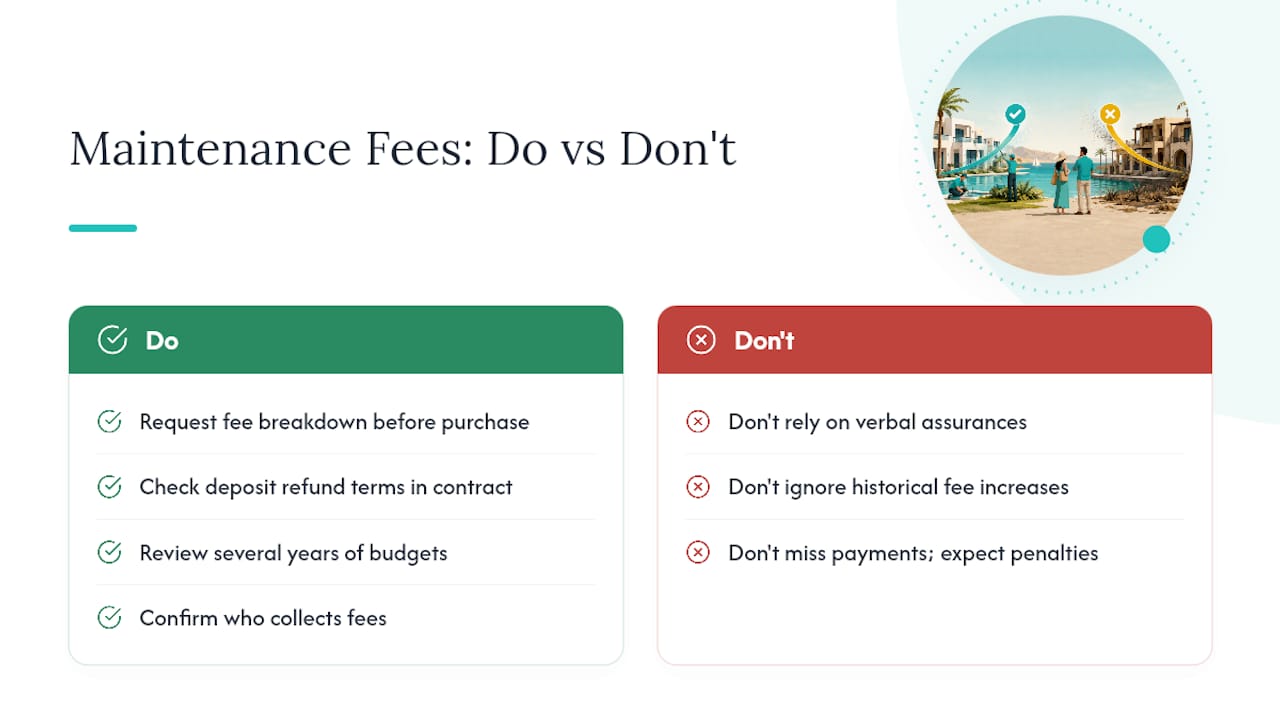
Who do I pay maintenance fees to? It depends on the compound's stage of development. Early on, the developer usually collects fees directly; once a Federation for Occupants forms under Building Law No. 119, that body typically takes over collection and reporting.
Sources
- Maintenance Deposit Under Egyptian Laws - Construction & Planning - Egypt
- HOA fees: Hidden Costs Every Homebuyer Must Understand
- Buying Property in Egypt for Foreigners: 7 Legal Checks