
If you're a UK resident and your second home abroad earns rental income or you sell it for a gain, you must report it to HMRC through Self Assessment using the SA106 foreign pages. Report your net rental profit, any capital gain on disposal, and foreign tax you've already paid. If your property sits in Egypt, the UK–Egypt Double Taxation Convention helps prevent you paying tax twice on the same income. Your next move: register for Self Assessment if you haven't already, and start gathering your rental and purchase records now.
- Overseas rental profit (after allowable expenses)
- Capital gains on sale or disposal
- Foreign tax already paid on that income
- Remitted amounts if you've used the remittance basis or the new FIG regime
Key Takeaways
UK residents must report worldwide rental profits and capital gains from a second home abroad on the SA106 foreign pages, using Foreign Tax Credit Relief to avoid paying tax twice on the same income.
| Point | Details |
|---|---|
| File SA100 plus SA106 | Overseas rental profit and gains go on the foreign pages, not the main return alone. |
| Convert currency consistently | Use one documented sterling conversion method throughout the return to avoid HMRC queries. |
| Claim FTCR source by source | Match foreign tax paid to UK tax due on that specific property, not a blended total. |
| Check host-country rules first | Confirm local withholding, registration, and receipt requirements before filing in the UK. |
| Get local support early | Padsabroad helps owners collect Egyptian tax receipts and connects them with local advisors for compliance support. |
Table of Contents
- What Counts as Second Home Tax Declaration for UK Residents?
- How Do You Report Foreign Property Income to HMRC?
- How Do You Claim Relief to Avoid Double Taxation?
- What Local Tax Checks Should You Make in the Host Country?
- What Is the Step-by-Step Filing Checklist?
- What Are the Most Common Mistakes and Penalties?
- Why Documentation Discipline Matters More Than the Filing Itself
- How Padsabroad Supports Overseas Owners With Compliance
- Where to Verify These Rules Yourself
- Frequently Asked Questions
- Sources
What Counts as Second Home Tax Declaration for UK Residents?
Here's the principle that catches people out: UK residence, not property location, decides what HMRC can tax. If you're UK resident, you're normally taxed on worldwide income and gains, which means your Red Sea apartment's rental income and any profit from selling it both fall inside UK tax law, regardless of what you've already paid abroad.
What actually needs declaring:
- Gross rental income minus allowable running costs (repairs, letting agent fees, ground rent) equals your net profit
- Capital gains calculated from disposal proceeds minus acquisition costs and eligible expenses
- Foreign tax paid on the same income or gain, which becomes relevant later for relief
A few carve-outs matter. The property income allowance exempts the first £1,000 of overseas property income, so very small lettings might not need reporting at all. You can also choose cash-basis or traditional accounting for calculating expenses, affecting timing rather than the total tax owed.
One rule change trips up longtime owners: the Furnished Holiday Lettings regime was abolished from April 5, 2025, so properties that once qualified for separate FHL treatment now get reported like any other overseas rental. If you're newly UK resident, the FIG regime may exempt qualifying foreign income and gains for up to four years, though it comes with trade-offs worth modeling before you claim it.
The UK tax year runs April 6 to April 5, and online returns are due by January 31 following the end of that year.
How Do You Report Foreign Property Income to HMRC?
File a Self Assessment return that includes both the main SA100 and the SA106 "Foreign" pages. That's where overseas rental profits, capital gains, and foreign tax paid all get entered.
Before you sit down to file, gather:
- Bank statements showing rent received
- Tenancy or letting agreements
- Invoices for repairs, management fees, and other allowable costs
- Foreign tax receipts or certificates
- Purchase and sale contracts
- Mortgage interest statements
Currency conversion trips up more owners than any other step. Convert every figure to sterling using a consistent, defensible method, whether that's HMRC's published average exchange rates or your own documented approach applied uniformly across the return. The SA106 notes walk through exactly which boxes capture rents, expenses, and foreign tax paid.
Pro Tip: Save a screenshot or printout of the exchange rate you used on the date of each transaction. If HMRC ever queries your figures, contemporaneous evidence settles the question in minutes instead of weeks.
Foreign tax paid gets entered in the relevant SA106 columns, which then feeds into your Foreign Tax Credit Relief claim. Keep every supporting document for at least 22 months after the tax year ends, longer if you've claimed FIG or remittance-basis treatment, since HMRC can ask for evidence well after you've filed.
How Do You Claim Relief to Avoid Double Taxation?
You claim Foreign Tax Credit Relief (FTCR) on the SA106 to offset tax you've already paid abroad against your UK liability on the same income. The credit equals whichever is lower: the foreign tax you paid or the UK tax due on that specific income source.
The process in practice:
- Identify each source of foreign income separately (each property counts as its own source)
- Calculate UK tax due on that source
- Enter the foreign tax paid in the corresponding SA106 column
- Tick the FTCR boxes where you're claiming relief
Where Egypt is the host country, the UK–Egypt Double Taxation Convention sets out which country holds primary taxing rights over specific income types, and that framework underpins your relief claim rather than replacing it. FTCR is worked source by source, not as a single blended figure. If you own two properties in different countries, you calculate relief separately for each, and each claim needs its own foreign tax receipt as evidence.
What Local Tax Checks Should You Make in the Host Country?
Before you finalize anything with HMRC, check whether the country where your property sits taxes the same rental income or gain, requires local registration, or deducts withholding tax at source. Skipping this step is how owners end up double paying or missing a local deadline entirely.
Practical items to verify:
- Whether you need a local tax registration number
- Whether landlord withholding tax certificates are issued automatically or must be requested
- Whether letting platforms operating locally have their own registration requirements
- Local filing deadlines and penalty rules
- Municipal or occupancy-related charges tied to rental use
Pro Tip: Padsabroad always advises owners to request original tax receipts in both Arabic and English translation. HMRC accepts translated documents far more readily when the translation is official rather than informal.
If your property is in Egypt, confirm withholding treatment and receipt requirements directly with a local tax advisor or the Egyptian Tax Authority, since rules and enforcement practices shift and general guidance can go stale quickly. This article doesn't offer Egyptian legal advice, only the questions worth asking before you file.

What Is the Step-by-Step Filing Checklist?
Follow this sequence before you touch the SA106 form itself:
- Confirm your UK residence status for the tax year in question, since this determines whether worldwide taxation applies to you at all.
- Collect rental records, including every receipt of rent and every allowable expense.
- Convert figures to sterling and document the exchange rate method you used.
- Assemble foreign tax evidence, meaning receipts, certificates, or official statements from the host country.
- Calculate net profit on rental income and any capital gain from disposal.
- Complete the SA106 alongside the relevant helpsheets for foreign income and capital gains.
- Consider the FIG regime if you've recently become UK resident and might qualify for the exemption.
Documents worth keeping close at hand include tenancy agreements, repair invoices, mortgage interest statements, foreign tax slips, and both purchase and sale contracts. If a FIG claim looks attractive, model the outcome first. Giving up your Personal Allowance in a FIG year can cost more than the exemption saves, depending on your other income.
What Are the Most Common Mistakes and Penalties?
Late returns, incorrect FTCR claims, and thin record-keeping cause most of the penalties HMRC issues on overseas property. None of them are complicated to avoid once you know where they hide.
The recurring errors:
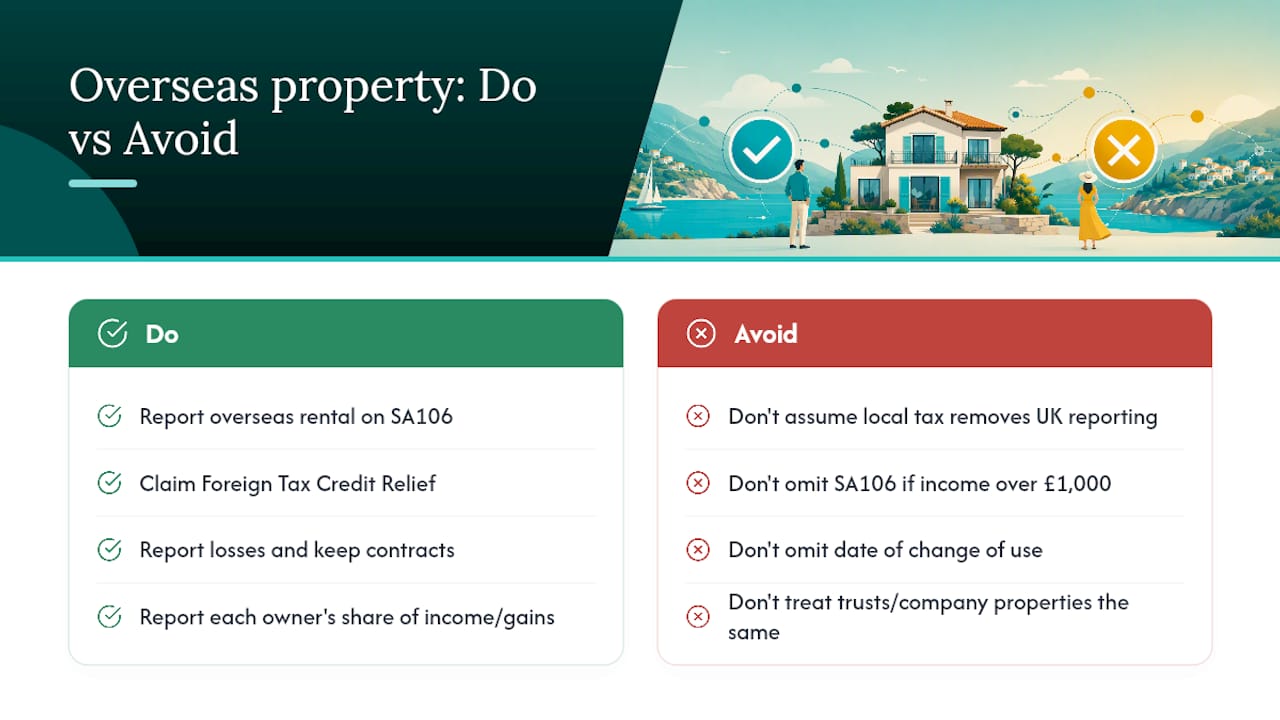
- Forgetting to report overseas rent because "it's already taxed abroad"
- Mixing personal-use costs with genuine rental expenses
- Switching exchange rate methods partway through a return
- Claiming FTCR without matching foreign tax receipts
Penalties escalate quickly. Missing the filing deadline triggers an automatic penalty, interest accrues on unpaid tax from the due date, and undisclosed offshore income can fall under harsher offshore penalty rules than domestic errors attract. If you've missed prior years, the Worldwide Disclosure Facility exists specifically for correcting undisclosed offshore liabilities before HMRC finds them first.
File early, keep contemporaneous records as you go rather than reconstructing them later, and get specialist help if your ownership involves a trust, a company structure, or joint ownership with non-UK parties.
Why Documentation Discipline Matters More Than the Filing Itself
Padsabroad has watched enough overseas owners scramble every January to know the pattern: the tax return itself rarely causes stress, it's the missing receipt from eighteen months ago that does. Getting local paperwork translated and filed away early, before the deadline pressure hits, changes the whole experience from a fire drill into a formality.
Owners in Egypt's Red Sea market most often trip up on the same thing: assuming a rental platform or property manager is tracking tax documentation on their behalf when nobody actually is. If your ownership structure involves multiple owners, a company, or a trust, get tailored advice before you file rather than after.
How Padsabroad Supports Overseas Owners With Compliance
Padsabroad works alongside overseas owners on the ground in Egypt, not just at the point of sale. That's the practical gap most agencies leave open: once you own the property, you're on your own for the paperwork that keeps HMRC and local authorities satisfied.

Through property management services for foreign owners, Padsabroad helps collect local rental records, secure original tax receipts, and connect owners with local tax advisors who understand Egyptian filing requirements firsthand. None of this replaces a certified tax adviser for your actual HMRC filing decisions. For anything touching FTCR calculations, FIG eligibility, or complex ownership structures, get advice specific to your situation.
If you're still deciding where in Egypt to buy or already own and want help staying compliant, start with Padsabroad's guide to buying property in Egypt safely and take it from there.
Where to Verify These Rules Yourself
Start with GOV.UK's overview of tax on foreign income to confirm how residence status affects your reporting duty. The official SA106 foreign notes detail exactly which boxes capture rents, expenses, and foreign tax paid, while the UK property notes explain the FHL abolition and current property reporting rules.
For plain-language guidance on the FIG regime and residence-based taxation, the Low Incomes Tax Reform Group breaks down the trade-offs clearly. Horizon UK Tax Solutions covers SA106 mechanics and mortgage interest restrictions from a practitioner's angle.
For Egypt-specific practicalities, Padsabroad's guide on Egypt residency, family, and UK tax and its explainer on Egyptian tourism rental income fill in the on-the-ground detail official HMRC guidance can't.
Frequently Asked Questions
Do I need to declare rental income from a second home abroad if I already pay tax on it locally?
Yes. UK residence determines your UK tax obligation regardless of local tax already paid. You report the income on SA106 and then claim Foreign Tax Credit Relief for the foreign tax you've paid, which prevents double taxation rather than eliminating the UK reporting duty.
What happens if I sell my overseas property at a loss?
You still report the disposal, but a loss can potentially offset gains elsewhere, subject to the normal capital gains rules. Keep your purchase and sale contracts regardless, since HMRC may ask you to substantiate the figures.
Does the £1,000 property income allowance mean I don't need to file at all?
If your total overseas property income stays under £1,000 for the year, you may not need to report it. Above that threshold, you generally need to complete the SA106, even if your net profit after expenses is small.
How does joint ownership affect my SA106 filing?
Each owner typically reports their share of income and gains individually, based on their percentage of ownership, unless a formal arrangement specifies otherwise. Trusts and company-held property involve different rules entirely and usually need dedicated professional advice.
What if my property changed from personal use to a rental during the year?
You report rental income and expenses only for the period it was actually let, and the change in use can affect your capital gains calculation on eventual disposal. Keep a clear record of the date usage changed, since it becomes the reference point for both income and gains reporting.
This article is general information, not a substitute for advice from a qualified financial advisor. Consult a qualified financial professional about your own circumstances before acting on anything here.
Sources
- Gov
- UK property notes (2026)
- UK tax for UK residents on foreign income and gains | Low Incomes Tax Reform Group
- Foreign Rental Income: UK Tax and the SA106 | Horizon UK Tax Solutions