
What is overseas property transfer tax and how does it affect U.S. buyers in Egypt?
Overseas property transfer tax is a one-time tax imposed by a local government when real estate ownership changes hands. In Egypt, this tax is collected at the point of deed registration and is calculated as a percentage of the property's declared value. It is not an annual charge, and it is separate from any U.S. tax obligations you carry as an American citizen.
For U.S. buyers investing in Egyptian real estate, this means you face two distinct tax worlds: Egypt's local transfer tax at closing, and a set of U.S. reporting requirements tied to how you fund and hold that property. Understanding both upfront prevents budget surprises and compliance gaps.
Here is what defines the Egyptian property transfer tax:
- One-time charge: It applies at the moment of ownership transfer, not annually.
- Calculated on property value: The tax is based on the declared or assessed value of the property at registration.
- Paid at deed registration: Payment is due when the title deed is officially recorded with Egyptian authorities.
- Separate from U.S. taxes: Egypt's transfer tax does not reduce or offset any U.S. tax liability directly.
- Distinct from ongoing taxes: Transfer tax is an event-triggered cost; annual property taxes recur based on assessed value and are a different obligation entirely.
- Non-deductible against income: Transfer taxes are generally not deductible from federal income taxes, but they can be added to your cost basis, which reduces capital gains when you eventually sell.
- Buyer responsibility is common in Egypt: Local custom typically places the transfer tax on the buyer, though the contract can specify otherwise.
Budgeting for this cost before you sign any purchase agreement is the right move. Globally, transfer fees vary widely across countries, so knowing Egypt's specific rate matters for accurate financial planning.
Table of Contents
- What U.S. tax reporting do you need to do when buying property in Egypt?
- How are rental income and capital gains from Egyptian property taxed in the U.S.?
- Practical steps for U.S. buyers navigating Egyptian property transfer tax
- Key takeaways on overseas property transfer tax for U.S. buyers in Egypt
What U.S. tax reporting do you need to do when buying property in Egypt?
Purchasing foreign real estate is not itself a taxable event under U.S. law. The IRS does not impose a transfer tax on the acquisition of overseas property. What triggers reporting obligations is how you move and hold money to make that purchase happen.
The two most critical compliance tools for U.S. buyers are FBAR and FATCA Form 8938.
- FBAR (FinCEN Form 114): Required if your foreign financial accounts exceed $10,000 at any point during the calendar year. This includes Egyptian bank accounts used for mortgage payments, property management fees, or rental income. The deadline is April 15, with an automatic extension to October 15.
- FATCA Form 8938: Filed with your federal tax return when foreign financial assets exceed certain thresholds ($50,000 for single filers living in the U.S.; higher thresholds apply for married filers and those living abroad). Importantly, owning foreign real estate directly does not trigger Form 8938, but holding that property through a foreign entity does.
- Worldwide income reporting: The IRS taxes U.S. citizens on worldwide income. Rental proceeds from your Egyptian property, even if they never leave Egypt, must be reported on your U.S. return.
- Foreign entity structures: If you hold your Egyptian property through a local company or LLC equivalent, additional IRS forms may apply, including Form 5471 for foreign corporations.
Statistic callout: Most compliance surprises for foreign property owners come not from the property transaction itself but from foreign entity structures and financial account reporting. FBAR and FATCA deadlines are where investors most commonly fall short.
A common mistake is assuming that because Egypt collected its transfer tax at closing, U.S. obligations are satisfied. They are not. The two systems operate independently. For detailed guidance on moving funds internationally for your purchase, Padsabroad's guide on transferring money abroad for property covers the compliance steps clearly.
How are rental income and capital gains from Egyptian property taxed in the U.S.?
Once you own property in Egypt, two ongoing tax events matter most: rental income and eventual sale proceeds.
Rental income from your Egyptian property is taxable on your U.S. return regardless of where the money sits. You report it on Schedule E. The good news is that you can deduct legitimate expenses against that income, including property management fees, maintenance costs, insurance, and depreciation on the building's value. Egyptian taxes paid on that rental income may qualify for a U.S. foreign tax credit, which directly reduces your U.S. tax bill rather than just lowering taxable income.
Capital gains on the sale of Egyptian property must be reported to the IRS. The gain is calculated as the sale price minus your adjusted cost basis. This is where the transfer tax you paid at purchase becomes useful: adding that transfer tax to your cost basis increases it, which reduces the taxable gain when you sell. It is a straightforward tax planning step that many buyers overlook.
Double taxation is a real concern, but it is manageable. The U.S. and Egypt have a tax treaty framework, and the foreign tax credit mechanism exists precisely to prevent you from paying full tax twice on the same income. For a deeper look at how U.S. tax law interacts with foreign property ownership, Padsabroad's article on property abroad tax implications is a practical starting point.
Key taxable events and applicable IRS forms at a glance:
- Rental income: Schedule E (Form 1040)
- Foreign tax credit on Egyptian taxes paid: Form 1116
- Capital gains on sale: Schedule D (Form 1040)
- Foreign financial accounts: FinCEN Form 114 (FBAR)
- Foreign financial assets via entities: Form 8938 (FATCA)
Practical steps for U.S. buyers navigating Egyptian property transfer tax
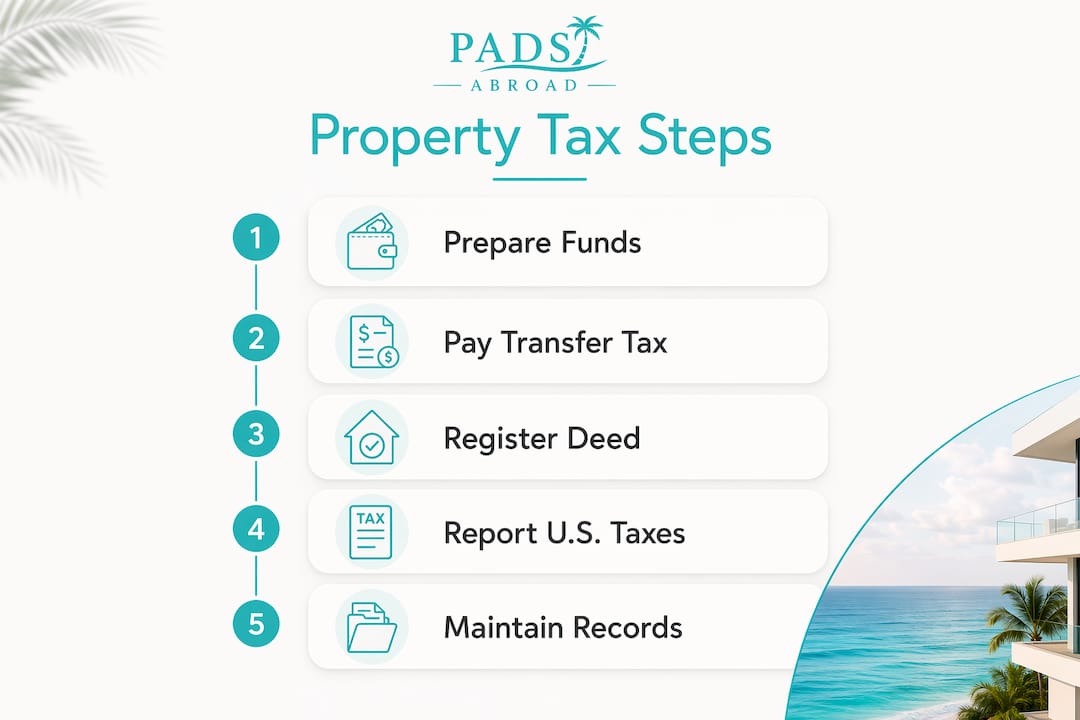
Getting the transfer tax process right in Egypt comes down to preparation, clear contracts, and organized records.
Egyptian transfer tax rates and process: Egypt applies a transfer tax calculated as a percentage of the property's registered value, collected at the time of deed registration with the Real Estate Publicity Department. The rate and exact calculation method can vary based on property type and location, so confirming the current rate with a licensed Egyptian attorney before closing is standard practice. For a broader comparison of how property purchase taxes work across international markets, that context helps frame Egypt's position.
Who pays and how to negotiate: Buyer responsibility is the common custom in Egyptian transactions, but this is not fixed by law. Your purchase contract should explicitly state which party bears the transfer tax. Careful contract negotiation avoids disputes at closing and ensures both parties understand their financial obligations before signing.
Timelines and deadlines: Transfer tax payment is due at deed registration. Delays in registering the deed can expose buyers to penalties, so coordinating with your Egyptian notary or attorney to complete registration promptly after the sale is finalized protects you from avoidable costs.
Adding transfer tax to your U.S. cost basis: Once you have paid the Egyptian transfer tax, keep the official receipt. That amount, along with other closing costs, can be added to your property's cost basis on your U.S. tax records. When you eventually sell, a higher cost basis means a lower taxable gain.
Recordkeeping: Maintain organized files for all Egyptian transaction documents, tax receipts, bank statements, and correspondence. U.S. reporting requirements for foreign assets can stretch back several years, and having clean records makes FBAR and Form 8938 filings straightforward.
Pro Tip: Before signing any Egyptian purchase contract, confirm in writing which party pays the transfer tax. Then consult a U.S. tax advisor who specializes in expatriate or international real estate to map out your FBAR, FATCA, and Schedule E obligations before closing day, not after.
Padsabroad works with buyers across Hurghada, El Gouna, Sahl Hasheesh, and the Red Sea coast. Their first-time buyer guide to Egypt Red Sea property covers the full purchase process, including legal and tax considerations, in one place.

Key takeaways on overseas property transfer tax for U.S. buyers in Egypt
Overseas property transfer tax in Egypt is a one-time, value-based charge at deed registration, separate from all U.S. tax obligations, and adding it to your cost basis reduces future capital gains exposure.
| Point | Details |
|---|---|
| Transfer tax is one-time | Egypt collects it at deed registration, not annually; it differs from recurring property taxes. |
| U.S. reporting is triggered by accounts | FBAR applies if your foreign accounts exceed $10,000 at any point in the year; property ownership alone is not a taxable U.S. event. |
| Rental income is always taxable | Report Egyptian rental income on Schedule E; foreign tax credits on Form 1116 offset double taxation. |
| Add transfer tax to cost basis | Including the Egyptian transfer tax in your U.S. cost basis lowers taxable capital gains at sale. |
| Contract clarity prevents disputes | Specify in writing which party pays the Egyptian transfer tax before signing any purchase agreement. |