An international wire transfer for property purchase is defined as a cross-border payment made to fund the acquisition of real estate in a foreign country. To transfer money abroad for a property purchase, you need the right provider, correct documentation, and a clear understanding of exchange rate risk. Get any one of those wrong and you face delays, extra costs, or a failed transaction. This guide covers every step, from preparing your paperwork to locking in your exchange rate, with specific guidance for buyers targeting Egypt's Red Sea coast and similar overseas markets.
What you need before transferring money abroad for real estate
Preparation is the single most important factor in a smooth international property transfer. Buyers who skip this stage face frozen funds, compliance holds, and missed contract deadlines.
Documentation you will need:
- Recent bank statements (typically 3–6 months) showing the source of funds
- Proof of identity: passport and a secondary government-issued ID
- Proof of address: utility bill or official letter dated within 90 days
- Source of wealth documentation: payslips, tax returns, or sale proceeds records
- Property purchase agreement or reservation contract from the seller
International transfers over $10,000 trigger Anti-Money Laundering (AML) reporting requirements in most jurisdictions. That threshold applies in many countries, meaning your bank or broker must verify where the money came from before releasing the transfer.
Pro Tip: Prepare your source of funds file before you make an offer on any property. Having it ready cuts processing time by days and prevents last-minute compliance holds.
Residency and visa status also matter more than most buyers realize. Failing to verify local residency requirements before initiating a transfer can invalidate the transaction entirely. In Egypt, foreign buyers are permitted to purchase property, but specific rules apply depending on nationality and property type. Confirm your eligibility with a local solicitor before any money moves.
If the country requires a local bank account to receive property funds, open one early. In Egypt, opening a local bank account is a practical step that simplifies the payment process and satisfies regulatory requirements for foreign buyers.
How do banks vs. currency brokers compare for property transfers?
The transfer method you choose directly affects how much you pay and how fast funds arrive. The difference between a bank and a specialist currency broker is not minor on large transactions.
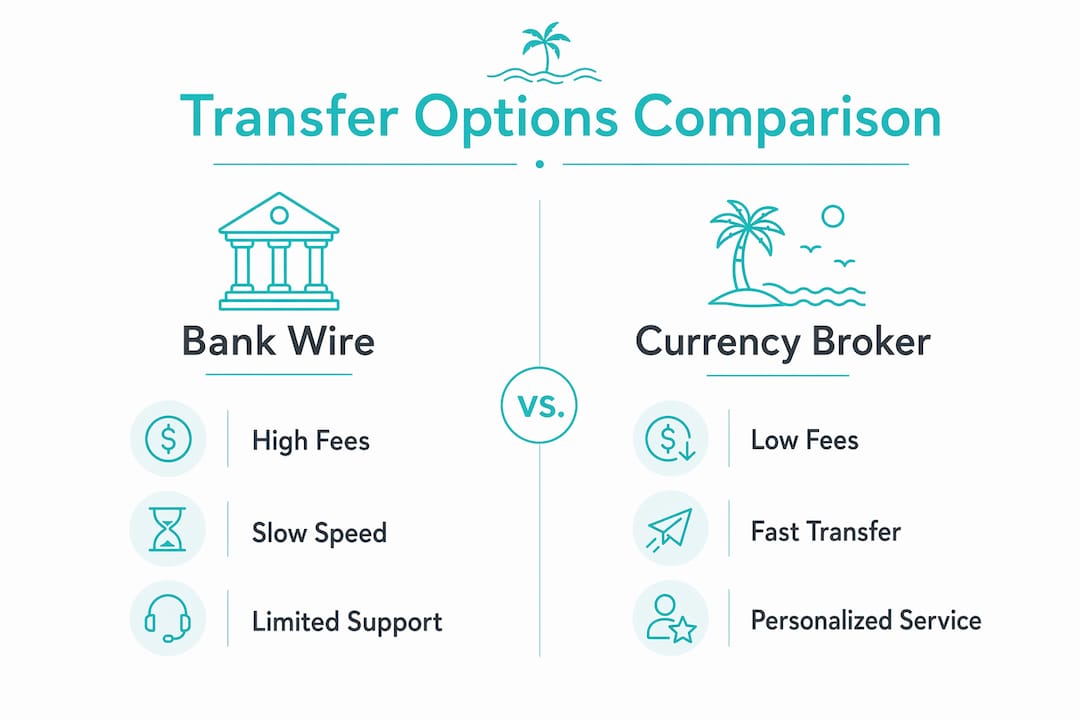
| Factor | Bank wire transfer | Specialist currency broker |
|---|---|---|
| Exchange rate margin | 2–4% above mid-market rate | 0.3–0.5% above mid-market rate |
| Transfer speed | 5–7 business days | 1–3 days, sometimes same day |
| Cost on €250,000 transfer | ~€5,000 in margin costs | ~€1,250 in margin costs |
| Forward contracts available | Rarely | Yes, standard offering |
| Dedicated account manager | No | Yes, with most brokers |
Banks charge 2–4% exchange rate margins on international property transfers, while specialist currency brokers charge 0.3–0.5%. On a €250,000 transfer, that margin difference saves approximately €3,750. That is money that stays in your pocket rather than disappearing into a bank's spread.
Traditional bank transfers take 5–7 business days, while specialist providers complete transfers in 1–3 days, with some offering same-day services for major currencies. Speed matters when you are working against a contract deadline.
Escrow accounts add another layer of protection. Using escrow accounts or reputable solicitors to hold funds is the safest way to protect your capital until legal title is confirmed. Escrow prevents the seller from accessing your money before all legal conditions are met. For buyers in Egypt, working with a licensed Egyptian solicitor who holds funds in a client account provides the same protection.
Pro Tip: Never send property funds to a third party's account. Third-party transfers cause rejection by receiving banks and trigger AML flags. The transfer must originate from your own account.
How do you manage currency risk when sending funds for real estate?
Currency volatility is one of the most underestimated costs in overseas property purchase financing. A 5% swing in the exchange rate on a $300,000 transfer equals $15,000 in unexpected cost or savings. That is not a rounding error.
Here are four practical steps to manage that risk:
-
Set a target rate. Identify the exchange rate at which your budget works comfortably. Most currency brokers let you set a rate alert so you are notified when the market hits your target.
-
Use a forward contract. Forward contracts allow you to lock in exchange rates for up to one year. This eliminates the risk of the rate moving against you between the time you sign a purchase agreement and the time you complete the transaction.
-
Stage your transfers. If your purchase involves multiple payment stages, such as a deposit followed by stage payments, you can lock in rates for each tranche separately. This spreads your exposure across different market conditions.
-
Avoid transferring during high-volatility periods. Major economic announcements, elections, and central bank decisions cause sharp rate movements. Monitor the economic calendar and avoid transferring large sums on those days unless you have already locked a rate.
"Currency transfers must be part of the property purchase strategy from the start, ideally held in escrow until title transfers." — Sending a Home Down Payment Overseas
The forward contract is the most practical tool available to private buyers. It costs nothing to set up with most specialist brokers and gives you certainty over your total purchase cost. Treating the exchange rate as a fixed number you can control, rather than a variable you must accept, changes how you plan your entire budget.
Step-by-step process to transfer funds safely for your property purchase
A structured process prevents the most common and costly mistakes. Follow these steps in order.
Step 1: Build your full budget before you transfer anything.
Acquisition overhead adds 12–15% on top of the property price due to taxes, legal fees, notary costs, and currency fluctuations. Budget for the total cost, not just the asking price. Experienced investors account for this overhead before they even view a property.
Step 2: Verify legal eligibility and open any required local accounts.
Confirm your right to purchase as a foreign national. In Egypt, this means checking nationality-specific rules and confirming the property type is available to foreign buyers. Review the overseas property ownership rules for your target market before signing anything.
Step 3: Choose your transfer provider and set up your account.
Compare at least two specialist currency brokers alongside your bank. Provide your KYC (Know Your Customer) documents and source of funds evidence at this stage. Do not wait until you need to transfer.
Step 4: Align transfer stages with your contract milestones.
Most overseas property purchases involve a reservation deposit, a contract deposit, and a final balance. Each payment has a deadline. Map your transfer schedule to those deadlines and build in a two-day buffer for processing.
| Payment stage | Typical amount | Recommended transfer timing |
|---|---|---|
| Reservation deposit | 1–2% of purchase price | Same day as reservation agreement |
| Contract deposit | 10–20% of purchase price | 3–5 days before contract signing |
| Stage payments (off-plan) | Per developer schedule | 5 days before each due date |
| Final balance | Remaining amount | 5–7 days before completion |
Step 5: Confirm recipient details before every transfer.
Verify the receiving account name, IBAN, SWIFT/BIC code, and bank address with your solicitor or escrow agent. A single digit error in an IBAN can send funds to the wrong account. Always confirm by phone, not just email, to guard against invoice fraud.
Step 6: Track the transfer and confirm receipt.
Request a SWIFT confirmation number from your provider. Follow up with the receiving solicitor or escrow agent to confirm funds have arrived before any legal steps proceed. Do not assume a transfer has landed because your account shows it as sent.
For buyers working with an overseas property mortgage, the lender's funds and your own equity transfer must arrive in the correct sequence. Coordinate with your mortgage provider and solicitor to align both payment streams.
Key takeaways
Transferring money abroad for a property purchase requires early preparation, the right transfer provider, and active management of exchange rate risk to protect your total budget.
| Point | Details |
|---|---|
| Use a specialist broker | Brokers save up to €3,750 on a €250,000 transfer compared to bank margins. |
| Prepare documentation early | Source of funds, bank statements, and ID must be ready before any transfer begins. |
| Lock rates with forward contracts | Forward contracts eliminate currency volatility risk between offer and completion. |
| Budget 12–15% overhead | Taxes, legal fees, and currency costs add significantly above the property price. |
| Always transfer from your own account | Third-party transfers trigger AML flags and cause rejection by receiving banks. |
What I have learned about moving money for overseas property
After working with international buyers purchasing property in Egypt's Red Sea markets, including Hurghada, El Gouna, and Sahl Hasheesh, one pattern stands out clearly. Most buyers treat the money transfer as the last step. They spend months researching the property, negotiating the price, and reviewing the contract. Then, days before the deadline, they scramble to move funds and discover their bank needs two weeks for compliance checks.
The buyers who close without stress treat the transfer as part of the purchase process from day one. They open their currency broker account before they make an offer. They have their source of funds file ready before they need it. They ask their solicitor about escrow arrangements during the first legal consultation, not the week before completion.
Cross-border tax complexity also catches buyers off guard. Capital gains tax, double taxation treaties, and local property taxes vary significantly by country and buyer nationality. Consulting a cross-border tax specialist before you transfer any funds is not overcautious. It is standard practice for anyone making a serious overseas investment.
The Egypt market specifically rewards buyers who move quickly when the right property appears. That speed is only possible if your financial infrastructure is already in place. The buyers who hesitate are usually the ones who have not yet sorted their transfer provider, their documentation, or their exchange rate strategy.
— Padsabroad
How Padsabroad helps international buyers move money for property

Padsabroad works with international buyers purchasing property along Egypt's Red Sea coast, including in Hurghada, El Gouna, Sahl Hasheesh, Soma Bay, and Marsa Alam. The team guides buyers through every stage of the purchase process, including the financial steps that most agents overlook. That means connecting you with trusted legal professionals, explaining local banking requirements, and helping you understand what documentation you need before funds move. If you are ready to explore overseas property in Egypt or want expert guidance on how to structure your purchase and transfer funds safely, the Padsabroad team is available to help you move forward with confidence.
FAQ
What documents do I need to transfer money abroad for property?
You need recent bank statements, proof of identity, proof of address, and source of wealth documentation such as payslips or tax returns. Most providers also require a copy of the property purchase agreement before releasing large transfers.
Is it cheaper to use a bank or a currency broker for property transfers?
Specialist currency brokers are significantly cheaper. Banks charge 2–4% exchange rate margins, while brokers charge 0.3–0.5%, saving thousands on large property transactions.
What is a forward contract and do I need one?
A forward contract locks in an exchange rate for up to one year, protecting your budget from currency fluctuations between signing and completion. Any buyer transferring a large sum for an overseas property purchase should consider one.
Can I send property funds from someone else's account?
No. Property transfer funds must come from the buyer's own bank account. Third-party payments trigger AML compliance flags and are routinely rejected by receiving banks.
What extra costs should I budget for beyond the property price?
Budget an additional 12–15% above the purchase price to cover taxes, legal fees, notary costs, and currency exchange costs. Buyers who overlook this overhead frequently run short of funds at the completion stage.