
A solid buy property abroad exchange rate strategy is defined as a plan that locks in currency costs before they move against you, protecting the real value of your overseas property investment from the moment you make an offer to the day you complete. Currency risk, the formal industry term for this exposure, is the single largest uncontrolled variable in any international real estate purchase. The greatest financial risk in overseas property transactions is currency movement throughout the entire transaction period, not the rate on the day you transfer. Tools like forward contracts, spot trades, and rate alerts exist specifically to manage this risk. Investors who treat currency planning as a core part of their property strategy consistently pay less and stress less.
What are the key currency exchange tools for buying property abroad?
Three tools form the foundation of any effective currency exchange strategy for property buyers: forward contracts, spot trades, and rate alerts. Each serves a different purpose, and using them together gives you both flexibility and cost control.
Forward contracts are the most powerful tool available to international property buyers. Forward contracts lock in exchange rates up to 24 months in advance, requiring a 5–10% deposit of the total transfer value. This means you can agree on a rate today and pay the bulk of your purchase price at that rate months later, regardless of how the market moves. For a large completion payment, this removes the single biggest variable from your budget.

Spot trades are immediate currency conversions at the current market rate. They work best for smaller, time-sensitive payments like reservation deposits or legal fees. Speed is the advantage here. The rate you get reflects the market at that exact moment, so spot trades carry more risk on large amounts but are practical for smaller sums where locking in a rate months ahead is not worth the deposit cost.
Rate alerts are monitoring tools that notify you when a currency pair reaches your target rate. Most specialist currency brokers and FX platforms offer them at no charge. Rate alerts do not execute a trade automatically. They give you the information you need to act at the right moment, which is particularly useful during the weeks between offer acceptance and exchange of contracts.
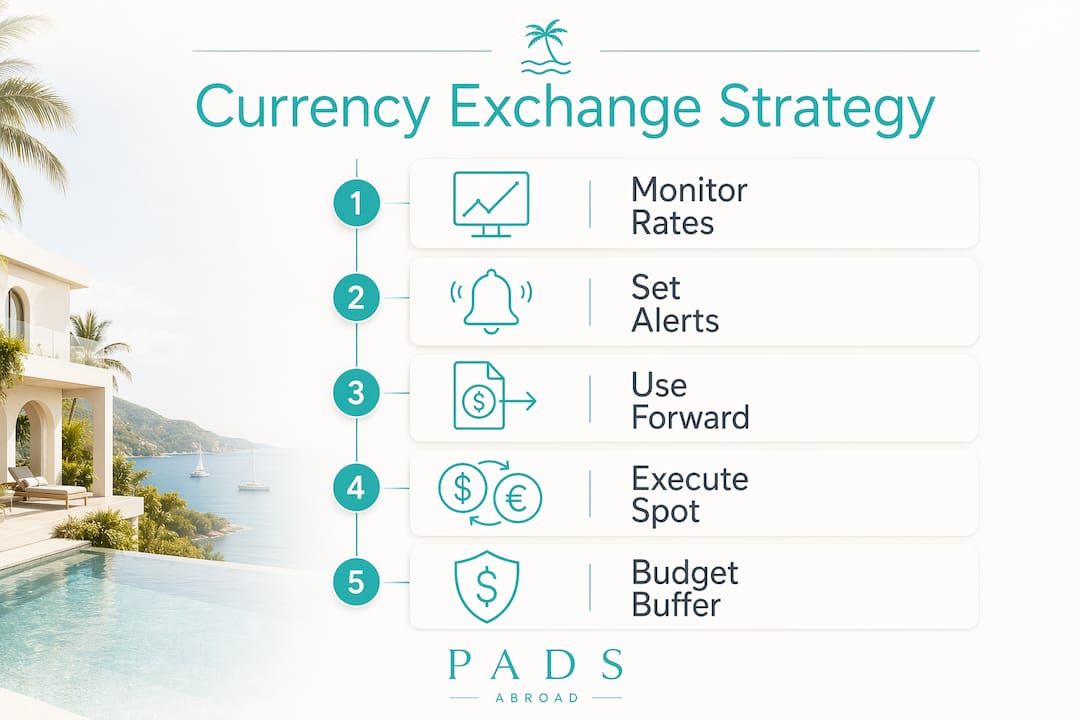
Pro Tip: Mix all three tools across your purchase timeline. Use rate alerts to monitor the market, a spot trade for your initial deposit, and a forward contract to lock in the rate on your completion balance as soon as contracts are signed.
How do exchange rate fluctuations impact your total property purchase cost?
Currency movements between offer and completion can add or subtract a significant amount from your total cost. A 2–3% adverse rate movement over a typical property transaction period is entirely plausible, and on a large purchase, that translates directly into thousands of dollars, pounds, or euros lost with no corresponding benefit to the property itself.
International property acquisitions often carry overhead costs adding 12–13% above the headline price, covering local taxes, legal fees, registration costs, and management fees. Every one of those costs is also exposed to currency risk if you have not locked in a rate. Buyers who budget only for the purchase price in their home currency frequently discover at completion that their total bill is materially higher than expected.
The table below shows how a 3% adverse rate movement affects a €200,000 property purchase for a buyer converting from US dollars.
| Scenario | Exchange Rate (USD/EUR) | USD Required | Difference |
|---|---|---|---|
| Rate at offer | 1.08 | $185,185 | Baseline |
| 1.5% adverse move | 1.0962 | $182,476 | +$2,709 |
| 3% adverse move | 1.1124 | $179,793 | +$5,392 |
| 3% favorable move | 1.0476 | $190,919 | -$5,734 |
The numbers above illustrate why building a 3–5% currency buffer into your budget is standard practice, with an additional 10–15% set aside to cover taxes and closing costs. That buffer is not pessimism. It is the difference between completing your purchase and scrambling for extra funds at the worst possible moment.
What practical steps should international buyers take to implement a currency strategy?
Execution matters as much as planning. The following steps reflect how experienced international buyers structure their currency approach from offer to completion.
-
Engage a specialist currency broker immediately after offer acceptance. Delaying currency planning until final completion creates unnecessary cost exposure. Early engagement opens up forward contract options and lets you align transfer timing with your legal milestones.
-
Use a spot trade for your reservation deposit. The deposit is typically a small percentage of the purchase price and needs to move quickly. A spot trade handles this efficiently without tying up capital in a forward contract deposit.
-
Set rate alerts for your target rate on the completion balance. Once you know the completion amount, set alerts at your ideal rate and at a floor rate you can still afford. This keeps you informed without requiring you to watch the market daily.
-
Lock in a forward contract for the completion balance as soon as contracts are exchanged. Locking in rates after contracts are signed converts exchange rate risk from a variable cost into a known cost. Your budget becomes accurate, and your completion is protected.
-
Include estimated taxes, legal fees, and registration costs in your forward contract amount. Failing to budget forward contracts for the full cost of acquisition, not just the purchase price, leaves a significant portion of your total spend exposed to currency risk.
-
Verify compliance and documentation requirements with your broker before each transfer. International transfers above certain thresholds require source-of-funds documentation. Delays caused by missing paperwork can push your transfer past a legal deadline.
Pro Tip: Ask your currency broker to map your transfer schedule against your legal completion timeline. A dedicated FX specialist aligns transfer timing with transaction milestones, which reduces both cost and last-minute pressure.
What are common pitfalls when managing exchange rate risk abroad?
The most expensive mistake international buyers make is treating currency exchange as an administrative task rather than a financial decision. By the time most buyers think about currency, they have already lost the ability to lock in a favorable rate.
The second most common error is using a high street bank for international transfers. High street banks do not typically offer forward contracts to personal clients and charge significantly higher spreads than specialist brokers. Using a specialist currency broker instead of a bank can save 2–4% in exchange rate margins, equivalent to over £11,000 on a £500,000 property purchase. That saving requires no additional risk. It simply requires choosing the right provider.
"Treat currency exchange as a financial transaction integral to your investment strategy, not an administrative afterthought to real estate. The investors who protect their returns are the ones who plan their currency approach on day one."
Preventive measures every international buyer should take:
- Open a specialist broker account before you make an offer, so you are ready to act immediately.
- Always budget in both your home currency and the destination currency to catch discrepancies early.
- Use only FCA-regulated or equivalent licensed currency providers to protect your funds.
- Never assume the rate you saw last week will still be available. Set rate alerts and act when your target is hit.
- Read the common pitfalls in overseas property purchases before you sign anything, because currency is rarely the only risk.
- Factor in the full acquisition cost, including taxes and fees, when sizing your forward contract.
If the market moves against you before you lock in a rate, contact your broker immediately. A good specialist will present options including partial hedging or a limit order that executes automatically at your target rate.
Key Takeaways
A proactive currency exchange strategy is the most reliable way to protect your overseas property budget from the moment of offer to the day of completion.
| Point | Details |
|---|---|
| Forward contracts are essential | Lock in your completion rate up to 24 months ahead to remove currency risk from your largest payment. |
| Budget beyond the purchase price | Add 3–5% for currency volatility and 10–15% for taxes and closing costs in your forward contract amount. |
| Specialist brokers outperform banks | Broker margins can save 2–4% versus high street banks, a material saving on large transfers. |
| Engage early, not at completion | Contacting a currency broker immediately after offer acceptance unlocks the best hedging options. |
| Mix tools across the timeline | Use spot trades for deposits, rate alerts for monitoring, and forward contracts for the completion balance. |
Padsabroad's take on currency strategy as a core investment decision
At Padsabroad, we have worked with international buyers purchasing property along Egypt's Red Sea coast for years, and the pattern is consistent. The buyers who feel confident at completion are the ones who treated currency as part of the investment decision, not a box to check at the end.
The buyers who regret their experience almost always made the same mistake: they waited. They waited to open a broker account, waited to set rate alerts, and waited to lock in a forward contract. By the time they acted, the rate had moved, and the savings they expected had evaporated.
Forward contracts are not complicated. They require a small deposit and a conversation with a licensed broker. The return on that effort, measured in cost certainty and peace of mind, is substantial. We consistently recommend that buyers review currency transfer options before they even finalize their property shortlist. Currency planning and property selection should happen in parallel, not in sequence.
The other shift we encourage is moving away from high street banks entirely for international transfers. The rate difference is real, the savings are real, and the process with a specialist broker is no more difficult. For buyers investing in markets like Hurghada or Sahl Hasheesh, where the Egyptian pound adds another layer of currency consideration, getting this right from the start makes a measurable difference to your total return.
— Padsabroad
Padsabroad supports your overseas property investment
Buying property in Egypt's Red Sea region is one of the most accessible entry points into overseas property investment, with strong rental yields and a growing international buyer base. Padsabroad guides international buyers through every stage of the process, from property selection to legal checks and currency planning.

Whether you are a first-time buyer or an experienced investor, Padsabroad connects you with FCA-regulated currency transfer partners and provides localized guidance specific to markets like Hurghada, El Gouna, and Soma Bay. Start with the Egypt property buyer guide to understand the full purchase process, or browse all available properties to see where your currency strategy can take you. The team is available for tailored consultations, rate alert setup support, and step-by-step guidance through your purchase.
FAQ
What is a forward contract in property buying?
A forward contract locks in an exchange rate for a future currency transfer, requiring a 5–10% deposit of the total amount. It protects buyers from adverse rate movements between offer acceptance and completion.
How much should I budget for currency risk when buying property abroad?
Build a 3–5% buffer into your currency budget to cover market volatility, plus an additional 10–15% to cover taxes, legal fees, and closing costs in your forward contract.
Why should I use a specialist broker instead of my bank?
Specialist brokers save 2–4% in exchange rate margins compared to high street banks, and they offer forward contracts that most banks do not provide to personal clients.
When should I start planning my currency exchange strategy?
Start immediately after your offer is accepted. Early engagement with a specialist broker unlocks forward contract options and gives you time to monitor rates before committing to a large transfer.
Does currency risk affect more than just the purchase price?
Yes. Acquisition overheads including taxes, legal fees, and registration costs can add 12–13% above the headline price, and all of those costs are exposed to currency risk if not included in your forward contract.