
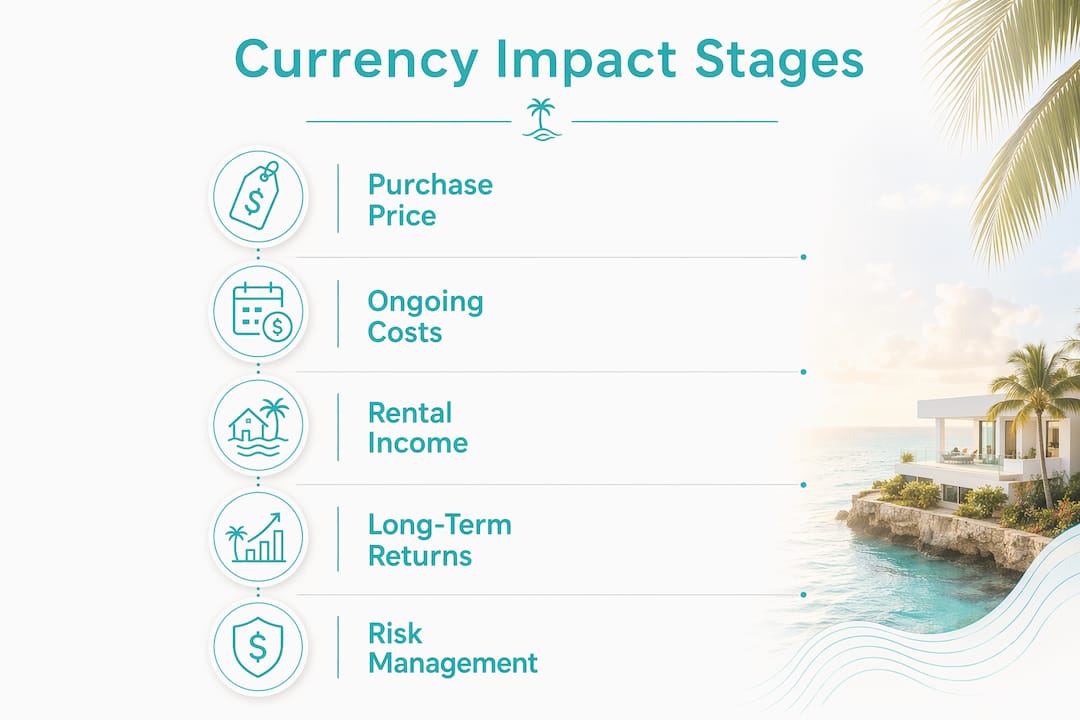
Currency fluctuation is defined as the change in the relative value of one currency against another, and it directly determines how much you pay for overseas property and how much you earn from it. Foreign exchange risk, the standard industry term for this exposure, is the single most underestimated cost in international real estate. A 5–10% shift in exchange rates can add or wipe that same percentage from your total investment return. On a €500,000 property, that translates to a €25,000 swing before you even factor in legal fees or taxes. Understanding why currency fluctuation affects overseas property is not optional for serious investors. It is the foundation of sound financial planning abroad.
Why currency fluctuation affects overseas property purchase prices
Exchange rate risk begins the moment you agree on a price and ends when the funds clear in the seller's account. That window is typically 3–6 months during the conveyancing period, and the rate you see on the day you make an offer is rarely the rate you pay at completion.
Consider a practical example. You agree to buy a property priced at €500,000 when the GBP/EUR rate is 1.15. Your cost in sterling is approximately £434,782. If the rate shifts to 1.10 by completion, your cost rises to £454,545. That £19,763 difference appeared without any change to the property price itself. The impact of currency rates on real estate is that stark.
Transaction costs compound the problem. Legal fees, notary charges, property transfer taxes, and agent commissions are all paid in the local currency. A 2–3% shift in exchange rates during conveyancing can exceed the total cost of your legal fees, making FX risk management as financially significant as price negotiation. Most buyers spend weeks negotiating a 1% price reduction and then ignore a 3% currency move that costs them far more.
Key costs affected by exchange rate changes during purchase:
- Property purchase price converted at completion rate
- Transfer taxes and stamp duty equivalents paid in local currency
- Notary and legal fees billed in the property's country currency
- Agent commissions often denominated in local currency
- Survey and inspection fees paid locally
Pro Tip: Lock in your exchange rate as early as possible after agreeing on a purchase price. Even a small favorable move can cover a significant portion of your transaction costs.
What ongoing financial impacts do currency fluctuations have during ownership?
Currency risk does not stop at completion. Currency risk persists for the full ownership period, affecting every payment you make and every euro or dollar you receive. This is the part most buyers fail to model before purchasing.
Rental income is the clearest example. If your Red Sea property generates EGP 120,000 per year in rental income, the sterling or dollar value of that income changes every time you convert it. A weakening Egyptian pound reduces your effective yield even if your occupancy rate stays constant. The property performs well locally but delivers less to your home bank account.
Ongoing costs create the same exposure in reverse. Annual property taxes, building insurance, maintenance contracts, and management fees are all billed in the local currency. When your home currency weakens, each of these costs rises in real terms. Investors who model their annual holding costs at a fixed exchange rate often find their actual expenses run higher than projected.
Borrowing in a foreign currency while earning in your home currency introduces a financing mismatch that compounds over years. If you take a mortgage in euros but your income is in sterling, a weakening pound increases your effective monthly repayment without any change to the loan terms. This multi-year exposure is one of the most financially damaging and least discussed aspects of overseas property ownership.
Ongoing costs subject to currency risk include:
- Annual property taxes billed in local currency
- Building and contents insurance premiums
- Property management fees paid to local agents
- Maintenance and repair costs invoiced locally
- Mortgage repayments if financed in foreign currency
- Rental income conversions back to your home currency
Pro Tip: Build a currency buffer of at least 5% into your annual ownership budget. This absorbs rate movements without forcing you to convert at unfavorable times.
What practical strategies can investors use to manage exchange rate risk?
Managing property investment currency risks starts with one decision: treat currency as a cost center, not an afterthought. The investors who handle this well plan their currency strategy at the same time they plan their purchase, not after contracts are signed.
1. Use a forward contract
A forward contract lets you fix today's exchange rate for a payment due in the future. Forward contracts neutralize currency risk during the 3–6 month conveyancing window by locking in the rate at the point of agreement. You know exactly what you will pay in your home currency, regardless of what markets do between now and completion.
2. Use a specialist currency provider
Banks apply wide margins to foreign exchange transactions. Specialist currency providers offer better exchange rates than banks, and buyers can save £2,500 to £6,000 on a £250,000 overseas property purchase by avoiding standard bank margins. That saving is real money that stays in your pocket. For guidance on how to transfer funds abroad efficiently, specialist brokers are consistently the better option.
3. Time your transfers strategically
You cannot predict currency markets with certainty, but you can avoid converting large sums during periods of known volatility. Major political events, central bank announcements, and economic data releases all move exchange rates sharply. Scheduling transfers away from these windows reduces unnecessary exposure.
4. Set rate alerts
Most specialist currency providers offer rate alert services. You set a target rate and receive a notification when the market reaches it. This removes the need to monitor rates daily and helps you act quickly when conditions are favorable.
5. Maintain a local currency account
Holding a bank account in the property's country lets you accumulate rental income locally and pay local expenses without converting every transaction. This reduces the number of conversions you make and gives you flexibility to convert larger sums when rates are favorable.
Pro Tip: Review your currency exposure annually alongside your property's financial performance. Rate environments change, and a hedging strategy that worked in year one may need adjusting by year three.
The most common pitfall is waiting until just before completion to think about currency. By that point, you have no flexibility. The rate is whatever the market offers that day, and if conditions are unfavorable, you absorb the full cost.
How do currency fluctuations affect long-term investment returns?
The long-term picture of how currency changes affect property is more complex than the purchase transaction alone. When you eventually sell, the proceeds convert back to your home currency at whatever rate applies on that day. A property that appreciated 20% in local currency terms can deliver a much lower return in your home currency if the local currency weakened over the same period.
The reverse is equally true. Investors often use overseas properties as a hedge against home currency weakness, seeking assets priced in stable or hard currencies like the USD or EUR. When your home currency weakens, property priced in a stronger currency becomes more valuable in relative terms. This is one reason demand for real estate in USD-pegged or euro-denominated markets rises during periods of local currency instability.
However, local inflation and market conditions can erode apparent currency advantages. A strong home currency increases your buying power at the point of purchase, but if local property prices and operating costs inflate rapidly, the currency benefit disappears over time. Rigorous evaluation of local market fundamentals matters as much as the exchange rate itself.
Key long-term considerations for investors:
- Sale proceeds convert at the prevailing rate on the day of completion
- Capital growth in local currency may not translate equally to your home currency
- Currency diversification across multiple markets reduces concentration risk
- Local inflation can offset the advantage of a favorable exchange rate
- Rental yield in home currency terms fluctuates independently of local occupancy rates
The best investors structure their currency exposure so that timing matters less. They view property as a long-term asset and build currency risk into their financial model from day one, rather than hoping rates stay favorable.
Thinking about diversifying into overseas property requires this long-term currency lens. Short-term rate movements are noise. Multi-year structural trends in exchange rates are the signal that shapes real returns.
Key Takeaways
Currency fluctuation affects overseas property at every stage of ownership, from purchase through ongoing costs to final sale, making active exchange rate management a core part of any international property investment plan.
| Point | Details |
|---|---|
| Purchase price exposure | A 5–10% rate shift can change your real cost by €25,000 on a €500,000 property. |
| Ongoing ownership costs | Taxes, insurance, and management fees all fluctuate in real terms with exchange rates. |
| Forward contracts work | Locking in a rate at agreement removes uncertainty during the conveyancing period. |
| Specialist brokers save money | Using a currency specialist instead of a bank can save £2,500–£6,000 on a £250,000 purchase. |
| Long-term modeling is required | Local inflation and sale conversion rates determine whether currency gains survive to exit. |
Padsabroad's view on currency risk in overseas property
Buyers consistently underestimate how long currency risk lasts. They focus on the purchase rate and assume the hard part is over at completion. The reality is that ownership creates a multi-year stream of currency exposures that compound quietly in the background.
The buyers who handle this well are not the ones who time markets perfectly. They are the ones who build currency risk into their financial model before they make an offer. They know their break-even rate. They know how much a 5% adverse move costs them annually in rental income. They have a forward contract in place before they sign.
Seeking specialized advice early is not a luxury for large transactions. On a £250,000 purchase, the difference between a bank rate and a specialist rate can cover a year's worth of management fees. That is a concrete, recoverable cost that most buyers simply leave on the table.
The other overlooked factor is the sale. Buyers plan their purchase currency carefully and then forget to plan their exit. The rate on the day you sell determines your actual return in home currency terms. Building that into your long-term model from the start gives you a realistic picture of what the investment actually delivers.
— Padsabroad
Padsabroad helps you buy abroad with confidence
Buying overseas property involves more moving parts than a domestic purchase, and currency risk sits near the top of that list. Padsabroad works with international buyers purchasing property in Egypt, including prime Red Sea destinations like Hurghada, El Gouna, Sahl Hasheesh, and Soma Bay.

Padsabroad's team guides buyers through the full process, from understanding overseas property ownership to structuring payments and managing exchange rate exposure. Whether you are buying for investment, lifestyle, or both, having the right support reduces cost and removes uncertainty. Visit Padsabroad to speak with a specialist who understands both the local market and the financial mechanics of buying abroad.
FAQ
Why does currency fluctuation affect overseas property costs?
Currency fluctuation changes the amount you pay in your home currency for a property priced in a foreign currency. A rate shift of just 2–3% during the conveyancing period can cost more than your total legal fees.
What is a forward contract in overseas property buying?
A forward contract locks in an exchange rate for a future payment, protecting you from rate movements during the 3–6 month period between agreement and completion.
How much can I save by using a specialist currency provider?
Buyers can save £2,500 to £6,000 on a £250,000 overseas property purchase by using a specialist currency provider instead of a standard bank transfer.
Does currency risk end when I complete the purchase?
Currency risk continues throughout ownership, affecting rental income conversions, annual taxes, insurance, maintenance costs, and eventually the proceeds when you sell.
How do exchange rates affect long-term property investment returns?
Exchange rates affect both the ongoing yield in home currency terms and the final sale proceeds. Local inflation can also erode currency advantages, so long-term modeling must account for both factors.