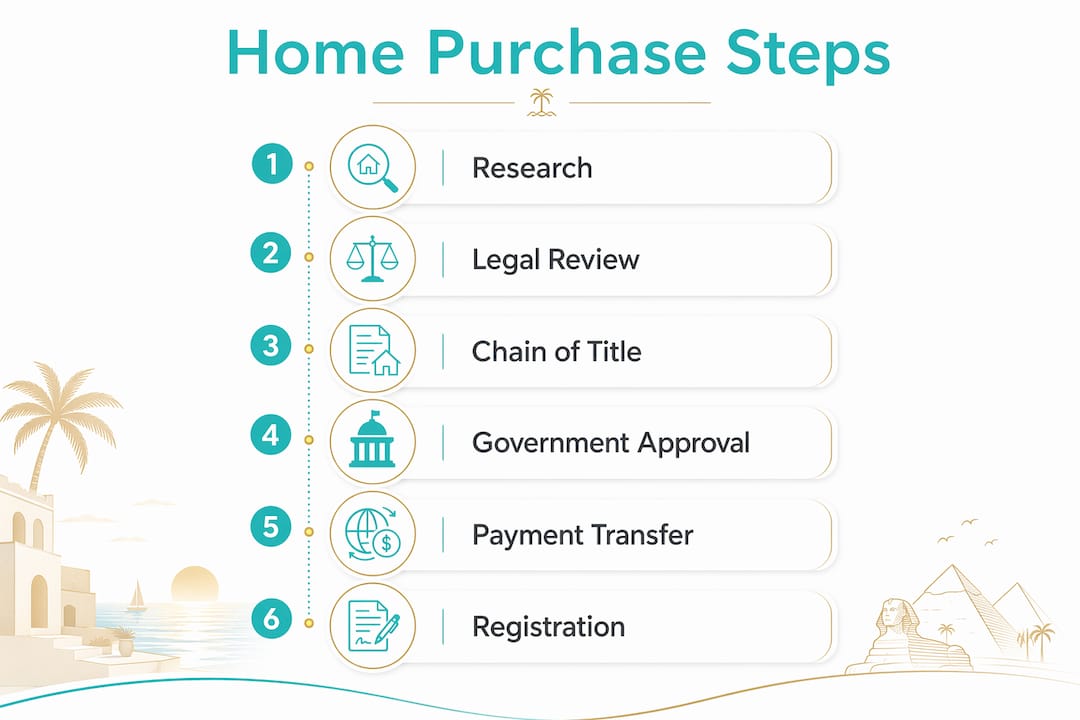
The second home purchase process in Egypt is a defined sequence of legal, financial, and administrative steps that secures ownership and protects international buyers. For UK residents and other foreign nationals, this process involves verifying title chains, signing the right contract type, transferring funds through official Egyptian banking channels, and completing registration with Egyptian authorities. The buying process for foreigners typically takes 4–12 weeks depending on property readiness. Getting each step right from the start protects your investment and avoids costly delays.
What are the essential legal steps when buying a second home in egypt?
The legal framework for buying a second home in Egypt requires careful attention at every stage. Skipping or rushing any step can leave you with a contract that offers far less protection than you expect.
Verify the chain of title first
Before signing anything, an independent lawyer must verify the chain of title and confirm no liens, unpaid debts, or competing claims exist on the property. This step is non-negotiable. A clean title is the foundation of a secure purchase.
Understand the two main contract types
Egypt uses two primary contract types for property sales:
- Possession Contract: A private agreement between buyer and seller. It is commonly used but carries significant risk because it is not registered with Egyptian authorities. Possession contracts are not recognized as full legal ownership.
- Registered Deed (Green Contract): Registered through the Real Estate Publicity Department (REPD). A Registered Deed provides the highest level of ownership security recognized by Egyptian law. Always prioritize properties eligible for REPD registration.
Government approvals and security clearance
Foreign buyers must obtain mandatory government approvals and a security clearance before completing a purchase. This process is handled through official Egyptian channels and typically runs in parallel with the legal due diligence stage. Your lawyer manages this on your behalf.
Power of attorney for remote buyers
If you are buying from abroad, you will need to issue a Power of Attorney (POA) to authorize a local representative to act on your behalf. The POA must be notarized in your home country and legalized through the Egyptian consulate before it is valid in Egypt. This document allows your lawyer or agent to sign contracts, submit applications, and complete registration without you being physically present.
Pro Tip: Never use the developer's own legal representative as your sole legal counsel. Appoint an independent Egyptian lawyer who works exclusively for you. The developer's lawyer protects the developer's interests, not yours.
How does the payment and financing process work?
Egypt updated its foreign currency payment rules in 2024 and 2026, and these changes directly affect every international buyer. Understanding them before you transfer any money is critical.
The 2026 foreign currency requirement
As of 2026, foreign buyers must transfer all purchase funds in foreign currency through Egypt's formal banking system. This rule applies to all international buyers, including UK residents. The requirement improves transparency and creates a documented paper trail for authorities.
The bank certificate of transfer (form 4)
The Bank Certificate of Transfer, known as Form 4, is the document your Egyptian bank issues after receiving your foreign currency transfer. This certificate is mandatory for property registration and is also required if you plan to apply for Egyptian residency through property ownership. Without Form 4, you cannot complete the official registration process.
Payment schedules and financing options
The steps for managing payments typically follow this sequence:
- Agree on the payment schedule with the developer or seller before signing any contract. Ready-to-move properties usually require a larger upfront payment. Off-plan properties often allow staged payments tied to construction milestones.
- Open an Egyptian bank account to receive and manage your transferred funds. Padsabroad's guide on opening a bank account in Egypt covers the full process for foreign nationals.
- Transfer funds in foreign currency through your Egyptian bank and obtain Form 4 immediately after each transfer.
- Confirm payment receipts with the developer in writing at every stage.
Most international buyers use developer installment plans or equity release from their home country because Egyptian mortgages for foreigners remain limited. Some buyers also use international financing secured against UK or European assets. Down payments for off-plan properties in Egypt typically range from 10% to 30% of the purchase price.
Pro Tip: Never send funds outside the official Egyptian banking system. Informal transfers do not generate Form 4, which means you cannot register the property or apply for residency. The risk is not worth it.
Which regions and property types are best for a second home?
Egypt's popular second home areas include the Red Sea Riviera, Sharm El-Sheikh, Hurghada, Soma Bay, and major urban centers like Cairo. Each location offers a different balance of lifestyle appeal and investment potential.
Location and property type comparison
| Location | Property Types | Best For |
|---|---|---|
| Hurghada / El Gouna | Apartments, villas, chalets | Year-round rental income, lifestyle use |
| Soma Bay / Sahl Hasheesh | Luxury villas, resort apartments | Capital appreciation, premium rentals |
| Sharm El-Sheikh | Apartments, chalets | Tourism-driven rental yields |
| Marsa Alam / Port Ghalib | Villas, off-plan developments | Long-term growth, lower entry price |
| Cairo | Apartments, townhouses | Urban investment, local rental market |
Price comparison with the UK market
Egypt's Red Sea resorts offer exceptional value compared to UK prices. A luxury villa in Hurghada or Soma Bay can be purchased for around $300,000, a fraction of what a comparable London property costs. That price gap is the primary reason UK buyers are increasingly active in the Egyptian market.
Key considerations for buyers evaluating Egypt real estate investment:
- Rental potential: Red Sea resort areas attract strong tourist demand, supporting short-term rental income.
- Capital appreciation: Off-plan properties in developing resort zones like Sahl Hasheesh have shown consistent price growth.
- Legal ownership limits: Foreign buyers are allowed to own up to two residential properties in Egypt, with land size limits typically set at 4,000 square meters per property.
- Developer reputation: Always verify a developer's track record and license before committing to an off-plan purchase.
For a detailed breakdown of returns, Padsabroad's analysis of Egypt real estate ROI covers the numbers behind the investment case.
What practical steps should overseas buyers follow?
Buying a second home in Egypt from abroad is entirely possible. The process requires careful planning and the right local support. Follow these steps to keep the transaction on track:
- Appoint a qualified independent Egyptian lawyer before taking any other action. Your lawyer handles due diligence, contract review, government approvals, and registration.
- Issue and legalize a Power of Attorney in your home country. Have it notarized and authenticated by the Egyptian consulate so it is valid for use in Egypt.
- Verify the developer's license and the property's registration status remotely. Your lawyer can obtain official documentation from the REPD and relevant government ministries.
- Open an Egyptian bank account and transfer your purchase funds in foreign currency. Collect Form 4 after each transfer.
- Monitor payment schedules and construction milestones in writing. Request regular updates from the developer and keep records of every payment confirmation.
- Complete final registration through your lawyer using the POA. Your lawyer submits the Registered Deed application to the REPD and collects the title deed on your behalf.
The full process for an overseas property ownership transaction in Egypt is well-established for international buyers. With the right legal and financial support in place, physical presence in Egypt is not required for most stages.
What are the most common legal risks and how do you avoid them?
The Egyptian property market carries specific risks that catch unprepared buyers off guard. Knowing these risks in advance lets you take the right precautions.
- Possession Contracts vs. Title Deeds: Many developers issue Possession Contracts as standard. These are not the same as a Registered Deed. Possession contracts carry significant risk and do not represent full legal ownership under Egyptian law. Always push for REPD registration.
- Relying on the developer's lawyer: The developer's legal representative is not your advocate. Appointing your own independent lawyer is the single most important step you can take to protect your purchase.
- Outstanding liens and unpaid utilities: Confirm in writing that the property has no outstanding debts, unpaid service charges, or utility arrears before signing. These liabilities can transfer to the new owner.
- Non-compliant fund transfers: Sending money outside official Egyptian banking channels means you will not receive Form 4. Without Form 4, registration is blocked and residency applications cannot proceed.
- Delivery delays on off-plan properties: Build contractual penalties for late delivery into your purchase agreement. Your lawyer can negotiate these terms before you sign.
"Court Validity Suits (Sihha wa Nafaz) can validate contracts legally but do not replace full REPD registration. Savvy buyers use this as a protective interim step when full registration is pending." Source
Pro Tip: If REPD registration is delayed, ask your lawyer to file a Court Validity Suit as an interim measure. This legally validates your contract while the full registration process is completed.
Key takeaways
Buying a second home in Egypt requires independent legal counsel, foreign currency compliance, and REPD registration to secure full ownership protection.
| Point | Details |
|---|---|
| Appoint an independent lawyer | Never rely on the developer's representative; your lawyer protects your interests alone. |
| Prioritize REPD registration | A Registered Deed is the only contract type that provides full legal ownership security in Egypt. |
| Follow the 2026 payment rules | Transfer all funds in foreign currency through Egyptian banks and collect Form 4 after every payment. |
| Know your ownership limits | Foreign buyers can own up to two residential properties with land sizes up to 4,000 square meters. |
| Use a POA for remote purchases | A notarized and legalized Power of Attorney lets your lawyer complete the full process without your physical presence. |
What Padsabroad has learned about buying in egypt in 2026
The most common mistake we see from international buyers is treating the Egyptian property market like a simplified version of buying at home. It is not. The legal framework is different, the contract types carry different levels of protection, and the 2026 banking regulations add a layer of compliance that many buyers underestimate until it causes a problem.
The buyers who have the smoothest experiences are those who engage an independent Egyptian lawyer before they fall in love with a property. Once you are emotionally committed to a specific villa or apartment, it becomes harder to walk away if due diligence reveals a problem. Starting the legal process early keeps your options open.
The 2026 foreign currency enforcement is actually a positive development for buyers. It creates a documented paper trail, reduces informal transactions, and makes the market more transparent. The buyers who struggle with it are those who try to work around it. Those who follow the official process find it straightforward.
Egypt's Red Sea coast continues to offer genuine value for UK buyers. The price gap with the UK market is real, the rental demand in resort areas is consistent, and the legal framework, while different from the UK, is navigable with the right guidance. The key is knowing which questions to ask before you sign anything.
— Padsabroad
How Padsabroad can support your egypt property purchase
Padsabroad specializes in helping UK and international buyers complete their second home purchase in Egypt with confidence. From the first property search to final title deed registration, the team provides practical support at every stage.

Padsabroad connects buyers with vetted independent Egyptian lawyers, assists with Power of Attorney preparation, and guides clients through the 2026 foreign currency transfer requirements. The team covers key Red Sea destinations including Hurghada, El Gouna, Sahl Hasheesh, Soma Bay, Marsa Alam, and Port Ghalib. Whether you are buying for lifestyle, rental income, or long-term investment, Padsabroad's local knowledge and UK-based support make the process clear and manageable. Visit Padsabroad to speak with a specialist about your Egypt property goals.
FAQ
How long does the second home purchase process in egypt take?
The buying process for foreigners in Egypt typically takes 4–12 weeks. The timeline depends on whether the property is ready to move into or still off-plan.
Can UK residents buy a second home in egypt?
Yes. UK residents can legally purchase residential property in Egypt. Foreign buyers are permitted to own up to two residential properties, subject to a land size limit of 4,000 square meters per property.
What is form 4 and why does it matter?
Form 4 is the Bank Certificate of Transfer issued by an Egyptian bank after receiving a foreign currency payment. It is mandatory for property registration and required for any residency application linked to the purchase.
What is the difference between a possession contract and a registered deed?
A Possession Contract is a private agreement that does not provide full legal ownership. A Registered Deed, recorded with the Real Estate Publicity Department, is the only contract type that offers complete ownership security under Egyptian law.
Do i need to be in egypt to complete the purchase?
No. You can complete the full purchase process remotely by issuing a notarized and legalized Power of Attorney to a qualified local lawyer, who acts on your behalf for all legal, administrative, and registration steps.