
Escrow is defined as a neutral third party holding funds and documents during a property purchase until all contract conditions are met. For buyers asking what does escrow mean property abroad, the answer is both legal and financial: it protects your money while the deal closes across international borders. A neutral escrow agent's loyalty is strictly to the purchase agreement terms, ensuring fairness between buyer and seller regardless of geography. Without escrow, cross-border property deals carry serious risks, including title fraud, stalled ownership transfers, and unresolved liens. Understanding how escrow works overseas is the first step to buying property abroad with confidence.
What does escrow mean for property abroad?
Escrow in international real estate refers to three distinct but related concepts. Escrow commonly covers the escrow period itself, the escrow account holding earnest money during the transaction, and the lender escrow account that collects funds for taxes and insurance after purchase. Each concept applies at a different stage of the buying process. Buyers who confuse them often misread contract terms or underestimate how long their funds will be held.
The escrow period is the window between signing the purchase agreement and completing the transaction. During this time, the escrow agent holds your deposit and all key documents. Funds are released only when both parties fulfill their contractual obligations, such as passing inspections, clearing title, and securing financing. This structure gives both buyer and seller a defined, enforceable framework.

Earnest money deposits held in escrow demonstrate buyer seriousness and often apply toward the down payment or closing costs. This protects the seller from buyers who back out without cause. For the buyer, it means the deposit sits in a protected account rather than going directly to the seller before the deal is confirmed. That separation is the core value of escrow in any property transaction.
How escrow works in foreign property purchases
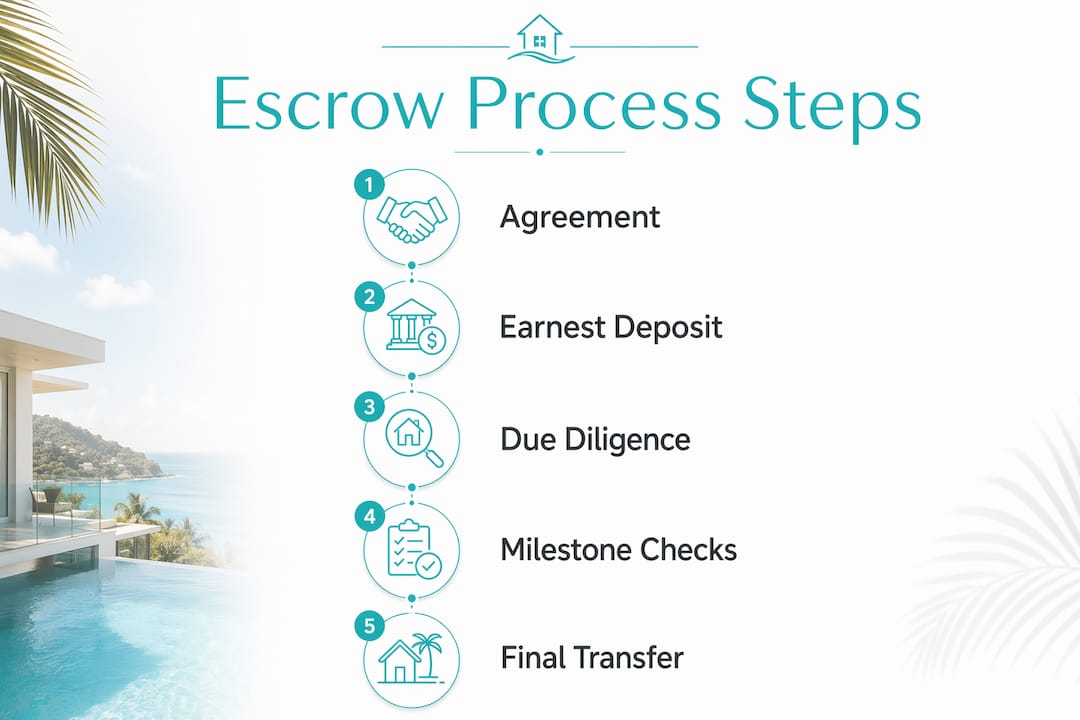
The typical escrow flow follows a clear sequence. You sign a purchase agreement, deposit earnest money into the escrow account, and the agent holds those funds while both parties complete their obligations. Milestones such as title verification, inspection sign-off, and mortgage approval trigger each stage of fund release. The final disbursement happens at closing, when ownership legally transfers.
The roles involved in this process vary by country. In the United States, a licensed escrow officer or title company manages the entire process. In other countries, the function splits between a financial escrow agent and a legal official. In Mexico, the Notario Público handles legal verification while the escrow agent manages the financial side, and neither reports to the other. Buyers who expect one person to handle everything are often caught off guard.
Escrow also provides critical protection against fraud and title disputes. The agent verifies that the seller has clear ownership before releasing funds. This step is especially valuable in markets where title registries are less digitized or where property records have gaps. Skipping escrow when buying abroad leaves buyers exposed to risks like stalled ownership transfers and unclear title liens.
Key stages in a typical international escrow process:
- Signing the purchase agreement: Both parties agree to terms and the escrow account is opened.
- Earnest money deposit: Buyer funds are transferred to the escrow account, not to the seller.
- Due diligence period: Title checks, inspections, and legal reviews are completed.
- Milestone approvals: Each completed condition triggers the next stage of the process.
- Closing and fund release: The agent disburses funds and transfers documents once all conditions are met.
Pro Tip: Always confirm in writing which party controls each milestone trigger before signing. Ambiguity here is the most common cause of escrow delays in cross-border deals.
How does escrow vary across different countries?
Escrow practices differ significantly depending on whether a country follows common law or civil law. In the United States, escrow agents are licensed professionals operating under state-specific regulations, and they manage both the financial and administrative sides of the transaction. In civil law countries, a state-appointed notary takes on the legal compliance role instead.
In civil law jurisdictions like Mexico and France, the public notary (Notario Público in Mexico, Notaire in France) is a state-appointed official responsible for legal compliance, not for accelerating the process. This distinction matters because buyers often expect the notary to act like an American escrow officer. The notary's job is legal validity, not transaction management.
Across Europe, the escrow role is often fulfilled by a public notary who acts as a quasi-public official ensuring legal validity rather than administrative coordination. In the UK, the process is called conveyancing, handled by a solicitor who manages both legal and financial elements without a separate escrow account in the traditional sense. Each system has its own timeline and formality requirements.
| Country / Region | Escrow Equivalent | Key Official | Governing Law |
|---|---|---|---|
| United States | Licensed escrow officer or title company | Escrow agent | State escrow law |
| Mexico | Escrow agent (financial) + Notario Público (legal) | Notario Público | Often US or Canadian law |
| France | Notaire manages funds and legal compliance | Notaire | French civil law |
| United Kingdom | Solicitor handles conveyancing | Conveyancing solicitor | English property law |
| Egypt | Developer or legal representative holds funds | Notary / legal counsel | Egyptian civil law |
Most Mexican real estate escrow agreements are governed by US law, with funds held in US or Canadian banks for stronger legal recourse. This arrangement gives foreign buyers a familiar legal framework even when buying in a civil law country. It also means disputes can be resolved through US courts rather than navigating an unfamiliar foreign legal system.
Pro Tip: Before signing any escrow agreement abroad, confirm which country's law governs the account. US-governed escrow in Mexico, for example, gives you far stronger dispute rights than a locally governed account.
What are the benefits and risks of escrow for property abroad?
Escrow delivers clear protections for both buyers and sellers in international transactions. For buyers, the primary benefit is fund security. Your money sits in a neutral account and cannot be accessed by the seller until every contractual condition is satisfied. This protection extends to legal compliance checks, title verification, and contingency enforcement.
Sellers also benefit from escrow. The earnest money deposit confirms the buyer's commitment and compensates the seller if the buyer walks away without a valid reason. This financial accountability keeps both parties focused on completing the deal rather than renegotiating terms mid-process.
Escrow service costs typically range between 1% and 2% of the home's sale price, varying by location and complexity. On a $200,000 property, that translates to $2,000–$4,000 in escrow fees alone. Buyers should budget for this cost alongside legal fees, transfer taxes, and agent commissions when calculating total purchase costs.
Five common mistakes to avoid when using escrow for property abroad:
- Assuming one agent handles everything. In many countries, the escrow agent and the legal notary are separate roles with no shared reporting line.
- Ignoring the governing law clause. Always check whether the escrow agreement is governed by local law or a more familiar jurisdiction like US or UK law.
- Underestimating the timeline. Foreign escrow processes routinely take longer than domestic ones due to translation requirements, international wire transfers, and local bureaucracy.
- Skipping independent legal review. Never rely solely on the seller's attorney or the developer's recommended escrow agent. Hire your own legal counsel.
- Waiving escrow to speed up the deal. Waiving escrow to close faster is a serious risk. It removes the neutral party protecting your funds and your legal rights.
Escrow agents can file interpleader actions in US courts when disputes arise, ensuring funds are held securely until a judge resolves the matter. This legal mechanism is not available in every jurisdiction. Buyers using locally governed escrow in some markets have far fewer options if a dispute occurs.
How to navigate escrow when buying property internationally
Selecting a reputable escrow provider is the single most important decision in an international property purchase. Look for agents licensed in a recognized jurisdiction, with verifiable references from other foreign buyers. Avoid providers recommended exclusively by the seller or developer, as their loyalty may not align with your interests.
Understanding your contract terms is equally critical. The escrow agreement should specify which milestones trigger fund release, what happens if a condition is not met, and which country's law governs the account. If any of these points are vague, request clarification in writing before signing. Ambiguity in escrow contracts is where most international disputes begin.
Key steps for managing escrow effectively in a foreign property purchase:
- Hire independent legal counsel in the country where the property is located. Local expertise is not optional.
- Confirm the escrow agent's license and jurisdiction before transferring any funds. Check overseas property ownership rules in your target country.
- Request a milestone schedule in writing so you know exactly when funds move and why.
- Plan for delays. International escrow processes involve multiple time zones, currency conversions, and regulatory checks. Build at least 30 extra days into your timeline.
- Monitor fund transfers closely. Use a trusted service for transferring money abroad and confirm receipt with the escrow agent before each milestone.
Understanding the distinct roles of escrow agents and state-appointed notaries reduces buyer confusion and prevents unrealistic expectations about transaction timelines. Buyers who treat the notary as an escrow officer, or vice versa, consistently run into avoidable delays. Knowing who does what from day one keeps the process on track.
Key Takeaways
Escrow in international property purchases protects both buyer and seller by placing funds and documents with a neutral third party until every contract condition is satisfied.
| Point | Details |
|---|---|
| Escrow definition | A neutral third party holds funds and documents until all purchase conditions are met. |
| Country variations | Escrow roles split between financial agents and legal notaries in civil law countries like Mexico and France. |
| Governing law matters | US-governed escrow accounts offer stronger dispute rights than locally governed accounts in many markets. |
| Cost to budget | Escrow fees typically range from 1% to 2% of the sale price, varying by location and deal complexity. |
| Biggest risk | Waiving escrow to speed up a foreign deal removes the only neutral protection for your funds and legal rights. |
Padsabroad's view on escrow in international property buying
Escrow is the part of international property buying that most buyers underestimate until something goes wrong. Working with buyers across markets including Egypt's Red Sea coast, Padsabroad has seen the same pattern repeatedly: buyers focus on the property and the price, then treat escrow as administrative paperwork. That mindset creates real exposure.
The most common source of confusion is the split between the escrow agent and the legal notary. Buyers expect one person to manage everything, and when they realize the notary cannot instruct the escrow agent, or vice versa, they feel the process is broken. It is not broken. It is just different from what a domestic buyer expects. The fix is simple: get a clear written explanation of each party's role before you sign anything.
Patience is not optional in cross-border escrow. International wire transfers, translation requirements, and regulatory checks all add time. Buyers who plan for a 60-day escrow and then panic at day 75 create pressure that leads to poor decisions, including waiving protections they should not waive. Build the extra time into your plan from the start.
The buyers who navigate foreign escrow best are the ones who stay proactive. They check in with their escrow agent and legal counsel at every milestone. They do not wait for news. They ask for it. That habit alone prevents most of the delays and disputes Padsabroad has seen in international transactions. If you are buying property abroad, treat escrow as a process to manage, not a box to check.
— Padsabroad
Buying property abroad safely with Padsabroad
Padsabroad specializes in helping international buyers purchase property safely along Egypt's Red Sea coast, including Hurghada, El Gouna, Sahl Hasheesh, and Marsa Alam. Understanding escrow and legal protections is central to every transaction the team supports.

Whether you are a first-time buyer or an experienced investor, Padsabroad provides clear guidance on legal processes, fund security, and the steps involved in buying property in Egypt safely. The team works with independent legal counsel and trusted local contacts to make sure your funds and your rights are protected at every stage. For buyers ready to take the next step, the first-time buyer guide covers everything from escrow basics to closing day.
FAQ
What is escrow in international real estate?
Escrow is a legal arrangement where a neutral third party holds funds and documents during a property purchase until all contract conditions are satisfied. It protects both buyer and seller in cross-border transactions.
How does escrow work overseas compared to the US?
In the US, a single licensed escrow officer manages the process. Overseas, the role often splits between a financial escrow agent and a state-appointed legal notary, each with separate responsibilities and no shared reporting line.
What does escrow cost for property abroad?
Escrow fees typically range from 1% to 2% of the property's sale price, varying by country and deal complexity. Budget for this cost alongside legal fees and transfer taxes.
Is escrow required when buying property in Egypt?
Escrow is not universally mandated in Egypt, but using a neutral third party to hold funds during the purchase process is strongly recommended. Padsabroad advises all buyers to review trust checks for Egypt purchases before committing funds.
What happens if an escrow dispute arises abroad?
When escrow is governed by US law, the escrow agent can file an interpleader action in a US court to hold funds securely until a judge resolves the dispute. Locally governed escrow accounts in some markets offer fewer legal remedies, which is why governing law matters.