
Overseas property diversification is defined as the practice of allocating investment capital to real estate markets outside your home country to reduce portfolio concentration risk. Investors who diversify into overseas property gain access to higher rental yields, currency protection, and growth cycles that move independently from domestic markets. Overseas markets regularly deliver gross rental yields of 5–7%, compared to 3–4% in many UK cities, with some emerging hubs projecting up to 12% annually. That yield gap alone makes international real estate worth serious consideration for any investor building a resilient, income-generating portfolio.
Why diversify into overseas property: the financial case
The financial argument for international property investment is direct. Rental income is higher, tax structures are often more favorable, and currency exposure adds a layer of protection that purely domestic portfolios lack.
| Factor | Overseas property | Domestic (UK average) |
|---|---|---|
| Gross rental yield | 5–7% (up to 12% in emerging hubs) | 3–4% |
| Currency exposure | Multi-currency income stream | Single currency |
| Tax incentives | Residency programs, reduced rates in select markets | Standard domestic rates |
| Growth drivers | Global demographics, tourism, infrastructure | Local economic cycle |
Currency diversification is one of the most underrated benefits of overseas investments. When your home currency weakens, income earned in a stronger foreign currency actually increases in real terms when converted back. Investors holding Egyptian pound-denominated assets alongside sterling or dollar holdings, for example, benefit from a natural hedge against any single currency's depreciation.
Tax efficiency is another concrete advantage. Several popular overseas markets offer reduced property tax rates, VAT exemptions on resale, or residency-by-investment programs that lower the overall tax burden on foreign buyers. Egypt's Red Sea coast, where Padsabroad operates, offers relatively low acquisition costs and no capital gains tax for non-residents on property sales, making it a financially attractive entry point for international investors.

Pro Tip: Before committing capital, calculate your net yield after local taxes, management fees, and currency conversion costs. Gross yield figures can look impressive, but net yield is what actually lands in your account.
How does overseas property reduce portfolio risk?
Portfolio risk reduction is the primary institutional reason to hold international real estate. Allocating 5–15% of a portfolio to international real estate reduces overall volatility because overseas property markets move on different economic cycles than domestic stocks and bonds.
The key concept here is correlation. When domestic equities fall sharply during a local recession, a well-chosen overseas property in a tourism-driven or infrastructure-growing market may hold its value or even appreciate. International exposure produces smoother, less volatile returns aligned with global population growth and expanding middle-class economies, rather than the sharp swings tied to any single country's political or economic events.
| Asset type | Correlation with domestic stocks | Volatility profile |
|---|---|---|
| Domestic real estate | Moderate to high | Follows local cycles |
| Overseas property (developed market) | Low to moderate | Smoother long-term returns |
| Overseas property (emerging market) | Low | Higher short-term risk, higher growth potential |
| Domestic bonds | Moderate | Low yield, low growth |
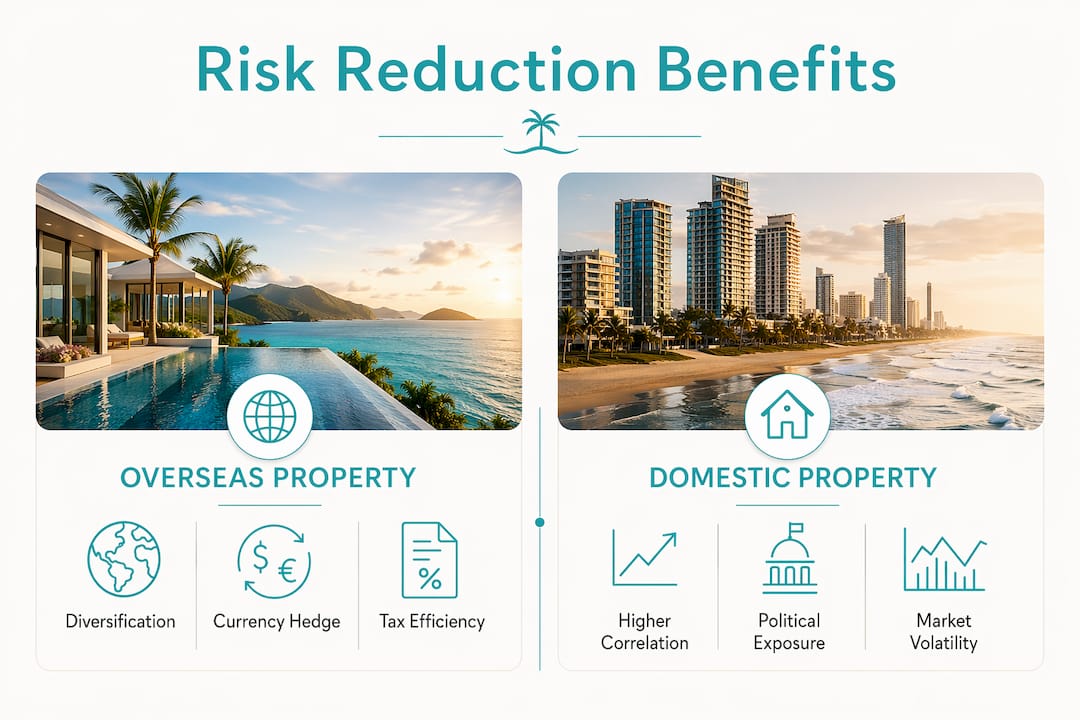
Reduced political and economic exposure is equally important. A change in domestic tax law, a housing market correction, or a currency crisis can devastate a portfolio concentrated in one country. Spreading assets across multiple jurisdictions limits the damage any single event can cause.
Pro Tip: Treat international property as a separate asset class in your portfolio, not just a geographic variation of your domestic holdings. Track its performance independently to see the true diversification benefit.
What are key challenges when diversifying into foreign real estate?
Foreign real estate investment carries real risks that investors must assess before committing capital. Investors who commit emotionally risk overlooking objective factors like ownership laws, financing structures, tax obligations, and exit liquidity, all of which directly affect returns.
The most common pitfalls follow a predictable pattern. Understanding common pitfalls in overseas property before you buy is the single most effective way to protect your capital. Here are the key risk areas every investor should address:
- Ownership law verification. Some countries restrict foreign freehold ownership. Always confirm whether you can hold title outright or only through a long-term lease structure.
- Foreign exchange management. Currency fluctuations affect both your purchase price and ongoing income. Use a specialist FX service rather than a retail bank to reduce conversion costs. A dedicated guide to transferring money abroad covers the mechanics in detail.
- Financing and mortgage access. Local mortgage products may be unavailable to foreign buyers, or carry significantly higher rates. Review overseas property mortgage options early in the process to understand your financing choices.
- Exit liquidity. Emerging markets can produce illiquid, hard-to-sell assets when weak contracts, poor FX execution, and unreliable property management compound over time. Assess the resale market depth before you buy, not after.
- Cash reserve requirements. Successful investors maintain cash reserves covering 6–12 months of payments, up to 6% of the unit price, to cover vacancies and market downturns without being forced to sell at a loss.
Smart buyers treat overseas property as an operating asset, not a lifestyle purchase. Local lending conditions, infrastructure quality, and demographic trends shape a market's behavior far more than broad economic headlines. Doing the work upfront on these factors separates profitable investments from expensive mistakes.
Pro Tip: Always engage a local lawyer independent of the developer or selling agent. Their job is to protect your interests, not to close the deal.
How can investors apply overseas property diversification strategically?
Strategic application of international property diversification starts with capital allocation. Investors typically allocate 10–30% of investable capital to overseas property and use installment plans to avoid concentrating large capital withdrawals at a single point in time. This phased approach reduces both financial strain and market timing risk.
Diversifying by region and strategy adds another layer of protection. A portfolio holding one property in a mature European market and another in a high-growth emerging market like Egypt's Red Sea coast captures both stability and upside. The two assets respond to different demand drivers: European tourism cycles versus Red Sea infrastructure growth and year-round sun tourism.
Key principles for building a diversified overseas property portfolio:
- Allocate by risk appetite. Conservative investors lean toward 10–15% in stable, developed markets. Growth-oriented investors may push toward 25–30% across a mix of emerging and developed markets.
- Diversify by property type. Residential rentals, holiday lets, and commercial units each carry different income profiles and vacancy risks. Mixing types smooths overall income.
- Use phased entry. Installment-based purchase plans, common in markets like Egypt, let you spread capital over 2–5 years rather than committing a lump sum upfront.
- Balance rental income with capital growth targets. Some markets, like Hurghada and Sahl Hasheesh, offer strong short-term rental income from tourism. Others offer stronger long-term capital appreciation. Matching the strategy to your timeline matters.
- Review overseas property ownership structures in each target market. Freehold, leasehold, and usufruct arrangements each carry different rights and resale implications.
For every $1 invested abroad, approximately $0.77 in additional income is generated over 5 years through stronger trade linkages and investment returns. That figure reflects the compounding benefit of international exposure over a medium-term holding period, not just the initial yield.
Key Takeaways
Overseas property diversification reduces portfolio risk, increases income potential, and provides currency protection that purely domestic real estate cannot deliver.
| Point | Details |
|---|---|
| Higher rental yields | Overseas markets deliver 5–7% gross yields versus 3–4% in the UK, with emerging hubs reaching up to 12%. |
| Portfolio risk reduction | A 5–15% allocation to international real estate lowers overall volatility through lower correlation with domestic assets. |
| Currency protection | Multi-currency income streams hedge against domestic currency depreciation and single-market exposure. |
| Capital allocation discipline | Allocating 10–30% of investable capital with phased installment plans reduces concentration risk and timing risk. |
| Cash reserve requirement | Holding 6–12 months of payment reserves (up to 6% of unit price) prevents forced sales during vacancies or downturns. |
Padsabroad's perspective on overseas property investment
The investors who get the most out of international property are the ones who treat it like a business from day one. They are not buying a dream. They are buying a cash-flowing asset in a market they have researched, with a management structure they trust and a cash buffer they have set aside before the first payment clears.
The biggest mistake we see is emotional buying. An investor falls in love with a location, skips the due diligence on ownership law or resale liquidity, and ends up holding an asset they cannot easily exit. The fix is simple: complete your legal and financial checks before you fall in love with the floor plan.
Egypt's Red Sea coast is a market we know well. Hurghada, El Gouna, Sahl Hasheesh, and Soma Bay all offer genuine investment fundamentals: year-round tourism demand, low entry prices relative to comparable Mediterranean markets, and a growing base of international buyers that supports resale liquidity. These are not speculative bets. They are markets with real demand drivers.
The investors who succeed here are the ones who buy with a clear income target, appoint professional local management, and hold for at least 5 years. Short-term flipping in emerging markets is a high-risk game. Long-term income generation with capital appreciation on exit is where the real returns are.
— Padsabroad
Padsabroad: your partner for overseas property investment
Padsabroad specializes in helping international buyers invest in Egypt's Red Sea coast, one of the most accessible and yield-competitive overseas property markets available to UK and international investors in 2026.

Whether you are allocating your first 10% of capital to international real estate or expanding an existing overseas portfolio, Padsabroad provides market-specific guidance, vetted property listings, and on-the-ground support across Hurghada, El Gouna, Sahl Hasheesh, Soma Bay, Marsa Alam, and Port Ghalib. The team handles the complexity of foreign ownership structures, legal checks, and property management so you can focus on the investment decision itself. Visit Padsabroad to connect with a specialist and review current investment opportunities along Egypt's Red Sea coast.
FAQ
What is the main reason to diversify into overseas property?
Overseas property investment reduces portfolio concentration risk by adding assets that move on different economic cycles from domestic stocks and real estate. It also provides access to higher rental yields and currency diversification.
How much of a portfolio should be allocated to overseas property?
Institutional guidance recommends allocating 5–15% of a portfolio to international real estate for diversification benefits, while active investors often allocate 10–30% of investable capital depending on their risk appetite and growth targets.
What are the biggest risks of investing in foreign real estate?
The main risks are illiquidity in thin resale markets, foreign exchange losses, weak legal frameworks, and unreliable property management. Maintaining cash reserves covering 6–12 months of payments significantly reduces the risk of a forced sale.
Are overseas rental yields really higher than domestic yields?
Gross rental yields in many overseas markets range from 5–7%, compared to 3–4% in UK cities. Some emerging markets project yields up to 12%, though net yields after local taxes and management fees will be lower.
Can foreign investors buy property in Egypt?
Foreign nationals can legally purchase property in Egypt, including freehold title in designated areas along the Red Sea coast. Padsabroad guides international buyers through the ownership structure, legal process, and registration requirements specific to each location.