
Fix part or all of your exchange rate with a forward contract before you reach completion day. That single step removes the biggest source of cost uncertainty in any overseas purchase. Your immediate next steps are straightforward: open an account with a specialist FX provider, calculate the total dollar amount exposed across each payment milestone, and map those milestones to a calendar. If you need certainty above all else, hedge the full amount. If you can absorb a defined adverse move, a split between a forward contract and a spot transfer gives you some upside while capping your downside.
A useful rule of thumb: stress-test your budget against a 5–10% adverse FX move before signing anything binding, as even small rate changes can substantially impact your dollar cost on foreign currency purchases. That is real money, and it appears with no change to the property price at all.
Table of Contents
- What does currency risk actually mean for an overseas property purchase?
- How a modest FX move changes what you actually pay in dollars
- Which hedging tools are right for your purchase?
- How to choose an FX provider: bank, broker, or specialist?
- How much of your purchase should you hedge?
- Timing, transfer mechanics, and the fees to budget for
- Common mistakes and red flags to watch for
- How Padsabroad supports buyers through the currency planning process
- Key Takeaways
- The hedging posture that actually matches your situation
- Padsabroad's buyer support for Egypt Red Sea property
- Useful sources and further reading
What does currency risk actually mean for an overseas property purchase?
Currency risk for a property buyer is the chance that exchange rates move between the day you agree a price and the day you transfer funds. There are three types, and each shows up at a different stage of ownership.

Transaction risk is the most immediate. It is the exposure between agreeing a purchase price in a foreign currency and converting your dollars to pay it. Every day that passes between signing a preliminary contract and completing the transfer, the rate can move against you.
Translation risk applies once you own the asset. If you report your net worth or investment portfolio in dollars, the dollar value of a property priced in euros or Egyptian pounds will shift every time the exchange rate moves, even if the local market price is unchanged.
Economic risk is longer-term. Persistent currency weakness in the country where you own property can erode rental yields and sale proceeds when you eventually convert them back to dollars. A property that performs well in local currency terms can still disappoint in dollar terms if the exchange rate drifts against you over years.
The most critical, overlooked factor is the "completion gap" — the window of several months between signing a preliminary contract and final settlement — where the buyer is legally bound yet exposed to exchange-rate movement that can inflate the final dollar cost by thousands.
For most buyers, transaction risk dominates. It peaks during the completion gap: the period after you are contractually committed but before funds are transferred. Mortgage repayments and rental income carry ongoing translation and economic risk, and sale proceeds bring all three back into focus at exit.
How a modest FX move changes what you actually pay in dollars
Here is a concrete example. A U.S. buyer agrees to purchase a property in Egypt's Red Sea region priced at €400,000. At the time of signing, EUR/USD is 1.10, so the dollar cost is $440,000. By completion, the rate has moved to 1.155 — a 5% adverse move. The same property now costs $462,000. That is a $22,000 increase with no change to the agreed purchase price.

| EUR/USD Rate | Dollar Cost of €400,000 | Change vs. Baseline |
|---|---|---|
| 1.10 (baseline) | $440,000 | — |
| 1.155 (5% adverse) | $462,000 | +$22,000 |
| — | — | +$44,000 |
For staged or off-plan purchases, the exposure is cumulative. A reservation payment, a deposit, and one or two construction-stage calls each carry their own rate risk. Currency risk is cumulative across each milestone, and many advisers recommend locking rates for each payment separately rather than waiting to hedge in one lump sum at the end.
The math scales quickly. A 1% adverse move on €250,000 is already more than £2,000 at common EUR/GBP rates. At 5%, that difference is large enough to cover renovation costs or legal fees. For U.S. buyers working in dollars, the principle is identical.
Pro Tip: If your purchase involves staged payments, ask your FX provider to set up a series of forward contracts aligned to each milestone date rather than a single conversion. This fixes your total project cost in dollars from the start.
Which hedging tools are right for your purchase?
Each instrument solves a different problem. The right choice depends on your completion timeline, your tolerance for cost certainty versus rate flexibility, and whether your purchase could fall through.
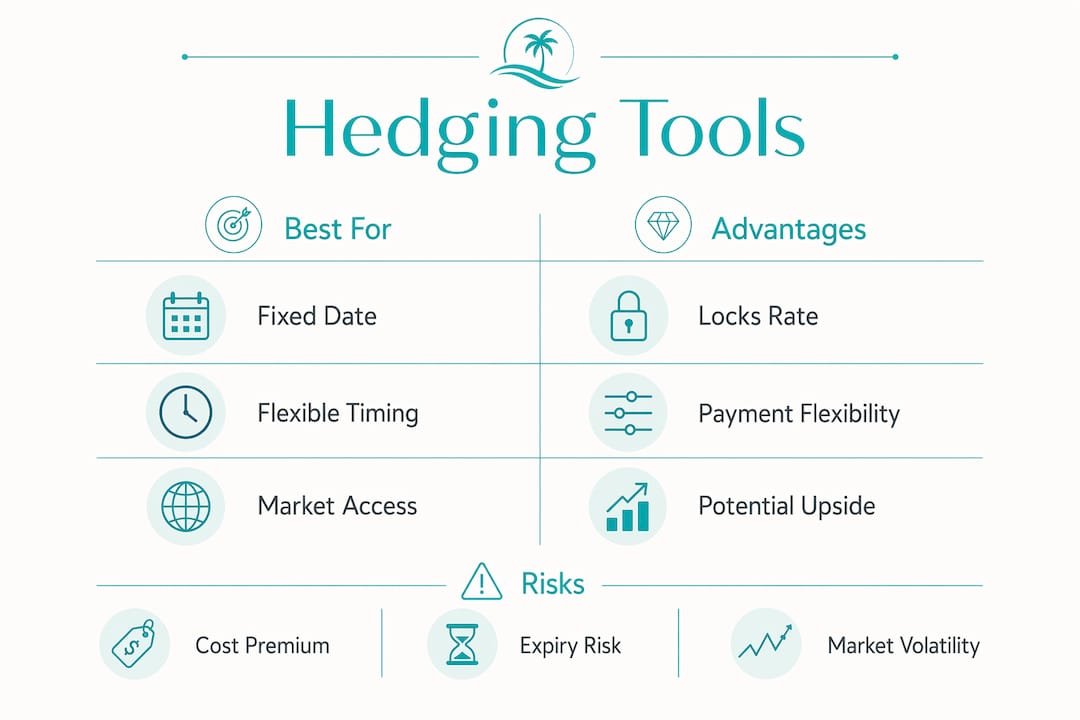
| Tool | Best For | Key Advantage | Key Risk/Cost |
|---|---|---|---|
| Forward contract | Fixed completion date | Locks rate up to 12 months ahead | Binding — exit cost if sale collapses |
| Currency option | Uncertain timeline | Right but not obligation to convert | Option premium adds upfront cost |
| Limit order | Target-rate buyers | Executes automatically at your target | No guarantee rate is ever reached |
| Stop-loss order | Downside protection | Prevents conversion below a floor | May trigger at an unfavorable moment |
| Multi-currency account | Ongoing ownership costs | Hold foreign currency without converting | No rate lock; still exposed to moves |
| Dollar-cost averaging | Long build schedules | Smooths rate over time | No certainty; average may still be adverse |
| Spot transfer | Immediate, small transfers | Simple, no commitment | Full exposure on the day |
Forward contracts are commonly available up to 12 months ahead and typically require a small deposit to secure the rate. They are the most widely used tool for property completions because they remove uncertainty entirely. The trade-off is that they are binding: if your purchase falls through, you may need to close the contract at market rates, which can produce a gain or a loss depending on where the rate has moved.
Limit and stop-loss orders let you automate conversions at target levels or protect against deeper adverse moves. They work well alongside a forward contract: lock the bulk of your exposure with a forward, then use a limit order for any remaining balance if you want to capture a better rate.
- Forward contract: ideal when you have a confirmed completion date and want full certainty.
- Currency option: useful when the timeline is uncertain or the deal could fall through; the premium is the cost of flexibility.
- DCA: practical for long off-plan builds where payments span 12–24 months and a single lock-in feels premature.
Pro Tip: Always discuss exit scenarios with your FX provider before signing a forward contract. Ask specifically: "What happens to this contract if my purchase collapses?" A good provider will walk you through the close-out process and any associated cost.
How to choose an FX provider: bank, broker, or specialist?
Banks are the default choice for most buyers, but they are rarely the best one for large property transfers. High-street banks often add noticeable margins above interbank rates on large conversions, plus fixed transfer fees. On a sizable transfer, a noticeable percentage margin can represent a significant additional cost compared to a specialist provider.
Specialist FX providers typically offer tighter spreads, forward contracts, limit orders, and a named account manager who understands property purchase timelines. That last point matters more than buyers expect: coordinating a large transfer with a notary deadline or a lender's closing schedule requires someone who can act quickly and communicate clearly.
Criteria to evaluate any provider:
- Regulated status (FinCEN registration in the U.S., FCA authorization in the UK, or equivalent)
- Segregated client accounts (your funds held separately from the provider's operating capital)
- Published all-in pricing, not just a headline rate
- Forward contract availability with clear terms on deposits and exit
- Named account manager for property transactions
- Delivery times for large transfers and any same-day surcharges
- Minimum transfer amounts and any account fees
Questions to ask before you commit:
- What is your all-in rate on a transfer of [your amount] today?
- Do you offer forward contracts, and what deposit do you require?
- Are client funds held in segregated accounts?
- Who is my named contact for this transaction?
- What is your standard delivery time, and can you meet a notary deadline of [date]?
- What happens if my purchase falls through and I need to close a forward contract?
Pro Tip: Get a rate quote from at least two specialist providers and one bank before deciding. The spread difference on a six-figure transfer is often larger than buyers expect, and the comparison takes less than 30 minutes.
How much of your purchase should you hedge?
The answer depends on three things: your budget tolerance, your timeline certainty, and whether you could absorb an adverse move without losing the property. A simple framework helps.
- Identify your total exposure. List every payment milestone (reservation, deposit, stage calls, completion balance) and the approximate date and amount of each in the foreign currency.
- Set a budget tolerance. Decide the maximum dollar increase you could absorb without the purchase becoming unaffordable. Advisers recommend stress-testing your budget against a moderate adverse FX move as a baseline.
- Decide your hedge percentage per milestone. Match the instrument to the certainty of each payment date.
- Review if the timeline changes. If completion slips by more than 30 days, contact your provider to discuss extending or adjusting the forward contract.
Three sample policies:
- Conservative (100% hedge): Lock the full amount of each milestone with a forward contract as soon as the payment date is confirmed. Maximum certainty, no upside capture.
- Balanced (50/50): Hedge half of each milestone with a forward contract and convert the other half at spot when the payment falls due. Reduces cost uncertainty while leaving some exposure to a favorable move.
- Opportunistic (limit orders + spot): Set limit orders at target rates and convert at spot if the target is not reached. Suits buyers with flexible timelines and higher risk tolerance.
Pro Tip: If you are buying off-plan with payments spread over 18–24 months, consider a milestone-based forward series rather than a single hedge. Lock each payment 30–60 days before it falls due, once the date is confirmed by the developer.
Timing, transfer mechanics, and the fees to budget for
The typical overseas purchase involves at least three separate transfers: a reservation or holding deposit (often 1–5% of the purchase price), an exchange deposit (commonly 10%), and the completion balance. Each has its own deadline, and missing one can put your deposit at risk.
Buyers who wait until completion day to convert typically face sudden, often large, unfavorable moves that add thousands to the cost of a purchase. The solution is to align your FX provider's schedule with your lawyer's timeline from the start, not the week before closing.
Fees and costs to include in your budget:
- Spread above interbank rate (varies by provider; banks typically 2–4%, specialists often less)
- Fixed transfer or wire fees (per transaction)
- Receiving-bank handling fees (charged by the beneficiary's bank, not your provider)
- Same-day or urgent transfer surcharges
- Forward contract deposit (typically a small percentage of the total amount)
- Option premium if using currency options
Operational checklist for each transfer:
- Confirm beneficiary account details with your lawyer at least five business days before the deadline.
- Provide your FX provider with any required anti-money-laundering documentation (source of funds, proof of identity) well in advance of the first transfer.
- Verify the receiving currency and account name match exactly — mismatches cause delays.
- Allow at least two business days for standard international transfers; confirm whether same-day delivery is available and at what cost.
- Keep a written record of every rate agreed, every transfer reference number, and every confirmation received.
For a practical breakdown of transfer costs and wire timing, including documentation requirements for large sums, Padsabroad's transfer guide covers the operational steps in detail.
Common mistakes and red flags to watch for
The most frequent and costly mistake is leaving the conversion to completion day. By that point, you are under time pressure, your negotiating position with a provider is weak, and any adverse rate move is locked in. Buyers who convert only at completion consistently lose more to market moves than those who use hedging tools early.
Other common errors include:
- Using a high-street bank without comparing spreads to a specialist provider
- Signing a forward contract with a completion date that is too tight, then facing extension fees when the deal slips
- Failing to account for receiving-bank fees, which can reduce the amount that arrives at the notary
- Not aligning proof-of-funds documentation with anti-money-laundering checks, causing last-minute delays
- Treating a favorable rate move as a reason to delay conversion rather than a bonus on an already-locked position
Red flags from providers:
- No segregated client accounts
- Refusal to provide all-in pricing before you commit
- No forward contract availability
- No named account manager for property transactions
- Unusually long settlement times with no explanation
- Pressure to convert immediately without time to compare
Pro Tip: If a provider cannot answer "Are client funds held in segregated accounts?" with a clear yes and a regulatory reference, walk away. That single question filters out the highest-risk operators.
For a broader look at pitfalls when buying overseas, including contract and legal errors that compound currency mistakes, Padsabroad's 2026 guide covers the full picture.
How Padsabroad supports buyers through the currency planning process
Currency planning is not a separate task from the property purchase. It runs in parallel with legal due diligence, financing, and closing logistics. Padsabroad builds that coordination into its buyer support from the first inquiry.
For buyers considering Red Sea property investment in Egypt, the payment timeline typically involves a reservation deposit, a contract deposit, and staged construction payments or a completion balance. Each milestone needs a corresponding FX decision. Padsabroad helps buyers map those milestones early, so the FX provider can be briefed and forward contracts can be set up before any payment deadline creates pressure.
Good currency risk management is about removing uncertainty rather than predicting the market. Set the budget in both currencies, decide how much dollar exposure you are prepared to tolerate, and speak to your FX provider early — not the day before completion.
Padsabroad's practical support for currency risk includes:
- Coordinating payment milestone calendars with legal and developer timelines
- Providing educational resources on exchange rate strategy for overseas buyers
- Helping buyers understand the full cost picture, including FX charges, before signing any binding contract
- Connecting buyers with vetted FX specialists where appropriate
Pro Tip: Ask Padsabroad for a milestone payment schedule before you approach any FX provider. Having confirmed dates and amounts in hand gives the provider everything they need to structure forward contracts efficiently.
Key Takeaways
Currency risk is manageable when you treat FX planning as part of the purchase decision itself, not an afterthought at completion.
| Point | Details |
|---|---|
| Start FX planning early | Open a specialist FX account and map payment milestones before signing any binding contract. |
| Stress-test your budget | Advisers recommend testing affordability against a 5–10% adverse FX move on the full purchase amount. |
| Use forwards for fixed dates | Forward contracts lock your rate up to 12 months ahead and remove completion-day uncertainty. |
| Hedge each milestone separately | For staged payments, a series of forward contracts aligned to each payment date fixes the total dollar cost. |
| Padsabroad coordinates the process | Padsabroad maps payment timelines, provides exchange rate resources, and connects buyers with vetted FX specialists. |
The hedging posture that actually matches your situation
Most buyers approach currency risk as a problem to solve at the last minute. Advisers who work with overseas property buyers regularly see the opposite approach work better: treat the hedging decision as part of the initial affordability calculation, before the offer is made.
For a conservative buyer, typically someone purchasing a retirement home or a lifestyle property with a fixed budget, full hedging of the deposit and completion balance is the right posture. The cost of a forward contract deposit is small relative to the certainty it buys. Capturing a slightly better rate is not worth the risk of the purchase becoming unaffordable.
For an opportunistic buyer, perhaps someone purchasing an investment property with more financial flexibility, a split approach makes sense. Lock the deposit and a portion of the completion balance with forwards, and leave the remainder on limit orders. If the rate moves favorably, the limit order executes and the buyer captures the gain. If it does not, the forward contract has already protected the core exposure.
The one scenario that suits neither profile is doing nothing. Monitoring rates without a plan is not a strategy. If your timeline slips by more than a month, contact your FX provider immediately to discuss adjusting or extending any forward contracts in place. Rates move, deals slip, and the buyers who stay ahead of both are the ones who close without surprises. For context on how currency fluctuations affect overseas property returns over the full hold period, including rental income and eventual sale proceeds, that longer view is worth reading before you commit.
Padsabroad's buyer support for Egypt Red Sea property

Buying property on Egypt's Red Sea coast, whether in Hurghada, El Gouna, or Sahl Hasheesh, involves a clear sequence of payments with defined deadlines. Padsabroad gives buyers a structured path through that sequence, including milestone calendars, cost breakdowns, and introductions to FX specialists who understand the local closing process.
The practical difference Padsabroad offers is coordination. Instead of managing your lawyer, your FX provider, and your developer separately, you have one point of contact who understands all three timelines. That matters most during the completion gap, when a missed deadline or an unhedged rate move can cost far more than any advisory fee.
To get started, visit the Egypt property buyer guide or browse current listings to see what your dollar budget buys on the Red Sea coast today. If you have specific questions about payment timelines or FX planning for a particular property, contact Padsabroad directly for a straightforward conversation.
Useful sources and further reading
Authoritative external sources used in this article:
- Managing risk when buying property overseas — Smart Currency Exchange: forward contracts, specialist provider criteria, and the cost of timing risk.
- Currency Exchange Rates When Buying Property Abroad — Halle International: bank vs. specialist spreads, limit orders, and stress-testing budgets.
- Buying Property Abroad: A Currency Guide — Medlock & Thames: the completion gap and its impact on final purchase cost.
- How to manage currency risk when buying property overseas — The Currency Guy: timing risk and the cost of waiting until completion day.
- International Mortgage & Currency Risk Guide — Cambridge Currencies: forward contract obligations and exit scenarios.
- Buying Property Overseas: Investor's Guide — World Property Investor: cross-border transaction structure and FX risk in the underwriting process.
- Expat permanent home ownership options — Caravans in France: residency, timeline, and deposit structure context for expat buyers in Europe.
Padsabroad resources for further reading:
- Why currency fluctuation affects overseas property returns — how exchange-rate moves change investment returns over the full hold period.
- Transfer money abroad for a property purchase — operational checklist and wire timing for large international transfers.
- Property abroad buying costs explained — full breakdown of fees and charges to include in your budget before signing.