Egypt real estate market entry strategy is the process of planning and executing property investments in Egypt's dynamic real estate sector with a focus on maximizing returns and managing risks. Egypt's residential real estate market is forecast to reach USD 10.71 billion in 2026, up from USD 9.81 billion in 2025. That growth is driven by urbanization, coastal tourism expansion, and government infrastructure programs like the New Administrative Capital. For investors and developers entering this market, understanding the current conditions, legal framework, and location dynamics is not optional. It is the foundation of every sound investment decision.
What are the current market conditions shaping Egypt real estate?
Egypt's real estate sector entered a correction phase in 2026, and that is actually a healthy signal for new investors. Egypt's top 10 developers recorded EGP 271 billion in sales during Q1 2026, a 6.5% decrease compared to the same period in 2025. That slowdown reflects a market moving from speculative volume toward quality absorption and product differentiation.
The shift is visible in what developers are building. The sector is moving toward integrated, mixed-use developments focused on execution quality rather than rapid unit turnover. Coastal and lifestyle projects in areas like Hurghada, El Gouna, and Sahl Hasheesh are attracting Gulf investors and international buyers looking for long-term value.
Government programs are also reshaping demand patterns. The Sakan Misr program delivered over 600,000 units by 2024, targeting middle-income buyers. The New Administrative Capital and East Cairo projects continue to draw expatriate and institutional demand. These infrastructure anchors create stable demand corridors that investors can track.
Key market signals to watch in 2026:
- Sales velocity per developer (a slowdown in top-tier developers signals price consolidation, not collapse)
- New project launches in coastal vs. urban zones
- Government land allocation announcements for new cities
- Mortgage rate movements, currently exceeding 24% for non-residents
Pro Tip: Watch quarterly sales reports from Egypt's top developers like Emaar Misr, Talaat Moustafa Group, and SODIC. Their project pipeline decisions are the most reliable leading indicator of where demand is heading.
How to choose the right location and property type in Egypt
Location selection is the single most consequential decision in any Egypt entry strategy for investors. The market divides clearly into two categories: urban Greater Cairo and coastal Red Sea or North Coast properties. Each serves a different investor profile.
Apartments and condominiums generated 62.5% of residential market revenue in 2025. That revenue dominance reflects strong local and expatriate demand in Cairo, particularly in New Cairo, Sheikh Zayed, and the New Administrative Capital corridor. Villas, by contrast, show the fastest growth trajectory with a projected CAGR of 10.78% through 2031. That growth is concentrated in coastal and resort communities.
| Location | Key Advantage | Primary Buyer Type | Growth Driver |
|---|---|---|---|
| Greater Cairo | High rental demand, infrastructure | Local, expat, institutional | New Administrative Capital |
| Red Sea Coast (Hurghada, El Gouna) | Tourism income, affordability | Gulf investors, Europeans | Tourism expansion |
| North Coast | Summer demand, premium pricing | Egyptian diaspora, Gulf buyers | Coastal lifestyle demand |
| Sahl Hasheesh / Soma Bay | Resort-grade developments | International buyers | Integrated resort growth |
| Marsa Alam / Port Ghalib | Emerging, lower entry price | Early-stage investors | Eco-tourism, diving |
The Red Sea coastal areas offer some of the most accessible price points in the Mediterranean and Red Sea region. Hurghada and El Gouna properties remain significantly cheaper per square meter than comparable coastal assets in Turkey, Greece, or the UAE. That pricing gap is a real advantage for investors entering now.
For a direct comparison of urban versus coastal returns, the Cairo vs. coastal Egypt investor guide breaks down the trade-offs clearly. Coastal properties typically generate stronger short-term rental yields through tourism, while Cairo properties offer more stable long-term capital appreciation.
Pro Tip: Match your investor profile to the location before selecting a property type. If you need rental income within 12 months, a furnished apartment in Hurghada or El Gouna outperforms a villa in a new Cairo development that may take 3 years to complete.
What are the legal and financial steps for foreign investors?
Foreign investors have the legal right to purchase property in Egypt, but the process involves more steps and longer timelines than local buyers face. Documentation and title deed verification are critical checkpoints where transactions frequently stall. Investors who skip thorough verification risk purchasing units with unresolved encumbrances or incomplete registration.
The financing picture for non-residents is straightforward but limiting. Bank mortgage rates for non-residents exceed 24%, making bank loans impractical for most foreign buyers. Developer installment plans are the standard alternative. Most major developers offer payment schedules spanning 5 to 10 years with down payments starting at 10–20% of the purchase price.
The typical purchase process for a foreign investor follows this sequence:
- Obtain a valid Egyptian tax registration number (required for property ownership)
- Open an Egyptian bank account to facilitate fund transfers
- Sign a reservation agreement and pay the deposit
- Conduct title deed verification through a licensed Egyptian notary
- Execute the sale contract with notarized signatures
- Register the property with the Real Estate Publicity Department
- Transfer utilities and obtain the final title deed
Foreign buyers should budget for a timeline of 3 to 6 months from reservation to full title deed registration. Bureaucratic delays are common, and having a local legal representative on the ground reduces that timeline significantly.
Pro Tip: Engage a bilingual Egyptian real estate lawyer before signing any reservation agreement. Legal fees are modest relative to the purchase price, and a qualified lawyer will catch title issues that agents and developers will not flag.
How to build a step-by-step market entry plan for Egypt
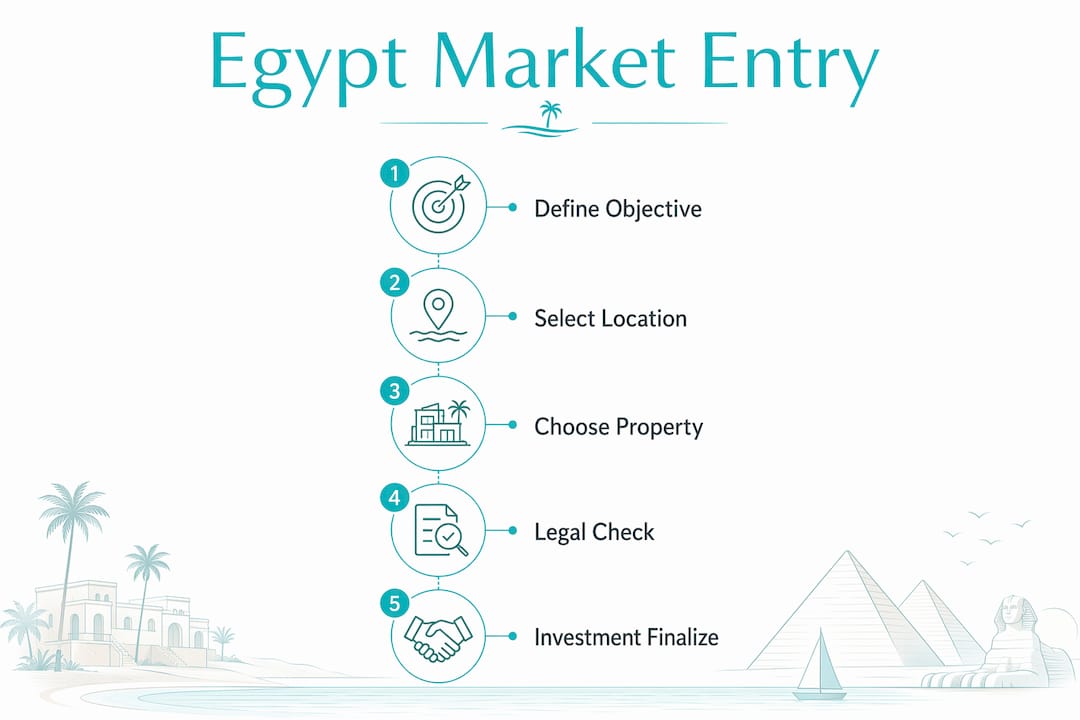
A practical property investment strategy for Egypt starts with defining your investment objective before selecting any asset. Are you targeting rental yield, capital appreciation, or a personal use property with resale potential? That answer determines your location, property type, budget, and financing structure.
The secondary market in Egypt offers a specific arbitrage opportunity that many first-time investors overlook. Foreign investors regularly find a 30–50% price difference between primary developer prices and secondary market resale prices. Buying a completed unit in the secondary market eliminates construction risk and delivers immediate rental income potential.
A structured entry plan covers these steps in order:
- Define your budget and return target. Include purchase price, registration fees (roughly 2–3% of value), legal costs, and furnishing if targeting short-term rentals.
- Conduct market research. Review quarterly developer sales data, tourism occupancy rates in your target area, and comparable resale prices.
- Select your location and property type. Use the urban vs. coastal framework and match it to your income timeline.
- Identify a trusted developer or agent. Verify the developer's track record, delivery history, and current project registration status.
- Complete legal due diligence. Verify title deeds, check for liens, and confirm building permits are in order.
- Secure financing. Confirm developer installment terms or arrange cash transfer through a compliant Egyptian bank account.
- Close the purchase and register. Follow the 7-step registration process and retain all notarized documents.
- Arrange property management. For rental properties, appoint a local management company before handover.
Understanding Egypt real estate ROI before committing capital helps you set realistic return expectations and avoid overpaying in high-demand micro-markets.
Pro Tip: Time your purchase to coincide with early project launch phases when developer pricing is lowest. Prices within the same development can increase 20–30% between launch and completion, creating built-in appreciation for early buyers.
What pitfalls should investors avoid in Egypt's property market?
The most common mistake foreign investors make is treating Egypt's real estate market as uniform. Prices, demand, and legal complexity vary significantly between Cairo, the Red Sea coast, and the North Coast. Applying a single strategy across all three regions produces poor results.
Specific pitfalls to avoid:
- Skipping title deed verification. Unregistered or disputed titles are the leading cause of failed transactions for foreign buyers.
- Relying solely on developer marketing materials. Developers present best-case scenarios. Independent price comparisons and site visits are non-negotiable.
- Using bank mortgages as the primary financing tool. Rates above 24% make bank financing economically unviable for most investment scenarios.
- Ignoring infrastructure timelines. A property near a planned road or metro extension is only valuable if that infrastructure actually delivers on schedule.
- Underestimating currency risk. Egypt's pound has experienced significant devaluation cycles. Investors holding USD or EUR assets benefit, but EGP-denominated costs can shift unexpectedly.
The correction phase visible in 2026 sales data is not a crisis. It is a normalization. Investors who mistake a healthy correction for a market collapse will exit positions prematurely or delay entry past the optimal window.
Pro Tip: Before committing to any development, visit the site in person and speak with existing owners or tenants in the same project. Their experience with the developer's delivery quality and management is more reliable than any brochure.
Key Takeaways
A successful Egypt real estate market entry strategy requires combining current market data, location analysis, legal compliance, and a financing plan suited to non-resident buyers.
| Point | Details |
|---|---|
| Market is in correction, not collapse | EGP 271bn in Q1 2026 sales confirms activity; the 6.5% dip signals healthy normalization. |
| Coastal villas lead growth | Villas show a 10.78% CAGR through 2031, strongest in Red Sea and North Coast areas. |
| Developer plans beat bank mortgages | Mortgage rates exceed 24% for non-residents; installment plans are the practical alternative. |
| Secondary market offers arbitrage | A 30–50% price gap between primary and resale markets creates real entry advantages. |
| Legal due diligence is non-negotiable | Title deed verification and local legal counsel prevent the most costly foreign buyer errors. |
Padsabroad's perspective on Egypt market entry in 2026
The investors who struggle in Egypt are almost always the ones who treat it like a commodity market. They pick a location from a brochure, wire a deposit, and expect the process to run like a London flat purchase. It does not work that way, and that gap between expectation and reality is where most mistakes happen.
What we have observed consistently is that the investors who do well are patient, specific, and locally connected. They pick one area, learn it deeply, and build relationships with developers and agents who have actual delivery track records. The Red Sea corridor, particularly El Gouna, Sahl Hasheesh, and Soma Bay, rewards that kind of focused approach. These are not speculative bets. They are established resort communities with real rental demand and proven resale markets.
The shift toward integrated developments is also real and worth taking seriously. The days of buying a bare unit in a half-finished tower and flipping it in 18 months are largely over. The market now rewards quality, location specificity, and long-term positioning. Investors who align with that direction will find Egypt genuinely rewarding. Those chasing quick speculation will find 2026 frustrating.
Stakeholders are also pushing for a unified digital platform to support real estate exports and reduce barriers for foreign capital. When that infrastructure arrives, entry will become easier. Getting in before that accessibility wave is a real timing advantage.
— Padsabroad
How Padsabroad can support your Egypt property investment
Padsabroad specializes in helping international buyers purchase and invest in Egyptian real estate, with a particular focus on the Red Sea coast. The team covers Hurghada, El Gouna, Sahl Hasheesh, Soma Bay, Marsa Alam, and Port Ghalib, giving investors direct access to the coastal markets with the strongest growth fundamentals.

Services include property selection, developer vetting, legal guidance, and ongoing management support. Whether you are buying your first overseas property or expanding an existing portfolio, Padsabroad provides the local knowledge and on-the-ground access that makes the difference between a smooth transaction and a costly delay. Visit Padsabroad to connect with a specialist and get personalized guidance on your Egypt entry plan.
FAQ
What is the minimum budget to invest in Egypt real estate?
Entry-level apartments in Hurghada and Marsa Alam start below USD 50,000, making Egypt one of the most accessible coastal markets for international buyers. Red Sea resort properties offer competitive pricing relative to comparable Mediterranean destinations.
Can foreigners legally own property in Egypt?
Foreign nationals can legally purchase and own property in Egypt, though the process involves more documentation and longer registration timelines than local buyers face. Title deed verification and a local legal representative are strongly recommended.
What financing options are available for non-resident investors?
Bank mortgages for non-residents carry interest rates exceeding 24%, making them impractical for most investors. Developer installment plans with 5 to 10 year terms and 10–20% down payments are the standard financing route for foreign buyers.
Which Egypt locations offer the best investment returns?
The Red Sea coast, particularly El Gouna, Sahl Hasheesh, and Hurghada, delivers strong short-term rental yields through tourism demand. Greater Cairo offers more stable long-term capital appreciation, especially near the New Administrative Capital.
How long does the property purchase process take for foreigners?
Foreign buyers should plan for 3 to 6 months from reservation to full title deed registration. Engaging a bilingual Egyptian lawyer and completing documentation requirements early reduces delays significantly.