
For most U.S. buyers, the Dominican Republic and Mexico (Riviera Maya or Baja) offer the clearest combination of affordable entry prices, straightforward legal frameworks, and proven rental demand. Portugal's Algarve suits buyers who want EU legal certainty and a steadier long-term hold. Panama and Belize work well for buyers prioritizing residency pathways and lower price points. Spain's Costa del Sol and the Balearics appeal to those who want liquidity and European infrastructure. The Bahamas is the premium short-haul option, while Costa Rica rewards patient buyers who understand its concession-based coastal ownership rules.
Three trade-offs shape every decision when you buy property abroad at beachfront locations:
- Ownership structure: Mexico requires a fideicomiso bank trust for coastal property; Costa Rica's Maritime Terrestrial Zone means most frontline holdings are concessions, not deeds; the Dominican Republic allows fee-simple title in your own name.
- Price vs. yield: Dominican Republic entry-level beachfront condos start at affordable prices with moderate gross rental yields, while comparable Costa Rica product is generally higher priced with moderate gross rental yields.
- Legal complexity vs. familiarity: EU markets (Portugal, Spain) carry familiar legal frameworks and strong resale liquidity; Caribbean and Latin American markets often offer higher yields but require more active management and local legal expertise.
Table of Contents
- How do these beachfront markets compare at a glance?
- What does buying look like on the ground in each market?
- How much does it really cost to buy beachfront abroad?
- What ownership rules and coastal restrictions must you check before signing?
- What questions should you ask before putting down a deposit?
- What are the biggest risks of buying beachfront property abroad?
- Why Egypt's Red Sea coast deserves a place on your shortlist
- Key Takeaways
- When does buying beachfront abroad actually make sense?
- Explore Egypt's Red Sea beachfront with Padsabroad
- Useful sources for further research
How do these beachfront markets compare at a glance?
The table below maps each market across the eight dimensions that matter most when comparing international beach real estate for U.S. buyers.
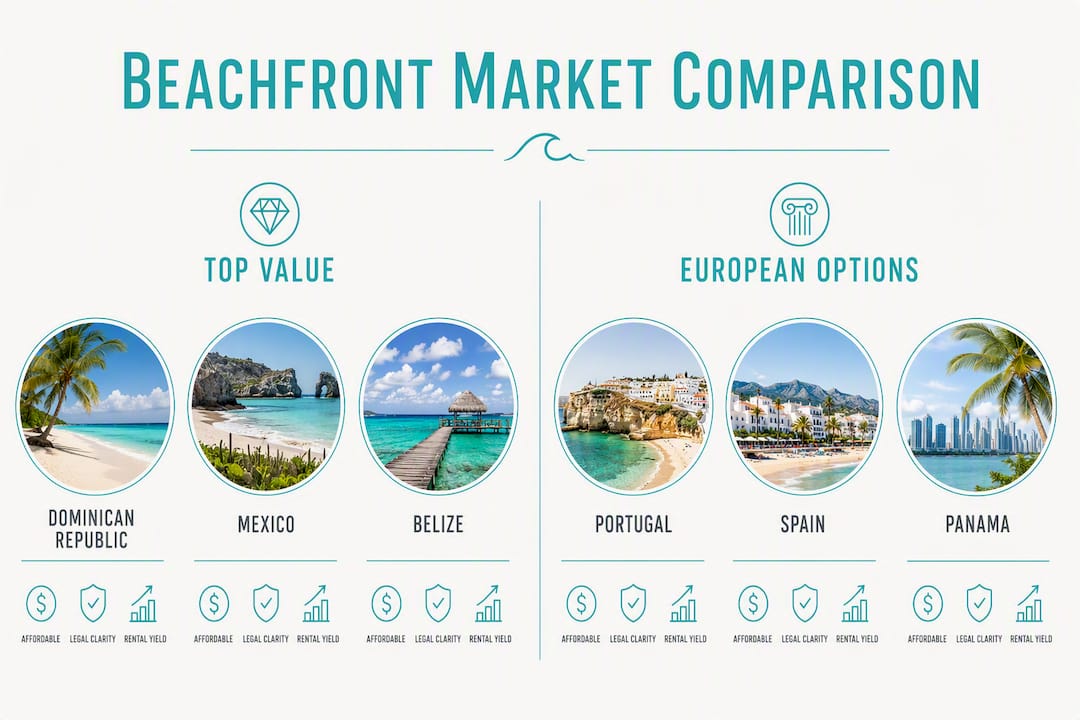
| Market | Typical Price Range | Foreign Ownership Ease | Residency/Visa Friendliness | Rental Yield (Gross) | Infrastructure & Safety | Liquidity/Resale | Hazard Exposure | Transaction & Tax Burden |
|---|---|---|---|---|---|---|---|---|
| Mexico (Baja/Riviera Maya) | $150K–$600K+ | Moderate (fideicomiso required in coastal zone) | Good (multiple visa/residency options) | 5%–9% | Good in resort zones | Strong in resort corridors | Hurricane (Caribbean side); seismic (Baja) | 2%–8% total closing friction |
| Dominican Republic | $120K–$400K | High (fee-simple title available) | Good (residency programs available) | 5.6%–7.7% | Improving; variable outside resorts | Moderate–Good | Hurricane zone | 3% transfer tax; CONFOTUR exemptions for new builds |
| Costa Rica | $300K–$600K+ | Moderate (concessions within 200m) | Good (pensionado/rentista programs) | 4%–6% | Good; stable infrastructure | Moderate | Earthquake; some hurricane exposure | ~1.5% transfer + ~0.85% stamps |
| Panama | $150K–$450K | High (fee-simple; no restrictions for foreigners) | Excellent (Pensionado program) | 5%–8% | Good in Panama City corridor | Moderate | Low hurricane risk | Low; no capital gains on primary home |
| Portugal (Algarve) | €200K–€1M+ | High (EU framework; straightforward) | Good (D7/NHR visa routes) | 4%–6% | Excellent | Strong | Low | IMT ~6–8%; annual IMI ~0.3%–0.45% |
| Belize | $150K–$500K | High (English common law; fee-simple) | Good (QRP program) | 5%–8% | Developing | Moderate | Hurricane zone | Low transfer tax; low annual property tax |
| Spain (Costa del Sol/Balearics) | €150K–€1M+ | High (EU framework) | Moderate (non-lucrative visa; Golden Visa paused) | 4%–6% | Excellent | Strong | Low | ITP ~6%–10%; IBI annual ~0.4%–1.1% |
| Bahamas | $400K–$2M+ | High (fee-simple; no restrictions) | Moderate (Haitian Homeowners Residency) | 4%–7% | Good in Nassau/Exuma | Moderate–Strong | Hurricane zone | Stamp duty ~10%; no income/capital gains tax |
Price ranges reflect entry-level to mid-market beachfront product. "Luxury" tiers in every market exceed these bands significantly. Transaction cost percentages are approximate and vary by municipality, property type, and deal structure.
Jurisdictional surprise: Costa Rica's concession system is the single most misunderstood ownership structure in this comparison. Many listings marketed as "beachfront" in Costa Rica sit within the first 200 meters of the high-tide line, governed by the Maritime Terrestrial Zone statute (Ley 6043). That means the buyer holds a renewable concession, not a deed. The Dominican Republic, by contrast, allows fee-simple title for foreign nationals registered directly in the national property registry, making title verification and succession planning considerably simpler.
What does buying look like on the ground in each market?
Understanding the numbers is one thing. Knowing what the buying experience actually feels like in each country is what separates confident buyers from those who stall at the offer stage.
Mexico: Baja California and Riviera Maya
Mexico is the most popular overseas beachfront market for Americans, and for good reason. Direct flights, cultural familiarity, and a wide inventory range from sub-$200,000 Baja studios to multi-million-dollar Tulum villas make it accessible at almost every budget. The legal catch is the fideicomiso requirement: any land within 50 kilometers of the coast must be held through a bank trust, where the buyer holds all beneficial rights but the bank holds legal title. Annual trust fees typically run $500–$1,000. Gross rental yields in resort corridors range from 5%–9%, and local financing for foreigners is limited, so most buyers pay cash or arrange U.S.-based financing. Residency pathways are well-established and accessible.
Dominican Republic
The DR is the strongest value proposition in the Caribbean for U.S. buyers who want clean title. Foreign nationals can hold fee-simple title directly in their own name, registered in the national property registry. Entry-level beachfront condos start around $120,000–$300,000, and gross rental yields run 5.6%–7.7%. The CONFOTUR tax incentive program exempts qualifying new-build developments from transfer tax and provides income tax relief for rental income, making developer purchases particularly attractive. Infrastructure outside major resort zones (Las Terrenas, Punta Cana, Cabarete) can be inconsistent, and hurricane exposure is real.

Costa Rica
Costa Rica suits buyers who prioritize lifestyle, political stability, and a well-established expat community over headline yield. The legal complexity is real: the Maritime Terrestrial Zone (Ley 6043) means the inner 50 meters from the high-tide line is public land, and the next 150 meters are typically held as 20-year renewable concessions, often structured through a local corporation for foreign buyers. True fee-simple frontline title is rare. Entry prices for comparable coastal product run $300,000–$600,000+, and gross yields come in at 4%–6%. The pensionado and rentista residency programs are among the most accessible in Latin America.
Panama
Panama punches above its weight for U.S. buyers. There are no foreign-ownership restrictions, fee-simple title is standard, and the Pensionado program is widely regarded as one of the most generous residency pathways in the Americas. Beachfront entry prices range from $150,000–$450,000 on the Pacific coast (Coronado, Pedasi) and the Bocas del Toro archipelago. Gross yields of 5%–8% are achievable in tourist-active areas. Panama uses the U.S. dollar, which eliminates currency risk entirely. Hurricane exposure is low compared to the wider Caribbean.

Portugal: Algarve
Portugal is the natural choice for U.S. buyers who want EU legal certainty and a market with deep liquidity. The Algarve offers some of the most established overseas beachfront property infrastructure in Europe, with entry prices from around €200,000 for apartments and €500,000+ for villas with direct sea access. Gross yields run 4%–6%, with strong seasonal demand from Northern European visitors. The D7 passive income visa and the NHR (Non-Habitual Resident) tax regime have historically attracted retirees and remote workers, though NHR rules have been revised and buyers should verify current eligibility with a Portuguese tax advisor. Transaction costs include IMT (property transfer tax) at roughly 6%–8% and annual IMI (municipal property tax) at 0.3%–0.45%.
Belize
Belize is the most underrated entry-level market in this comparison. English is the official language, the legal system is based on English common law, and foreign buyers can hold fee-simple title with no restrictions. Entry prices start around $150,000 for beachfront condos on Ambergris Caye, and the Qualified Retirement Program (QRP) offers meaningful tax incentives for eligible retirees. Infrastructure outside Ambergris Caye and Placencia is limited, and the resale market is thinner than in Mexico or the DR. Hurricane exposure is significant, and insurance availability can be patchy.
Spain: Costa del Sol and Balearics
Spain offers the strongest combination of EU legal clarity, infrastructure, and long-term resale liquidity in this comparison. The Costa del Sol and the Balearics (Mallorca, Ibiza, Menorca) attract a deep pool of European buyers, which supports prices and exit options. Entry prices on the Costa del Sol start around €150,000 for apartments; Balearic frontline product typically starts above €400,000. Gross yields run 4%–6%, with the Balearics commanding premium seasonal rates. Transaction costs are meaningful: ITP (property transfer tax) runs 6%–10% depending on the region, and annual IBI (local property tax) adds 0.4%–1.1% of cadastral value. Spain's Golden Visa program has been paused for new applicants as of 2024, so buyers seeking residency should explore the non-lucrative visa route instead.
Bahamas
The Bahamas is the premium short-haul option for East Coast buyers. No foreign-ownership restrictions, no income tax, and no capital gains tax make the fiscal structure attractive. The catch is price: entry-level beachfront in Nassau or the Exumas starts around $400,000, with trophy assets well above $2 million. Stamp duty runs approximately 10% of the purchase price, which is the highest transaction cost in this comparison. Gross yields of 4%–7% are achievable in high-demand areas, but the market is thin outside Nassau and a handful of Out Islands, so liquidity and resale timelines can be longer than buyers expect.
How much does it really cost to buy beachfront abroad?
The sticker price is only part of the equation. For U.S. buyers, the all-in cost of acquiring overseas beachfront property typically runs 5%–15% above the purchase price once transaction taxes, legal fees, and setup costs are included. Here is what to budget for:
- Transfer/stamp taxes: 3% in the Dominican Republic (0% for CONFOTUR-qualifying new builds); approximately 1.5% transfer plus 0.85% stamps in Costa Rica; 6%–10% ITP in Spain; approximately 10% stamp duty in the Bahamas.
- Notary and land registry fees: Typically 0.5%–1.5% of purchase price across Latin American and Caribbean markets; lower in EU markets where notary fees are regulated.
- Agent/broker commission: Usually 3%–6% of the purchase price, sometimes split between buyer and seller, sometimes paid entirely by the seller. Clarify this in writing before signing anything.
- Legal fees (independent lawyer): Budget $1,500–$5,000 for a qualified local attorney in most markets. Non-negotiable for title verification.
- Fideicomiso setup and annual fees (Mexico): Setup costs of $1,000–$2,000 plus annual trust fees of $500–$1,000.
- CONFOTUR or tax-status paperwork (DR): Developer-side cost, but verify the exemption is registered before closing.
- Ongoing property tax: Ranges from near-zero in Panama and Belize to 0.3%–0.45% annually in Portugal and 0.4%–1.1% in Spain.
- HOA and maintenance: Beachfront properties carry higher maintenance costs due to salt-air exposure. Budget 1%–2% of property value annually for maintenance reserves, plus HOA fees that vary widely by development.
- Property management fees: Typically 20%–30% of gross rental income for full-service management. As advertised gross yields commonly fall by 30%–50% once management, maintenance, and platform fees are deducted, model net yield carefully before committing.
For a more detailed breakdown of overseas property buying costs, including sample calculations by market, it is worth reviewing a dedicated cost guide before making an offer.
Financing for non-residents is limited in most of these markets. Local mortgages for foreign buyers are available in Spain and Portugal (typically 60%–70% LTV at higher rates than domestic borrowers), occasionally in Mexico through developer financing or U.S.-based international lenders, and rarely in the Caribbean. Most buyers in the DR, Belize, Panama, and the Bahamas pay cash or use home equity from a U.S. property.
Pro Tip: When transferring large sums internationally, use a specialist FX payment service rather than a retail bank wire. Services like Wise Business or OFX typically offer tighter exchange rates and lower fees than bank-to-bank transfers. Always report foreign property purchases and any rental income to the IRS: Form 8938 (FATCA) applies if foreign financial assets exceed reporting thresholds, and rental income from overseas property is taxable in the U.S. regardless of where it is earned. Confirm current thresholds with a U.S. tax advisor before closing.
U.S. buyers should also review property abroad tax implications to understand FBAR, FATCA, and foreign tax credit rules before transferring funds.
What ownership rules and coastal restrictions must you check before signing?
"Beachfront ownership" means something different in every country on this list. Getting clarity on what you actually own, and what rights you can pass on, is the most important legal step before you put down a deposit.
Mexico's restricted zone covers all land within 50 kilometers of the coastline. Under Mexican law, foreign nationals cannot hold direct title to this land. Instead, ownership is structured through a fideicomiso, a bank trust in which a Mexican bank holds legal title while the buyer holds all beneficial rights, including the right to use, rent, sell, and bequeath the property. The trust is typically set up for 50 years and is renewable. For succession planning, the fideicomiso allows beneficiaries to be named, but the trust structure adds a layer of complexity that buyers should discuss with a Mexican notario and a U.S. estate attorney.
Costa Rica's Maritime Terrestrial Zone (Ley 6043) divides the first 200 meters from the high-tide line into two bands. The inner 50 meters is inalienable public land; no private ownership is possible. The next 150 meters are a concession zone, where the government grants renewable 20-year concessions to private parties. Foreign nationals can hold a concession only if they have been legal residents of Costa Rica for at least five years, which is why most beachfront purchases are structured through a Costa Rican corporation (S.A. or S.R.L.) that holds the concession. The practical implication: you are not buying land, you are buying a company that holds a government concession. Resale and succession require transferring the company, not a deed.
The Dominican Republic is the clearest ownership framework in the Caribbean for U.S. buyers. Foreign nationals can register fee-simple title directly in their own name through the national property registry (Registro de Títulos). Title deeds (Certificados de Título) are issued by the registry and are the definitive proof of ownership. The CONFOTUR regime (Law 158-01) provides tax incentives for qualifying tourism developments, including transfer tax exemptions and income tax relief on rental earnings.
Belize uses English common law and fee-simple title with no restrictions on foreign ownership. Title searches are conducted through the Belize Land Registry, and the process is relatively straightforward compared to civil-law jurisdictions. Portugal operates under a well-established EU property law framework; title is registered in the Conservatória do Registo Predial (land registry), and the process is familiar to any buyer who has purchased in a Western European country.
For any market, the core documents to request from the seller or developer before signing are: the title deed extract (or concession certificate in Costa Rica), a current land registry search, approved site plans and building permits, proof of planning compliance and zoning status, CONFOTUR or equivalent tax-status certification where applicable, and evidence of up-to-date property tax and HOA payment history. A full overseas property ownership guide can help you understand how title formats differ across these jurisdictions.
What questions should you ask before putting down a deposit?
Due diligence on overseas beachfront property follows a clear sequence. Skipping steps, especially early ones, is how buyers end up with title problems or unexpected costs after closing.
Due-diligence sequence:
- Agree on a hold deposit with a clear refund condition tied to satisfactory title search results.
- Sign a conditional purchase agreement (not a final deed) that includes a due-diligence period of at least 30 days.
- Instruct an independent local lawyer, separate from the seller's or developer's attorney, to conduct a title search and verify the ownership chain.
- Confirm zoning status and any coastal setback restrictions with the local municipality.
- Commission a structural survey or independent inspection, especially for resale properties.
- Verify that all permits (building, occupancy, environmental) are in order and registered.
- Confirm the escrow or closing mechanics: who holds funds, under what conditions they are released, and what happens if the deal falls through.
- Review HOA documents, reserve fund balances, and any pending special assessments.
- Confirm the tax status of the property (CONFOTUR, IPI exemption, or equivalent) and model the ongoing holding costs.
- Arrange title insurance where available (common in Mexico and the DR; less standard elsewhere).
Ten questions to ask the seller, agent, or developer:
- What is the exact ownership structure: fee-simple deed, fideicomiso, or concession?
- What are the zoning setbacks, and does any part of the property fall within a coastal restriction zone?
- If a concession, when does it expire, and what is the renewal process and cost?
- Has a structural survey been completed in the last two years, and can you provide the report?
- What are the terms of any rental program, and what management fees and exclusivity periods apply?
- Is local insurance available for this property, and what does it cover (hurricane, flood, structural)?
- What are the HOA rules, monthly fees, and current reserve fund balance?
- What is the current tax status, and are there any outstanding tax liabilities on the property?
- For new builds: what developer guarantees apply, and what happens if the project is delayed or cancelled?
- Are there any exit fees, right-of-first-refusal clauses, or resale restrictions in the HOA or rental program agreement?
Red flags to watch for:
- Gaps in the title chain or a seller who cannot produce a clean registry extract
- Missing or expired building permits, especially for structures close to the waterline
- Unverified land use in a coastal setback or concession zone presented as fee-simple
- A developer who resists independent legal review or pressures you to use their in-house attorney
- HOA reserve funds that are underfunded relative to the age and condition of the development
What are the biggest risks of buying beachfront property abroad?
Beachfront property carries a specific risk profile that inland purchases do not. Understanding these risks before you buy, and pricing them into your decision, is what separates a good investment from an expensive mistake.
| Risk | Markets Most Exposed | Realistic Impact | Mitigation |
|---|---|---|---|
| Hurricane / tropical storm damage | Caribbean, Mexico (Caribbean coast), Belize | Structural damage; rental income loss; insurance claims | Hurricane-rated construction; comprehensive insurance; reserve fund |
| Coastal erosion and sea-level exposure | All frontline markets | Loss of beach access; property value decline | Engineering reports; setback compliance; avoid first-row in erosion-prone areas |
| Market volatility / thin resale liquidity | Belize, Bahamas Out Islands, emerging DR markets | Extended time to sell; price discounting | Buy in established resort corridors; prioritize markets with active buyer pools |
| Management failure / absentee owner risk | All markets | Rental income loss; property deterioration | Vetted, licensed property manager; regular inspections; clear management contract |
| Insurance gaps | Belize, some Caribbean islands | Uninsured losses after storm events | Verify local insurance availability before purchase; consider Lloyd's of London surplus lines |
| Currency risk | All non-dollar markets (Portugal, Spain, Costa Rica) | Purchase cost and rental income fluctuate in USD terms | Use FX forward contracts for large transfers; hold local account in property currency |
Insurance availability varies significantly by market. Spain and Portugal have deep, competitive insurance markets with standard coverage for coastal properties. Mexico's resort zones are generally insurable, though premiums for hurricane coverage can be substantial. Belize and some smaller Caribbean islands have thinner local insurance markets, and buyers may need to source coverage through international surplus-lines carriers.
Salt-air environments accelerate corrosion of metal fixtures, HVAC systems, and structural reinforcements. Beachfront properties require more frequent maintenance than inland equivalents, and the cost difference is meaningful over a 10-year hold.
Pro Tip: Budget a dedicated maintenance reserve of at least 1.5%–2% of property value per year for beachfront assets, separate from your HOA contributions. Schedule an independent inspection every 18–24 months, focusing on roof integrity, window seals, HVAC condition, and any exposed metalwork. Properties that skip this discipline tend to require expensive catch-up repairs that erode net returns significantly.
For buyers thinking about why beachfront property commands higher rents, the premium is real, but it comes with proportionally higher operating costs that must be modeled honestly.
Why Egypt's Red Sea coast deserves a place on your shortlist
Egypt's Red Sea coast, covering Hurghada, El Gouna, Soma Bay, Sahl Hasheesh, Marsa Alam, and Port Ghalib, is one of the most affordable beachfront markets available to international buyers in 2026. Entry-level studio apartments in Hurghada start below $40,000, with one-bedroom beachfront units in resort developments available from $60,000–$120,000. El Gouna, a private resort town with its own marina, hospital, and international school, attracts a more premium buyer profile, with apartments from $100,000 and villas from $250,000+. Soma Bay, a peninsula development with five-star resort infrastructure, sits between these two price points and is particularly popular with European buyers seeking a managed holiday-rental investment.
The buyer fit varies by location. Hurghada suits buyers seeking affordable holiday rentals with strong year-round occupancy driven by European charter tourism. El Gouna appeals to buyers who want a lifestyle-oriented second home with resort-quality amenities and a more established expat community. Soma Bay and Sahl Hasheesh work well for investors who want a managed rental product with developer-backed payment plans.
Buying in Egypt as a foreign national involves these steps:
- Engage a licensed Egyptian notary (Shahr Aqari) to verify title and prepare the sale contract.
- Conduct a title search through the Egyptian Real Estate Registry to confirm ownership and check for encumbrances.
- Sign the preliminary sale contract (Aqd Ibtidai) and pay the agreed deposit, typically held in escrow by the developer or notary.
- Complete the final notarized sale contract (Aqd Rasmi) and register the transfer at the local Real Estate Publicity Department.
- Foreign buyers must route purchase funds through an Egyptian bank account and obtain a foreign currency transfer certificate (Form 4), which is required for future resale and repatriation of proceeds.
- Developer payment plans are standard in the Egyptian new-build market, with installment periods of 3–10 years and typical down payments of 10%–30%.
For a detailed legal walkthrough of the Red Sea buying process, the Hurghada property ownership legal guide covers title verification, registration steps, and foreign-buyer protections in detail. The Red Sea property ownership checklist is a practical companion document for buyers at the offer stage.
Key Takeaways
The Dominican Republic and Mexico offer the strongest combination of affordability, legal clarity, and rental yield for most U.S. buyers, while Egypt's Red Sea coast stands out as the most affordable entry point globally with developer payment plans that reduce upfront capital requirements.
| Point | Details |
|---|---|
| Dominican Republic leads on value with fee-simple title, affordable entry prices, and moderate gross yields. | |
| Mexico requires a fideicomiso: all coastal property within 50 km of the shore must be held via a bank trust; annual fees run $500–$1,000. | |
| Gross yields overstate net returns | Advertised gross yields commonly fall 30%–50% once management, maintenance, and platform fees are deducted. |
| EU markets offer legal certainty | Portugal and Spain provide familiar legal frameworks and strong resale liquidity, but transaction costs (6%–10%) are higher. |
| Padsabroad for Red Sea options | Padsabroad assists U.S. and international buyers with beachfront purchases across Hurghada, El Gouna, and Soma Bay, with entry prices from under $60,000 and developer payment plans available. |
When does buying beachfront abroad actually make sense?
The buyers who tend to be satisfied with overseas beachfront purchases share a few common traits. They have a clear time horizon of at least five to seven years, which gives the market time to absorb transaction costs and any short-term volatility. They have either the capacity to manage the property actively from a distance or the budget to pay a professional manager without expecting the rental income to fully cover costs in the early years. And they have done the legal work upfront, not after the fact.
The most common regret trigger is buying on yield projections without stress-testing the net figure. A property that advertises 10% gross in a resort development often delivers 4%–5% net once management fees, maintenance, platform commissions, and vacancy are honestly accounted for. Buyers who model the net figure before signing, rather than the gross figure in the developer's brochure, rarely feel misled.
The second regret trigger is choosing a market based on price alone without understanding the ownership structure. A $150,000 beachfront condo in a concession zone is a fundamentally different asset from a $150,000 fee-simple apartment, and the difference matters enormously at resale and in estate planning.
Foreigner-friendly property markets vary more than the headline prices suggest. The right market is the one where the legal framework, the management infrastructure, and the buyer's personal capacity to oversee the asset from abroad all align.
Explore Egypt's Red Sea beachfront with Padsabroad
If Egypt's Red Sea coast is on your shortlist, Padsabroad offers direct access to vetted beachfront developments across Hurghada, El Gouna, Sahl Hasheesh, Soma Bay, Marsa Alam, and Port Ghalib. Entry prices start well below comparable Caribbean or European alternatives, and most developers offer installment-based payment plans that spread the purchase cost over three to ten years, reducing the upfront capital requirement significantly.

Padsabroad is a commission-based brokerage: buyers pay no direct fee, and the company earns its commission from the developer or seller on completed transactions. The team handles property discovery, developer introductions, legal referrals, and purchase facilitation for international buyers at every stage of the process.
To start with a shortlist of available beachfront properties matched to your budget and goals, visit the first-time buyer guide to Egypt Red Sea property or browse current listings and buy property in Egypt safely with Padsabroad's step-by-step guidance.
Useful sources for further research
The following sources back the claims in this article and offer deeper reading on specific markets, legal frameworks, and price data.
- Safe Harbor: Can Americans own beachfront property in Mexico? — Clear explanation of the fideicomiso trust requirement, restricted zone rules, and buyer rights under Mexican law.
- Property ownership in Hurghada: A legal guide | Padsabroad — Step-by-step legal framework for foreign buyers purchasing on Egypt's Red Sea coast.
- Overseas property ownership explained: 2026 buyer's guide | Padsabroad — Overview of foreign-ownership frameworks across multiple international markets.
- Property abroad tax implications: What U.S. buyers must know | Padsabroad — U.S.-specific tax reporting requirements including FBAR, FATCA, and foreign rental income rules.
- Why Red Sea property is affordable: 2026 buyer's guide | Padsabroad — Explains the structural reasons behind Egypt's Red Sea affordability and what buyers can realistically expect.