The fastest way to tell whether an overseas developer is trustworthy is a verified delivery record combined with escrowed buyer funds and an independent local attorney. Those three signals, taken together, predict project completion more reliably than any brochure, price point, or sales pitch.
Before you go further, run these five checks immediately:
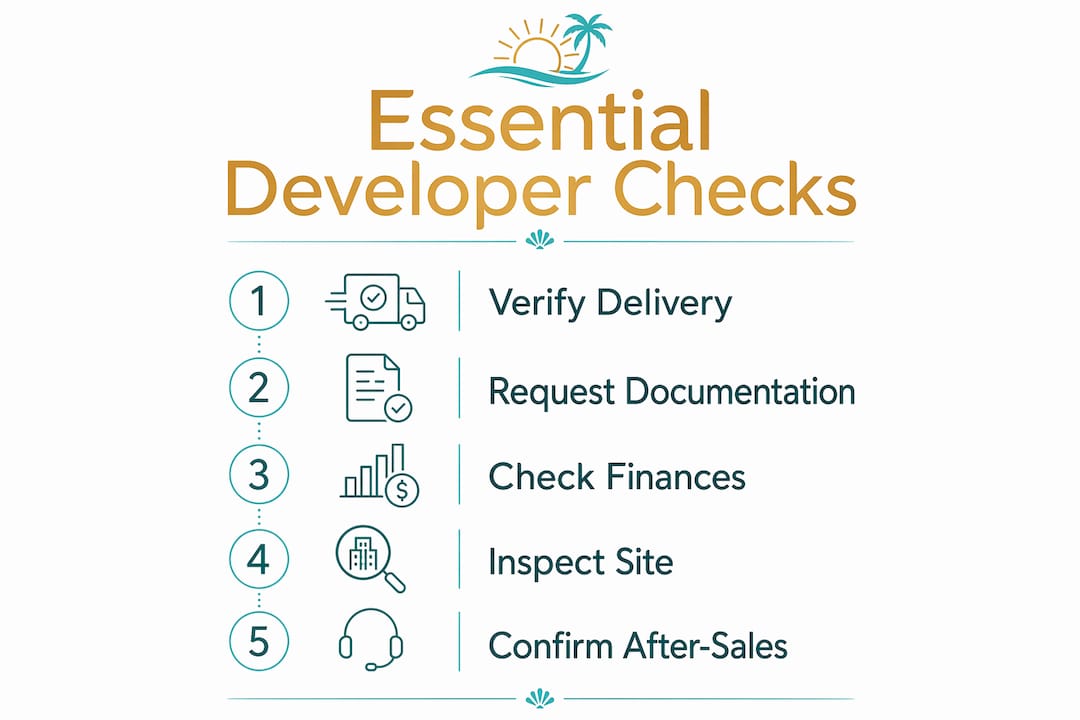
- Delivery record: Ask for a list of completed projects with titles transferred and contact details for current owners.
- Escrow confirmation: Request written confirmation that buyer payments are held in a third-party escrow or trust account, not the developer's operating account.
- Legal and planning approvals: Confirm building permits and land title registration with the local authority, not just the developer's word.
- Independent legal review: Hire a local attorney who has no connection to the developer to review the sales contract and title documents.
- Financial transparency: Ask for audited financial statements or, for listed companies, recent public filings.
Your next steps today: contact an independent local lawyer in the purchase country (not one the developer recommends), and ask the developer for their last three completed projects with owner contact details. Both actions cost nothing and tell you almost everything.
Table of Contents
- Why choosing a reliable developer determines your investment outcome
- Five essential checks every U.S. buyer should run first
- What documents should you request from a developer?
- How do you assess a developer's financial health?
- How to check construction status and arrange independent inspections
- A U.S.-investor checklist: legal, tax and advisory steps before you commit
- What timeline and costs should U.S. buyers budget for?
- After-sales service, warranties, and planning your exit from day one
- Top red flags that should stop you in your tracks
- Key Takeaways
- What overseas property specialists actually look for
- Padsabroad helps you buy safely on Egypt's Red Sea coast
- Useful sources and further reading
Why choosing a reliable developer determines your investment outcome
Developer selection is the single decision that most directly controls whether your overseas property delivers on time, at the promised quality, and with a clean legal title. Every other factor, location, price, rental yield projections, depends on the developer actually completing the project.
The NAHB warns that unusually low bids may indicate a builder cannot sustain cash flow to pay labor and materials across a full construction lifecycle — a risk that is amplified when the project is overseas and your legal recourse is limited.
For U.S. buyers specifically, the exposure is compounded by distance, unfamiliar legal systems, and currency risk. A developer who stalls or collapses mid-project leaves you with a partially built asset in a foreign jurisdiction, a legal dispute governed by local law, and recovery costs that often exceed the original deposit. Title defects, which stem directly from poor developer due diligence, can make a property unsellable for years.
The good news: most developer failures leave clear warning signs before you commit funds. The verification steps below are designed to surface those signs early, when you can still walk away.
Five essential checks every U.S. buyer should run first
These checks are ordered by impact. If you have limited time or budget, complete them in sequence and stop only when you have satisfactory answers to all five.
-
Delivery and completion record. Request a written list of every completed project, including the date titles were transferred to buyers and the names of the developments. Then contact current owners directly. Ask whether the project was delivered on time, whether the build quality matched the contract, and whether the developer honored after-sales commitments. Visiting older completed developments is more informative than any model unit or current marketing material, because it shows long-term maintenance and whether promised community services were sustained.
-
Legal and planning approvals. Run a land title search through the local land registry, not through the developer's solicitor. Confirm that building permits and planning approvals are current and issued by the relevant local authority. In many overseas markets, a developer can sell units before permits are fully in place; you need to know the exact status before paying a deposit.
-
Financial transparency. Ask for the latest audited financial statements. Publicly listed developers file quarterly disclosures that provide a verifiable audit trail of cash flows and project progress. Private developers should still be able to produce audited accounts. Also confirm whether buyer payments are held in an escrow or trust account separate from the developer's operating funds, and ask for a bank guarantee letter if available.
-
On-the-ground verification. Visit completed projects, not just the sales office. Talk to residents. Checking portfolios, visiting finished sites, and verifying business reputation with suppliers and banks are standard practices among experienced buyers. If you cannot travel, hire a local agent or inspection firm to do this on your behalf and provide a written report.
-
Reputation and disputes. Search the developer's company name in local court records and tribunal databases. Look for a pattern of complaints from previous buyers, unpaid supplier disputes, or frequent company name changes. A single resolved dispute is not disqualifying; a pattern is.
Pro Tip: If the developer hesitates to provide owner contact details for completed projects, treat that as a red flag, not a minor inconvenience. Reputable developers expect this question and answer it readily.
| Check | What to request | Where to verify |
|---|---|---|
| Delivery record | Completed project list, title transfer dates, owner contacts | Direct contact with owners; local land registry |
| Legal approvals | Building permits, planning approval certificates | Local authority / municipal office |
| Financial transparency | Audited accounts, escrow confirmation, bank guarantee | Independent accountant; bank letter |
| On-the-ground | Site visit report, photos, resident interviews | Independent local agent or inspector |
| Reputation | Litigation history, complaint records | Local court registry; Better Business Bureau equivalent |
Padsabroad publishes a practical trust-check guide specifically for overseas buyers in Egypt that walks through each of these steps in a local context.
What documents should you request from a developer?
Requesting the right documents is not aggressive; it is standard practice. Any developer who refuses to provide these is telling you something important.
| Document | What to look for | How to verify |
|---|---|---|
| Company registration / incorporation | Full legal name, registered address, ownership structure, director names | Local companies registry or equivalent |
| Audited financial statements | Positive operating cash flow, manageable debt levels, no qualified audit opinion | Independent accountant review |
| Building permits and planning approvals | Current status, issuing authority, expiry dates | Local municipal or planning authority |
| Land title documents | Clean title, no mortgages or liens on the plot, correct registered owner | Local land registry title search |
| Escrow / trust account paperwork | Third-party escrow agent named, buyer funds segregated | Written bank confirmation letter |
| Bank guarantee letter | Covers buyer deposits in the event of non-completion | Confirm directly with the issuing bank |
| Sales contract | Delivery date, penalty clauses, defect rectification period, warranty terms | Independent local attorney review |
| After-sales / warranty agreement | Scope of warranty, duration, named responsible party | Cross-check against local statutory minimums |
For title documents specifically, a title certificate guide explains the different document types you may encounter across markets and how to confirm their validity in practice.
How do you assess a developer's financial health?
Financial stability is the most overlooked check among first-time overseas buyers, and the one that most directly predicts whether a project gets finished.
- Public listings provide the clearest audit trail. A developer listed on a recognized stock exchange must file periodic financial disclosures, giving you access to cash flow statements, debt levels, and project progress reports that private developers are not required to share.
- Watch for high leverage and negative operating cash flow. A developer carrying significant debt relative to assets, or one that consistently spends more cash than it generates from operations, is vulnerable to delays when sales slow or construction costs rise.
- Understand the funding model. Some developers fund construction almost entirely from pre-sales, meaning your deposit is financing the build. That is not automatically a problem, but it means the project's viability depends on continued sales momentum. Ask whether the developer has institutional backing, joint-venture partners, or a construction finance facility from a recognized bank.
- Beware of unusually low pricing. The NAHB guidance warns that bids priced unrealistically low often signal a developer who cannot sustain cash flow across the full construction cycle. In overseas markets, this risk is higher because buyers have less visibility into cost structures.
- Red flags specific to financial health: missing or unaudited accounts, a sudden change in company ownership or directors, complaints from unpaid subcontractors, and a developer who cannot name their construction finance bank.
Pro Tip: Ask the developer which bank holds their construction finance facility and then call that bank to confirm the relationship. A developer with genuine institutional backing will not hesitate to provide this.
For buyers considering overseas mortgage financing, understanding how overseas property mortgages work helps you assess whether the developer's payment structure aligns with what lenders will actually fund.
How to check construction status and arrange independent inspections
Physical verification is the step most buyers skip and later regret. Marketing renders and progress photos supplied by the developer are not independent evidence.

Confirming progress remotely. Ask for timestamped photos taken from fixed reference points at regular intervals, not a curated selection. Some buyers commission drone surveys through local firms, which provide a clear overhead view of structural progress. Video calls with a trusted local contact walking the site in real time are also useful.
When to hire an independent inspector. Engage an inspector before paying any milestone payment tied to construction progress. Brief them specifically on structural integrity, waterproofing, and mechanical, electrical, and plumbing (MEP) systems, as these are the defects most commonly missed during developer-led handovers and most expensive to fix afterward.
What a snagging report does for you. An independent snagging report documents every defect at handover and creates a written evidence base for contract remedies. Inspection reports give buyers leverage to enforce retention releases and set clear remedial timelines. Without one, you are relying on the developer's own assessment of their own work.
Checklist for a short site visit:
- Confirm the structure matches the approved plans on file with the local authority.
- Check waterproofing in bathrooms, rooftops, and basement areas.
- Test all electrical outlets, plumbing fixtures, and HVAC systems.
- Photograph every defect and date-stamp each image.
- Get the developer's written response to the snag list before signing the handover certificate.
A U.S.-investor checklist: legal, tax and advisory steps before you commit
U.S. buyers face a layer of compliance obligations that purely domestic investors do not. Getting these right from the start protects you both in the purchase country and at home.
-
Hire an independent local attorney first. City National Bank advises hiring local legal and tax experts in the country of purchase rather than relying only on U.S.-based advisors. Critically, that attorney must be arms-length from the developer. An attorney suggested by the developer has a conflict of interest, regardless of how professional they appear. The role of a local solicitor in an overseas purchase covers title review, contract negotiation, and registry filings that a U.S. attorney simply cannot handle remotely.
-
Hire a local accountant or tax advisor. Local tax rules govern rental income, capital gains on sale, and property transfer taxes. These vary significantly by country and sometimes by buyer nationality. A local accountant also helps you understand VAT or sales tax obligations on the purchase itself.
-
Understand your U.S. reporting obligations. Owning foreign property and receiving rental income triggers reporting requirements with the IRS. The tax implications for U.S. buyers of property abroad cover FBAR, Form 8938, and foreign tax credit considerations that apply to most overseas property owners.
-
Insist on escrow or trust account payment routing. Never wire funds directly to a developer's operating account. Confirm the escrow arrangement in writing with the escrow agent or bank before transferring any money.
-
Understand the title transfer process. Ask your local attorney to walk you through exactly how title is recorded in the local land registry, what documents you will receive at handover, and how long the registration process typically takes after completion.
Pro Tip: Request a written timeline from your local attorney showing each legal milestone, the document you should receive at that stage, and who is responsible for filing it. This single document prevents most of the disputes that arise at handover.
What timeline and costs should U.S. buyers budget for?
Off-plan overseas property purchases typically run across four phases, each with its own payment trigger and documentation requirement.
| Phase | Typical duration | Payment trigger | Documentation to request |
|---|---|---|---|
| Reservation | Several weeks | Reservation deposit | Reservation agreement, escrow confirmation |
| Design and approvals | Several months | Second installment on permit issuance | Copy of building permit, planning approval |
| Construction | Up to multiple years | Milestone payments tied to construction stages | Timestamped progress reports, independent inspection sign-off |
| Handover and registration | Some months | Final payment on title transfer | Snagging report, title deed, registry confirmation |
Beyond the purchase price, budget for additional costs such as transfer taxes and stamp duties that vary by country. Notary and land registry fees add further costs that your local attorney can estimate in advance. Property management fees, if you plan to rent, typically constitute a portion of rental income. Building insurance, snagging repair costs, and any legal or accountant fees should also be factored in from the start.
A market-specific Egypt real estate investment checklist itemizes local fees and registration steps in detail for buyers considering the Red Sea coast. For a broader breakdown of what buying costs look like across overseas markets, a buyer costs guide covers the full picture beyond the headline price.
After-sales service, warranties, and planning your exit from day one
A developer's behavior after handover reveals as much about their reliability as their behavior before it. Strong after-sales support is not a bonus; it is a contractual right you should secure before signing.
What to insist on in writing. Your sales contract should specify the warranty period, the scope of defects covered, the named party responsible for repairs, and the response time commitment. Structural defects typically carry longer statutory warranty periods than cosmetic ones; confirm what local law requires and make sure the contract meets or exceeds that standard.
Property management and long-term value. If you plan to rent the property, confirm whether the developer offers a management contract and, if so, review the terms carefully. Some developers tie rental management to the purchase as a condition; others offer it optionally. Either way, get independent advice on whether the management fees and occupancy projections are realistic for that specific market.
Evaluating rental potential and resale liquidity. Ask your local agent for actual rental yield data from comparable completed units in the same development or nearby, not projected figures from the developer's marketing pack. Resale liquidity depends on title clarity, the depth of the local buyer pool, and whether the contract allows assignment before completion.
Exit-planning tip. Check whether the sales contract includes assignation rights, meaning you can sell your interest before the project completes. Some developers restrict this or charge a fee. Knowing this before you sign preserves your options if your circumstances change during the construction period.
For buyers interested in immediate-occupancy options rather than off-plan, resale apartments in Hurghada offer an alternative route that avoids construction risk entirely.
Top red flags that should stop you in your tracks
Some warning signs are fixable with better contract terms. Others mean you should walk away immediately.
Walk away immediately if you see:
- Missing or expired building permits, or a developer who cannot produce them on request.
- Refusal to use a third-party escrow or trust account for buyer payments.
- Frequent company name changes or a newly registered entity with no completed projects.
- Evasive or vague contract terms around delivery dates, penalties for delay, and defect rectification.
- Pressure to sign quickly or pay a deposit before you have reviewed any documents.
Fixable with contractual safeguards:
- A developer who is willing to use escrow but has not yet set it up — get it in writing as a condition of signing.
- Missing warranties in the initial draft contract — your attorney can negotiate these in.
- Incomplete permits where the developer can demonstrate a clear, documented approval timeline.
Immediate actions if you find a red flag:
- Stop all payments until the issue is resolved in writing.
- Get independent legal advice before taking any further steps.
- Ask for verifiable third-party confirmation of any claim the developer makes to address your concern.
Common pitfalls when buying overseas property follow predictable patterns. Most buyers who lose money ignored at least one of the warning signs above because the price or location felt compelling enough to overlook it.
Key Takeaways
Verified delivery records, escrowed buyer funds, and an independent local attorney are the three signals that most reliably separate trustworthy overseas developers from risky ones.
| Point | Details |
|---|---|
| Verify delivery first | Request completed project lists with title transfer dates and contact current owners directly before paying any deposit. |
| Insist on escrow | Never wire funds to a developer's operating account; confirm third-party escrow in writing before any transfer. |
| Hire independent local counsel | Engage a local attorney and accountant who have no connection to the developer, as U.S. advisors alone cannot cover foreign title and tax rules. |
| Inspect completed sites in person | Visiting older finished developments reveals long-term build quality and whether promised amenities were delivered. |
| Padsabroad as your local partner | Padsabroad provides developer vetting, legal introductions, and escrow facilitation for buyers purchasing on Egypt's Red Sea coast. |
What overseas property specialists actually look for
The conventional advice on evaluating overseas developers focuses almost entirely on paperwork: permits, audited accounts, escrow letters. Those documents matter, but experienced specialists know that the most revealing signal is behavioral, not documentary.
How a developer responds when you ask hard questions tells you more than any certificate. A developer who answers delivery-record questions with polished marketing materials instead of actual owner contacts, or who deflects escrow questions with vague reassurances, is showing you exactly how they will behave when a problem arises mid-construction. The documents confirm what the behavior already suggested.
Padsabroad has spent 17 years refusing risky Hurghada projects that looked attractive on paper but failed behavioral scrutiny. The pattern is consistent: developers who resist independent inspections, push back on escrow arrangements, or cannot produce owner contacts for completed projects almost always have something to hide. The buyers who got hurt were the ones who rationalized those signals away because the price was right.
The practical lesson is straightforward. Run the document checks, but pay equal attention to how the developer treats your questions. Transparency under pressure is the clearest indicator of how a developer will treat you when the project hits a delay or a defect. Independent local counsel and documented escrow are not optional extras; they are the structural protections that make every other check enforceable.
Padsabroad helps you buy safely on Egypt's Red Sea coast
Padsabroad gives U.S. and international buyers a concrete alternative to navigating Egypt's property market alone. Rather than handing you a list of developers and leaving you to verify them independently, Padsabroad's team conducts local market research, introduces buyers to vetted independent legal counsel, arranges site verification visits, and supports escrow facilitation throughout the purchase process.
The firm's 17-year track record of declining projects that did not meet its vetting criteria means the properties it presents have already passed the checks this article describes. For buyers who want after-sales support, Padsabroad also connects clients with property management services and provides guidance on resale and rental planning from day one.
If you are ready to move from research to action, the safe buying guide for Egypt outlines exactly how Padsabroad's process works. First-time buyers can also start with the Red Sea property investment guide for a market-specific overview. Contact the Padsabroad team directly to request an initial consultation and find out which developments currently meet the verification standards described here.
Useful sources and further reading
These resources support the verification, legal, financial, and market checks covered in this article.
- NAHB Builder and Remodeler Checklist — The National Association of Home Builders' practical checklist for evaluating builder credentials, financial stability, and contract terms. Use it as a baseline framework adaptable to overseas markets.
- City National Bank: 8 Tips for Buying Property Overseas — Covers the case for hiring local legal and tax experts rather than relying on U.S.-based advisors. Useful when briefing your domestic wealth team on what local counsel needs to handle.
- Padsabroad: Buying Property in Egypt Safely — Five trust checks applied specifically to the Egyptian market, with practical guidance on title searches, escrow, and developer vetting.
- Padsabroad: Role of a Local Solicitor in Overseas Purchases — Explains what an independent local solicitor does at each stage of an overseas purchase and why arms-length representation matters.
- Padsabroad: Egypt Real Estate Investment Checklist for 2026 — Market-specific checklist covering local fees, registration steps, and typical timelines for Red Sea coast purchases.
- One Marina Gardens Developer Profile — An example of how a reputable developer presents post-purchase buyer support and project credentials, useful as a benchmark when evaluating developer transparency in other markets.
- Padsabroad: Overseas Property Ownership Explained — Overview of ownership structures and registration processes across different overseas markets, helpful when assessing how title will be held and transferred.